















Sand Found to Flow Like Water

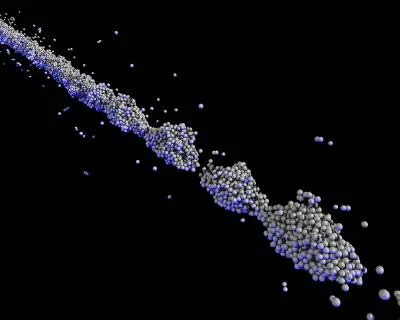
When poured, sand behaves much like water to form water-like droplets, scientists have discovered.
The finding could be important to a wide range of industries that use "fluidized" dry particles for oil refining, plastics manufacturing and the drug industry, the researchers say.
Researchers previously thought dry particles lacked sufficient surface tension to form droplets like ordinary liquids. But physicists from the Materials Research Science and Engineering Center at the University of Chicago, led by professor Heinrich M. Jaeger, used high-speed photography to measure minute levels of surface tension and detect droplet formation in flows of dry granular materials.
A short video shows how the discovery was made.
The work, supported by the National Science Foundation, was detailed last week in the journal Nature.
"Previous studies of granular streams were able to detect clustering by performing experiments in vacuum and were able to establish that the clustering was not caused by the drag from the ambient air," Jaeger said. "However, the cause of the clustering remained a mystery."
In the new experiment, Jaeger and colleagues used a special co-moving apparatus devised for a high-speed, $80,000 camera that captures images much like a skydiver might photograph a fellow jumper in free fall.
Get the world’s most fascinating discoveries delivered straight to your inbox.
They observed falling 100-micrometer-diameter glass beads, or streaming sand, and found that forces as much as 100,000 times smaller than those that produce surface tension in ordinary liquids could cause droplet formation in granular streams and cause these dry streams to behave like an ultra-low-surface-tension liquid.
Story continues below...
{{ video="LS_090624_sand" title="Sand Falls Like Water" caption="In high-speed video camera move alongside an accelerating, falling sand to track formation of grain clusters, similar to the formation of water droplets from a faucet. Credit: John Royer and Heinrich Jaeger, The University of Chicago" }}
John Royer, a graduate student in physics at the University of Chicago, developed the apparatus. Royer and his colleagues also directly measured grain-to-grain interactions with an atomic force microscope.
"At first we thought grain-grain interactions would be far too weak to influence the granular stream," Royer said. "The atomic force microscopy surprised us by demonstrating that small changes in these interactions could have a large impact on the breakup of the stream, conclusively showing that these interactions were actually controlling the droplet formation."
Researchers say understanding how dry materials coalesce could create greater efficiencies in their transportation and manipulation. The pharmaceutical production of pills, for example, could benefit by pouring equal amounts of a drug into a capsule every time while greatly reducing waste.
"Estimates show that we waste 60 percent of the capacity of many of our industrial plants due to problems related to the transport of these materials," Jaeger said. "Hence even a small improvement in our understanding of how granular media behave should have a profound impact for industry."
- Video: Sand Falls Like Water
- Really Cool Video: Fluids in Slow Motion
- Bubbles Behaving Badly
