















Neanderthal App Turns You into a Caveman
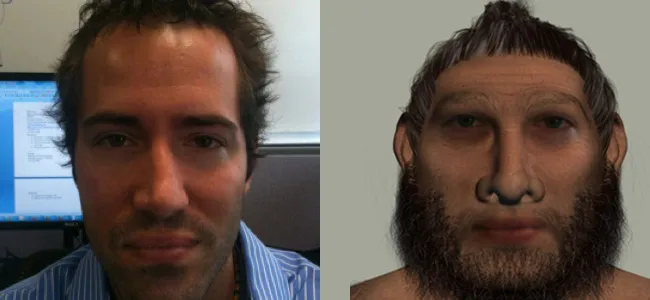
A new app could morph you into a caveman.
The MEanderthal app (a combination of "me" and "Neanderthal") just released by the Smithsonian National Museum of Natural History for the iPhone or Android, is grounded in science. It relies on what is known about the appearance of our closest extinct relatives, the Neanderthals, to transform your face into the face of an early human.
Paleo-artist John Gurche created the early human faces used in the app from fossils of early humans.
Here's what you can expect:
First you upload a portrait of your face and line up the image with markers for the eyes, nose and mouth. Next, you choose which human species you'd like to become, including: Homo floresiensis who lived between 95,000 and 17,000 years ago; Homo neanderthalensis who lived 200,000 to 28,000 years ago; and Homo heidelbergensis who lived 700,000 to 200,000 years ago.
Expect your nose to inch up in size in the resulting MEanderthal image.
"Neandertal faces tend to have much bigger noses," said Briana Pobiner, a paleoanthropologist at the Smithsonian Human Origins Program. "Big noses were good for humidifying and warming glacial, ice age air."
Get the world’s most fascinating discoveries delivered straight to your inbox.
Big noses also meant sloping cheekbones compared with the flat cheekbones of modern humans.
Neanderthals, especially males, also had big brow ridges and receding chins, she added. The large brow ridges are also found on chimps, gorillas and orangutans.
The app relies on technology that "dissolves" the modern-human face into the early human species chosen, and the resulting image keeps the areas around the eyes and mouth. So to change up your Neanderthal look, Robert Costello of the Human Origins Program recommends wearing sunglasses or sticking out your tongue in the image.
The mobile app stemmed from the popularity of a morphing station at the Smithsonian that essentially does the same facial transformation.
And while the caveman app won't further scientific research, it's important to science.
"We think it's really important for people to make emotional connections to our ancestors," Pobiner told LiveScience. "It's an important way to break down that barrier between things we think are so different or so 'other.'"
She added that Neanderthals were actually pretty similar to us behaviorally and genetically. In fact, a recent study showed non-African modern humans carry between 1 percent and 4 percent of Neanderthal genes, and suggests early humans mated with Neanderthals.
In addition, the app has a "cool factor" for teens. Yesterday, while standing outside the museum, Pobiner saw 11- and 12-year-old girls probably on a class trip. They were pointing at the Human Origins exhibit sign, saying "That's where you can take a picture and look like a caveman … that's really cool," Pobiner recalled.
"If we can be cool to the 12-year-olds, we've done something really good."
- Top 10 Things That Make Humans Special
- Who Were the Neanderthals?
- Top 10 Mysteries of the First Humans
Jeanna Bryner is managing editor of Scientific American. Previously she was editor in chief of Live Science and, prior to that, an editor at Scholastic's Science World magazine. Bryner has an English degree from Salisbury University, a master's degree in biogeochemistry and environmental sciences from the University of Maryland and a graduate science journalism degree from New York University. She has worked as a biologist in Florida, where she monitored wetlands and did field surveys for endangered species, including the gorgeous Florida Scrub Jay. She also received an ocean sciences journalism fellowship from the Woods Hole Oceanographic Institution. She is a firm believer that science is for everyone and that just about everything can be viewed through the lens of science.