
 Live Science Plus


Humans and Neanderthals Mated, Making You Part Caveman

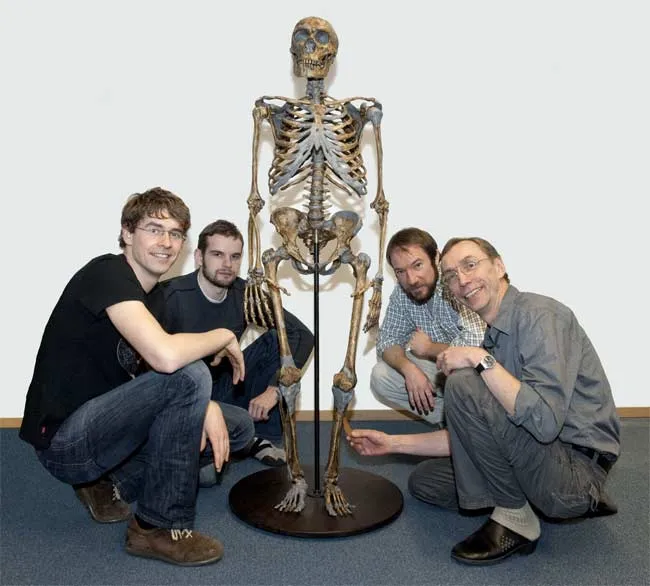
Many of us are part caveman, according to an analysis of Neanderthal genes, which were sequenced for the first time in a recent study.
The Neanderthal genome offers further evidence that this ancient hominid species mated and interbred with the ancestors of modern humans, scientists say.
"The Neanderthals are not totally extinct," said study leader Svante Pääbo of the Max-Planck Institute for Evolutionary Anthropology in Leipzig, Germany. "In some of us they live on a little bit."

In fact, between 1 percent and 4 percent of some modern humans' DNA came from Neanderthals, who lived between about 130,000 and 30,000 years ago, the researchers report today.
It took the scientists years to compile this first sequence of the Neanderthal genome, which is now about 60-percent complete. Researchers extracted DNA from the 40,000-year-old bones of three female Neanderthals found in a cave in Croatia. They had to come up with novel techniques to screen out contamination from bacteria and even present-day human DNA.
The feat is a major step forward in piecing together human evolutionary history, experts say.
"Dr. Pääbo's publication of the full Neandertal genome is a watershed event, a major historical achievement," said Gregory Hannon of Cold Spring Harbor Laboratory in Laurel Hollow, N.Y., who helped analyze the newly sequenced genome.
There has been a long-standing controversy over whether or not humans and Neanderthals interbred, but the new analysis offers some of the firmest proof yet that they did mate and share genes.
"We’re able to largely resolve the controversy over whether there was gene flow," said co-researcher David Reich of the Harvard Medical School Department of Genetics. "We think there's very strong evidence that it did occur."
Specifically, the scientists found evidence for Neanderthal genes in the genomes of modern humans in Europe, Asia and Oceania (Papua New Guinea), but not in Africa, meaning that the interbreeding likely took place after ancient humans migrated out of Africa, but before they splintered into many groups heading off in different directions.
"It occurred prior to the divergence, somewhere in the Middle East or northern Africa, at the gateway of Africa." Reich said. "It’s a small but very real proportion of [Neanderthal] ancestry in non-Africans today."
Researchers estimate this interbreeding may have taken place about 60,000 years ago.
These findings are consistent with the results of another recent study, led by a team of anthropologists at the University of New Mexico, which also found evidence for Neanderthal-human interbreeding. This team found excess diversity in the genomes of non-Africans living today that may have been contributed by archaic humans long ago.
It's too early to know what type of effect these Neanderthal genes may have had on the way ancient humans looked or behaved, the researchers say.
The sequenced genes could also help scientists tease out how humans differ from Neanderthals. The researchers compared the Neanderthal genome with modern human and chimpanzee genomes to identify the areas of greatest difference between humans and our closest relatives.
They found some genetic features that are unique to modern humans (and not found in Neanderthals or chimps), including genes involved in cognitive development, skull structure, metabolism, and the skin.
"In all these cases it requires much, much more work," Pääbo said. "This really just hints at what genes one should now study, and I'm sure we and many other groups will be doing that."
The results of the new study are detailed in the May 7 issue of the journal Science.
Top 10 Mysteries of the First Humans
Top 10 Things That Make Humans Special
