













Mystery of Tooth Strength Cracked

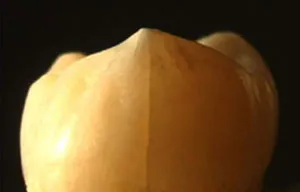
Our teeth are put to the test every day, withstanding all the crunching and munching of meals and snacks. This remarkable resilience appears to be due to the microscopic "basket-weave" structure of human tooth enamel, a new study finds.
Tooth enamel, which forms the outer coating of teeth, is a strong but brittle substance.
Given the brittleness of teeth, which is comparable to that of glass, it's a wonder that for the most part, they can last a lifetime without cracking to pieces.
"It's a bit of a mystery as to why they don't just fall apart," said co-author of the new study Brian Lawn of the National Institute of Standards and Technology.
Lawn and his colleagues took teeth extracted from humans, sea otters and a few other animals, and subjected them to loading from a metal rod, sort of a worst-case scenario bite.
The researchers, whose work was funded by the George Washington University Research Endowment Fund, wanted to "see how much force [the teeth] could withstand before they break," Lawn explained.
Basket-weave structure
Get the world’s most fascinating discoveries delivered straight to your inbox.
The team found that the basket-weave-like microstructure of the enamel kept any cracks that did form from propagating through the enamel and breaking apart the tooth.
This finding, detailed in the April 13 issue of the journal Proceedings of the National Academy of Sciences, explains why dentists can examine the teeth of older people and find that "the teeth are full of cracks, and yet the teeth remain intact," Lawn told LiveScience.
Enamel thickness and the size of teeth can also affect how resilient they are to a lifetime of chomping. For example, gorillas have bigger teeth than humans and so their teeth can handle tougher meals. Orangutans have similarly sized teeth as chimpanzees, but their enamel is thicker so they can eat nuts and crunchier foods than chimps, whose "diet is much more lightweight," Lawn said.
Anthropologists can use all of this information about enamel to piece together dental evolution in primates and animals in general — they can even use it to posit what early humans might have chowed down on.
Materials engineers like Lawn can also use the structure of enamel to develop similarly resilient substances, including better replacement teeth.
Currently, the crowns used to replace bad teeth "look nothing like the microstructure of an actual tooth," Lawn said, and so are more likely to fail. If engineers can grow materials that simulate the actual structure of teeth, that could make for happier patients at the dentist's office.
- Why Do We Grind Our Teeth?
- Body Quiz: The Parts List, How the Parts Fit
- The Truth About Tooth Decay

Andrea Thompson is an associate editor at Scientific American, where she covers sustainability, energy and the environment. Prior to that, she was a senior writer covering climate science at Climate Central and a reporter and editor at Live Science, where she primarily covered Earth science and the environment. She holds a graduate degree in science health and environmental reporting from New York University, as well as a bachelor of science and and masters of science in atmospheric chemistry from the Georgia Institute of Technology.