













Fluffy ball of darkinos could be lurking at the center of the Milky Way
Our galaxy's black hole may be something else entirely.

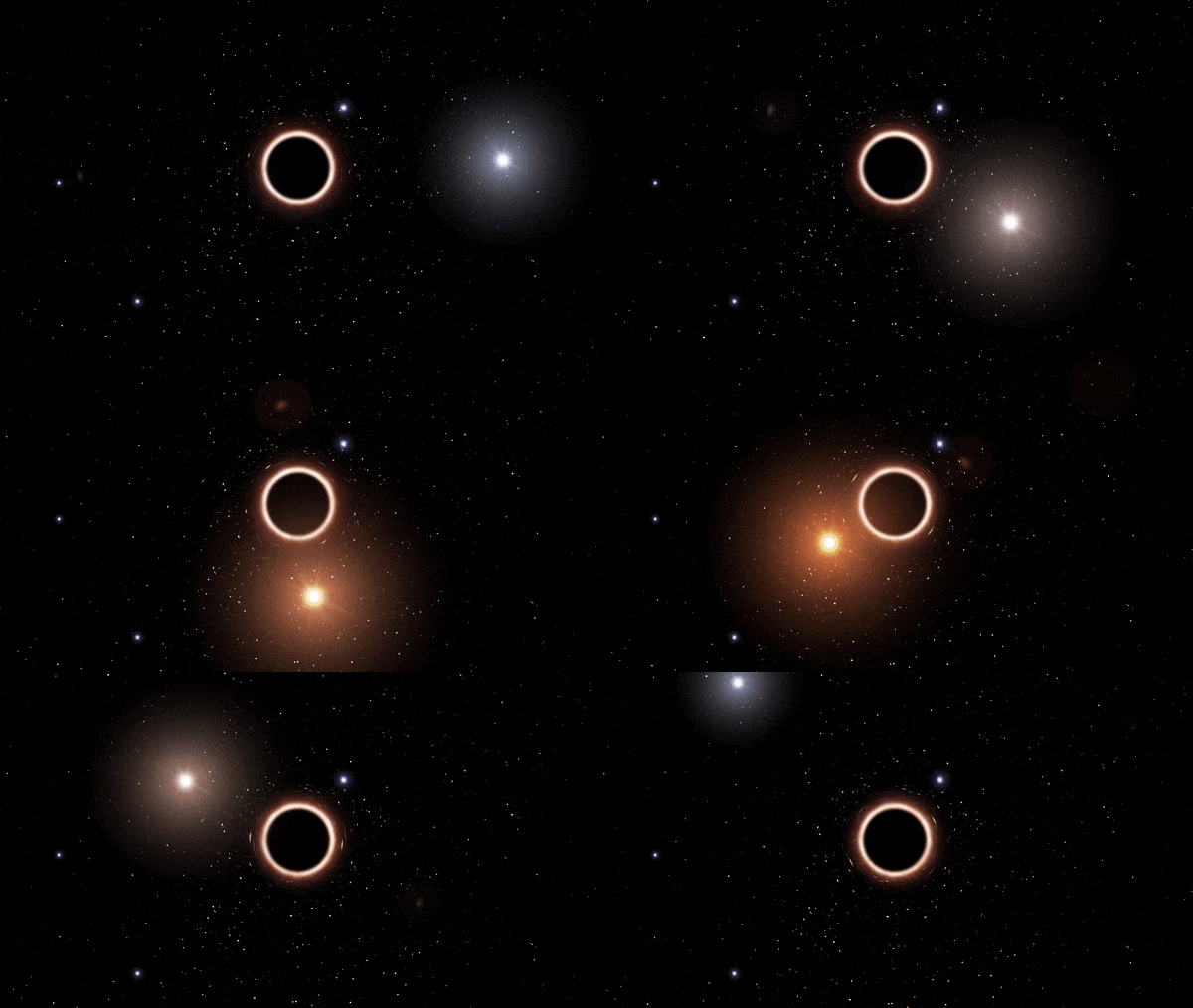
In the summer of 2014, astronomers watched with giddy anticipation as a cloud of gas, known as G2, swung dangerously close to a supermassive black hole at the center of the Milky Way. Sparks didn't fly, nor did a feeding frenzy ensue. Instead, G2 zipped by unscathed, surviving what astronomers thought would be a near-death experience.
But black holes are big bullies, so the fact that the gravity well ignored the gassy passerby was more than surprising. It seemed impossible. Now, astronomers are saying that the supermassive black hole in the center of our galaxy is not a black hole at all, but rather a fluffy ball of dark matter. New research suggests this strange hypothesis is able to account for the "impossible" encounter as well as all observations of the galactic center — and then some.
Related: The 11 biggest unanswered questions about dark matter
Icarus and the black hole
Astronomers have long thought that at the very core of the Milky Way, known as Sagittarius A*, sits a supermassive black hole. Of course, they can't see the black hole itself, because it doesn't give off any light of its own. Instead, they infer its existence by watching the movements of a cluster of stars known as the S-stars. The S-stars orbit around a hidden, unseen central object, and by charting their orbits over the years, astronomers can deduce the mass and size of that central object.
The most likely candidate for that hidden central object is, of course, a black hole, with an estimated mass more than 4 million times that of the sun. But the S-stars aren't the only thing to hang around our galactic downtown. Clumps of gas also lurk there, and one in particular, dubbed G2, drew special attention. Soon after astronomers discovered the clump decades ago, they realized that the orbit of G2 would bring it perilously close to the black hole — close enough that the intense gravity of the black hole should tear that gas cloud apart.
But after the closest approach of G2 to the black hole in 2014 — when it passed just 260 AU from the behemoth — the gas appeared to survive completely intact.
Related: The 12 strangest objects in the universe
Get the world’s most fascinating discoveries delivered straight to your inbox.
Make it fluffier
The most plausible explanation for the survival of G2 is that it's more than just an ordinary gas cloud. Its hidden superpower? A star or two could be tucked inside the cloud, and the gravity of that star kept the whole structure intact during its passage near the black hole.
But there's another, more radical explanation: Perhaps, the supermassive black hole isn't really a black hole. Perhaps, it's a fuzzy clump of dark matter.
Dark matter is the name astronomers give to an invisible substance that makes up more than 80% of the mass of the universe. It doesn't appear to interact with light — it doesn't glow, or absorb, reflect or refract light — and so it remains invisible to us. But it makes its presence known through its gravity. Multiple, independent lines of observation have all confirmed that most of the mass of the universe is this invisible dark matter.
One theory for the identity of dark matter suggests that it's made of an exotic, previously unknown particle, called "darkinos". According to the theory, the darkino is a type of particle known as a fermion. Electrons, protons, quarks and neutrinos are also fermions, whose central defining characteristic is that they can't share the same state. In other words, you can fit only so many fermions into a given volume (this is in contrast to the bosons, which you can shove as many as you want into a given volume).
Related: 7 strange facts about quarks
If dark matter is made of darkinos, and darkinos are fermions, then these dark matter particles would concentrate in the core of a galaxy only to a certain degree. This would mean that instead of a supermassive black hole, with a sharply defined edge at the event horizon, there is instead a gigantic ball of densely packed darkinos. The edge of this darkino ball would be pretty fuzzy — like partygoers waiting in line outside the local disco, not all of them can join the party at the very center.
Keep it consistent
Since the giant darkino ball would be fuzzy, the gravitational forces at the center of the galaxy would be a little bit milder, allowing for gas clouds like G2 to survive in their orbits.
But there's more to the center of our galaxy — and more to our observations of the galactic core — than G2. There are also all those S-stars. Any radical theory that hopes to replace a supermassive black hole with something else must make predictions that match those observations.
RELATED CONTENT
And that's exactly what a new study shows. The team of astrophysicists, led by Eduar Antonio Becerra-Vergara of the International Center for Relativistic Astrophysics in Italy, found that if they replaced the supermassive black hole with a ball of darkinos, and those darkino particles had the right mass and velocity, they could replicate all the observed motion of the S-stars. In some cases, their model could do even better than the vanilla black hole calculations at matching the observed orbits.
But that result doesn't mean much. The black hole model is exceedingly simple: You just need to plug in two numbers, the black hole mass and spin, to predict how the S-stars should behave. But the darkino model has many more parameters, allowing for more fine-tuning, and the researchers found the best possible combination of darkino properties.
The key test will come with future observations. If the dark matter is made up of darkinos, then a model that successfully describes what's happening at the galactic center should also replicate all the variety of dark matter observations across the universe. That would include explaining why galaxies spin faster than they should for their known masses.
The new research is detailed in the May issue of the journal Monthly Notices of the Royal Astronomical Society Letters.
Originally published on Live Science.

Paul M. Sutter is a research professor in astrophysics at SUNY Stony Brook University and the Flatiron Institute in New York City. He regularly appears on TV and podcasts, including "Ask a Spaceman." He is the author of two books, "Your Place in the Universe" and "How to Die in Space," and is a regular contributor to Space.com, Live Science, and more. Paul received his PhD in Physics from the University of Illinois at Urbana-Champaign in 2011, and spent three years at the Paris Institute of Astrophysics, followed by a research fellowship in Trieste, Italy.