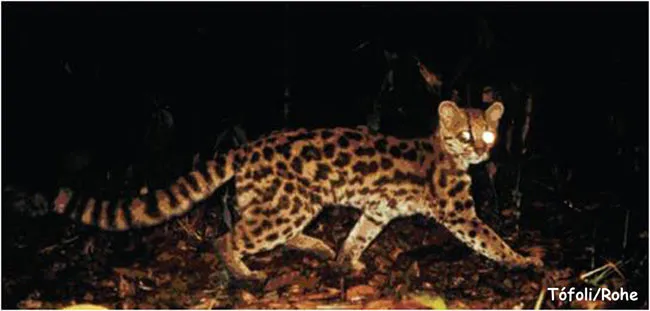
One wild cat species goes beyond physical camouflage to capture its prey — it disguises its voice, mimicking the calls of its victims, a new study finds.
Margays, wild cats native to the Amazon, have been observed imitating the calls of squirrel-sized monkeys known as pied tamarins. This is the first recorded instance of a wild cat species in the Americas copying the calls of its prey, the researchers say.
The observations confirmed what until now had been only anecdotal reports from Amazonian inhabitants of wild cat species — including jaguars and pumas — actually mimicking primates, rodents and other species in order to draw them within striking range.
Latest Videos From
"Cats are known for their physical agility, but this vocal manipulation of prey species indicates a psychological cunning which merits further study," said study researcher Fabio Rohe, of the Wildlife Conservation Society (WCS).
The study was carried out in the Amazonian forests of the Reserva Florestal Adolpho Ducke in Brazil.
Researchers first recorded the incident in 2005 when a group of eight pied tamarins were feeding in a ficus tree. They then observed a margay emitting calls similar to those made by tamarin babies. This attracted the attention of a tamarin "sentinel," which climbed down from the tree to investigate the sounds coming from a tangle of vines.
While the sentinel monkey started vocalizing to warn the rest of the group of the strange calls, the monkeys were clearly confounded by these familiar vocalizations, choosing to investigate rather than flee. Four other tamarins climbed down to assess the nature of the calls. At that moment, a margay emerged from the foliage walking down the trunk of a tree like a squirrel, jumping down and then moving towards the monkeys. Realizing the ruse, the sentinel screamed an alarm and sent the other tamarins fleeing.
While this specific instance of mimicry was unsuccessful, the researchers were amazed at the ingenuity of the hunting strategy.
"This observation further proves the reliability of information obtained from Amazonian inhabitants," said Avecita Chicchón, director of the WCS's Latin America Program. "This means that accounts of jaguars and pumas using the same vocal mimicry to attract prey — but not yet recorded by scientists — also deserve investigation."
The results appear in the June issue of the journal Neotropical Primates.