















Mission Accomplished: Orangutan Genome Decoded
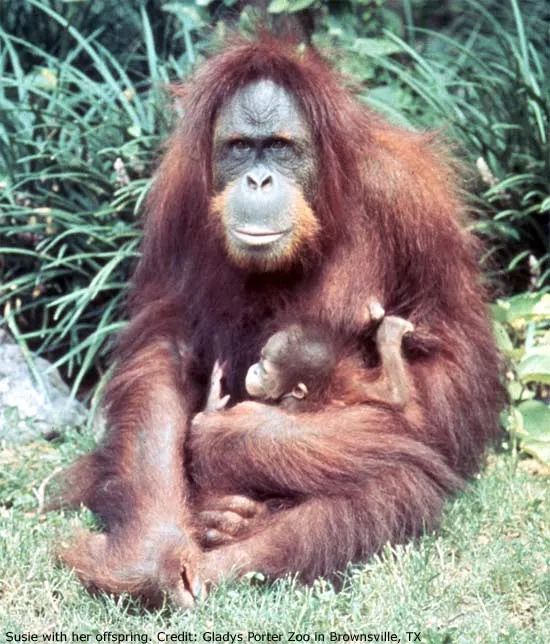

Susie, a female Sumatran orangutan from a Texas zoo — along with a few of her kin in the wild — has been decoded, her genetic instructions for life laid out for scientists to inspect, an international team of researchers announced today (Jan. 26).
The sequenced genomes of this great ape and her kin -- our most distant living relatives in the hominid family – evolved much more slowly than that of chimps and humans, the team found. [Read: Are You More Like Chimps or Orangutans?]
"Without doing a 15-million-year-long experiment, it's hard to say the precise reason for that difference," said Devin Locke, an evolutionary geneticist at Washington University and first author of the paper published online today (Jan. 26) in the journal Nature.
The researchers assembled the draft genome of the female Sumatran orangutan (Pongo abelii) using a whole-genome "shotgun" strategy, an old-fashioned approach that cost about $20 million. In addition, the researchers gathered sequence data from five wild Sumatran orangutans and five Bornean orangutans (Pongo pygmaeus) using a faster and thousandfold cheaper next-generation platform.
Changes in the DNA sequence called mutations drive the evolution of the genome, and the researchers found that these changes occurred at a slower pace in the orangutan genome compared with that of other great apes. For example, they found a lower turnover rate for genes, as well as fewer rearrangements — changes in the order of genes on the chromosome — and fewer segmental duplications—segments of DNA with near-identical sequences.
"That doesn't mean the species itself has evolved more slowly, but that this particular mechanism of genome evolution has been proceeding at a lower rate," Locke said. "Humans and chimps, in sharp contrast, have experienced an acceleration in this form of evolution over the past 5 million years or so."
The orangutan genome contained a small number of repetitive stretches of DNA called Alu elements, which make up about 10 percent of the human genome. Because Alu elements play a major role in restructuring primate genomes, a reduction in their numbers could explain why the orangutan genome remained so stable, Locke said.
Get the world’s most fascinating discoveries delivered straight to your inbox.
The team also found that primate genes involved in lipid metabolism, which is the chemical breakdown of a class of molecules including fats for the production of energy, evolved more quickly than expected. Changes in these genes may explain why orangutans are more efficient at using energy than other primates, Locke told LiveScience.
By analyzing certain variations in the DNA sequences, the researchers concluded that the Bornean and Sumatran species diverged about 400,000 years ago — more recent than previous estimates ranging up to 5 million years ago, Locke said. Since the split, the inhabitants of Sumatra became more genetically diverse than Borneo's residents, despite their smaller population size. (Today, only about 50,000 Bornean and 7,000 Sumatran orangutans still live in the wild.)
In total, Locke and his collaborators characterized more than 13 million variations in the DNA sequence called single nucleotide polymorphisms in the Bornean and Sumatran genomes
"With that data in hand, you could develop a barometer to test the genetic diversity of any orangutan population, whether it's in a zoo or in the wild," Locke said, adding that conservationists may be able to protect the endangered animals by attempting to preserve populations that have rare genetic variations.