













Genomic Fossils Reveal Explosion of Life 3 Billion Years Ago

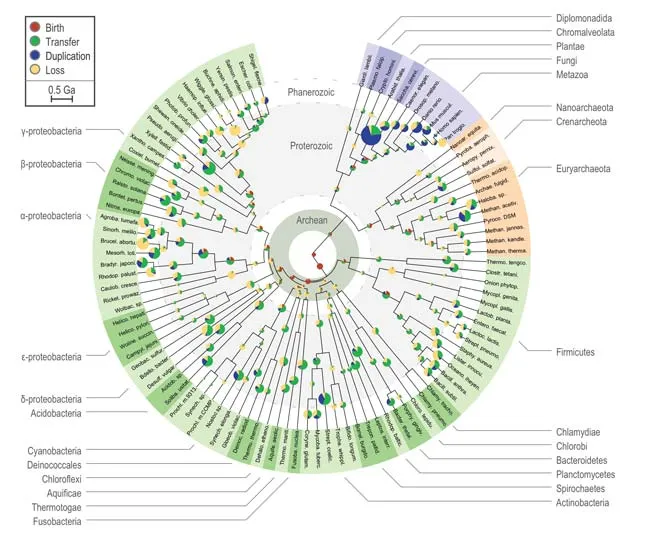
Life has existed on Earth for roughly 3.5 billion years, but there is very little fossil record left for most of that time. However, two researchers have used modern genomes to look back in time and reconstruct the evolution of ancient cells.
Their work has revealed an explosion of life about 3 billion years ago, coinciding with the appearance of the chemical mechanism that makes possible two crucial processes – respiration and photosynthesis. [Scientists Hunt for Signs of the Earliest Life on Earth]
"What is really remarkable about these findings is that they prove that the histories of very ancient events are recorded in the shared DNA of living organisms," said one of the researchers, Eric Alm, a professor of civil and environmental engineering and biological engineering at the Massachusetts Institute of Technology (MIT). He collaborated with Lawrence David, who received his doctorate from MIT and is now a junior fellow in the Harvard Society of Fellows.
To turn the clocks back, Alm and David used information about modern genomes in combination with their own mathematical model that took into account the ways genes evolve, such as, the creation and inheritance of new gene families and the loss of genes. Using this technique, they traced thousands of genes from 100 modern genomes back to those genes' first appearance on Earth.
This genomic "fossil record" indicates that the collective genome of life expanded between 3.3 billion and 2.8 billion years ago. During this period, 27 percent of all presently existing gene families came into being. The pair dubbed this the Archean Expansion.
This expansion coincided with the development of modern electron transport, which is the biochemical process responsible for shuttling electrons within cellular membranes to make breathing oxygen and carrying out photosynthesis possible.
"Our results can't say if the development of electron transport directly caused the Archean Expansion," David said. "Nonetheless, we can speculate that having access to a much larger energy budget enabled the biosphere to host larger and more complex microbial ecosystems."
Get the world’s most fascinating discoveries delivered straight to your inbox.
After the Archean Expansion, about 2.5 billion years ago, the atmosphere filled with oxygen, a dramatic event in the history of life on Earth, called the Great Oxidation Event. A type of photosynthesis, made possible by electron transport, is believed to have driven the oxygenation of the atmosphere.
Alm and David detailed their findings online Dec. 19 in the journal Nature.
- Extremophiles: World's Weirdest Life
- Top 10 Mysteries of the First Humans
- Greatest Mysteries: How Did Life Arise on Earth?
You can follow LiveScience writer Wynne Parry on Twitter @Wynne_Parry.
