Mammals Chewed Dinosaur Bones, Discovery Reveals

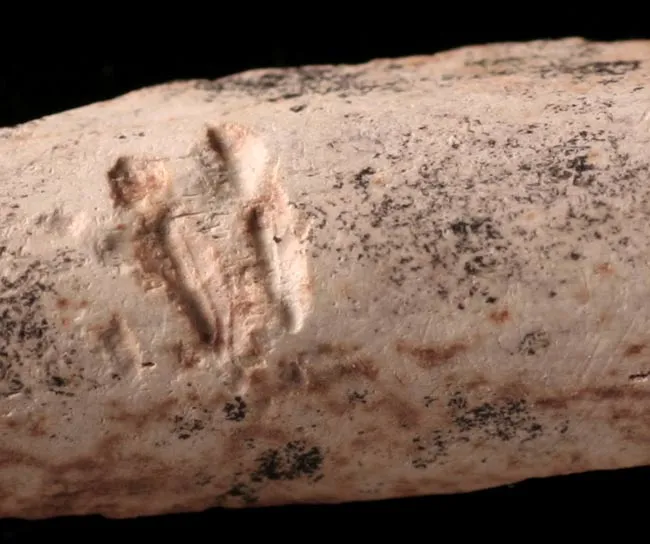
Squirrel-sized animals gnawed on the skeletons of Triceratops and other dinosaurs, leaving behind distinct tooth marks on the bones of these extinct giants.
The bite marks are about 75 million years old — from near the end of the age of dinosaurs. They are the oldest mammalian tooth marks found yet. Though small mammals existed in the dinosaur era, it was the fall of dinosaurs that spurred the rise of large mammals, theory holds.
Scientists discovered them during fieldwork in Canada, as well as during analyses of university and museum bone collections there.
"The marks stood out for me, because I remember seeing the gnaw marks on the antlers of a deer my father brought home when I was young," said researcher Nicholas Longrich, a vertebrate paleontologist at Yale University in New Haven, Conn. "So when I saw it in the fossils, it was something I paid attention to."
All the bones the researchers analyzed come from rocks in southern Alberta, back when they lay on the western margin of the Western Interior Seaway, a vast inland sea that divided what is now North America in half. The warm temperate environment there was home to a remarkable diversity of animals, including dinosaurs, birds, pterosaurs, alligators, turtles, lizards and mammals.
Bite marks were seen on the large rib of a dinosaur, likely belonging either to a horned behemoth such as Triceratops or to duck-billed giants known as hadrosaurs, as well as on the femur of an ornithischian, which included many beaked, herbivorous titans. Tooth marks were also seen on a femur bone of a Champsosaurus, an aquatic crocodilian-like reptile that grew up to 5 feet long (1.5 meters), and on the lower jaw bone of a small marsupial known as Eodelphis.
All the marks were only 4 to 7 millimeters long and 1 millimeter wide, suggesting they were made by squirrel-sized animals. The marks were made by opposing pairs of teeth, something at that time and place that was only seen in mammals. Specifically, the researchers suspect they were made by now-extinct rodent-like animals known as multituberculates, which had paired upper and lower incisors.
Get the world’s most fascinating discoveries delivered straight to your inbox.
"These are really deep bite marks — they're really getting into that bone, and probably generated a surprisingly high bite force," Longrich told LiveScience.
The animals were most likely gnawing on the bare bones for minerals rather than for meat, Longrich said. "The bones were kind of a nutritional supplement for these animals," he explained.
Several of the bones display multiple, overlapping bites made along the curve of the bone — a pattern similar to the way people eat corn on the cob. However, these marks are not very extensive compared with the kind of repeated shearing of bone seen with modern rodent gnawing.
"That kind of adept gnawing seemed to evolve later, long after the dinosaurs went extinct," Longrich said.
Many other instances of mammalian tooth marks on bones likely remain to be found, Longrich added.
"We didn't have to go through a lot of bones to find these bite marks," he said. "They're not super-common, but they're not as rare as you might think, either."
Longrich and Michael Ryan, curator and head of vertebrate paleontology at the Cleveland Museum of Natural History in Ohio, detailed their findings online June 16 in the journal Paleontology.
- 25 Amazing Ancient Beasts
- The World's Deadliest Animals
- Beasts and Dragons: How Reality Made Myth