













Giant Flying Reptiles Had Bird-Like Air Sacs

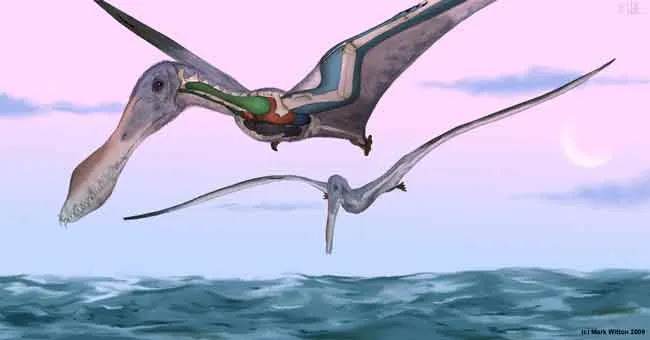
Long before birds took flight, giant reptiles called pterosaurs dominated the skies. Their wingspans varied widely, ranging from that of a sparrow to that of a Cessna.
A study last month suggests the birds, some as tall as giraffes, got airborne by virtue of a leap-frog maneuver, relying on all four limbs to launch themselves.
But how did the huge creatures stay aloft?
A new study concludes balloon-like air sacs extended from the pterosaurs' lungs into much of the skeleton, reducing body density and providing an efficient breathing system by helping the exchange of oxygen and other gases in and out of the beasts' bodies. The strategy was similar to that used by birds that descended from dinosaurs — much later.
"We offer a reconstruction of the breathing system in pterosaurs, one that proposes the existence of a mechanism with the same essential structure to that of modern birds — except 70 million years earlier," said study co-author Leon Claessens, an assistant professor of biology at the College of the Holy Cross in Massachusetts.
The new research is published in the journal PLoS ONE.
Claessens and a colleague were inspired in 2003 when David Unwin of the University of Leicester, then curator at the Natural History Museum in Berlin, showed them an extraordinarily preserved pterosaur. The scientists thought the specimen might finally shed light on how the animals powered sustained flight.
Get the world’s most fascinating discoveries delivered straight to your inbox.
"The shape and size of the rib segments that articulate with the sternum indicate that the ribcage was mobile, contrary to previous ideas," Claessens said. Unique and previously unrecognized projections on the ribs provided important leverage for the muscles that power lung ventilation, he added.
Because fossils rarely preserve soft tissues, the research team conducted a comparative study that included pterosaurs, birds and crocodilians in order to get a better understanding of the relationships among air sacs, lung structure and the skeleton. By using X-ray movies and CT scans, the group characterized how the skeleton works to move air through the lungs in living animals, and also how to identify the signature traces left on bones that have been invaded by air sacs.
Not only do the extinct pterosaurs show evidence that their bones that were invaded by air sacs, but patterns of internal air flow throughout the entire skeleton of different pterosaur species parallel trends identified in many living bird groups. For example, there is a direct relationship between the proportion of the skeleton invaded by air sacs and the absolute body size of an animal.
"Whereas small-bodied pterosaurs and birds typically pneumatize only a restricted part of the backbone, larger-bodied species routinely pneumatize most bones of the body, including the wing skeleton out to the ends of the fingers," said study co-author Patrick O'Connor, an assistant professor of biomedical sciences at the Ohio University College of Osteopathic Medicine.
The research was funded in part by the National Science Foundation.
- Video – Finding the "Leonardo" Dinosaur Fossil
- New X-ray Videos Show Animal Skeletons in Motion
- Birds of Prey: Spot Today's Dinosaurs
