















Psychedelic Mice Reveal Clues to Disease Transmission
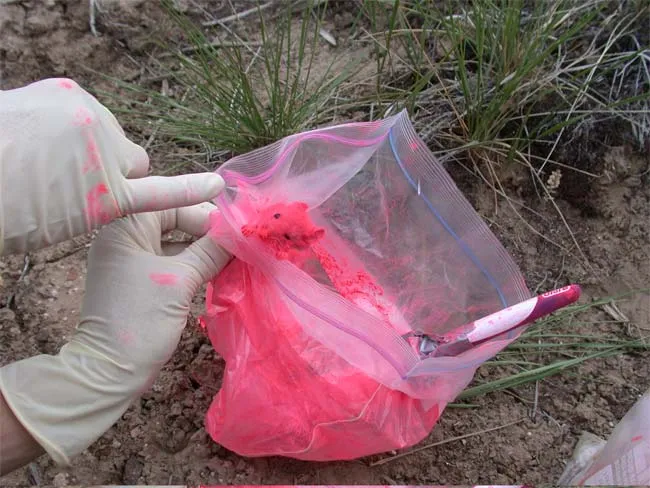
Psychedelic mice have recently scrambled across the Utah deserts as specks of fluorescent green, pink and yellow.
This rodent rave was part of an experiment to find out which mice had the most contact with other mice and were most likely to spread the so-called hantavirus.
The culprits? Heavier, old mice.
Hantavirus is carried by rodents and can be transmitted to humans who come into contact with infected rodents or who inhale the infected dust from the rodents' urine and droppings. In humans, the virus causes a potentially fatal respiratory illness called hantavirus pulmonary syndrome (HPS).
Deer mice (Peromyscus maniculatus) are the primary carriers of the virus in the western United States, first spreading it among each other without showing signs of illness.
To get a handle on mice contacts, the researchers captured and released deer mice at 12 sites in the western Utah desert during the spring and fall of 2005. The researchers collected blood samples and tagged some mice with radio transmitters while dusting others with fluorescent powders.
For two nights during the spring and fall, toothbrushes were used to apply colored powders to five mice at each of the 12 sites, resulting in each site having five different colored mice: pink, blue, green, yellow and orange.
Get the world’s most fascinating discoveries delivered straight to your inbox.
The next day, the researchers viewed mice captured in animal traps under an ultraviolet light (black light), looking for fluorescent powder on each mouse's head, ears, mouth, feet and tail.
"If mice were in contact with a powdered mouse, you'd see the colored bite mark on their ear or tail, or color on their genitals," said Denise Dearing, a biologist at the University of Utah and lead author of the study published online Jan. 7 in the journal Proceedings of the Royal Society B.
Mice having the most contacts with other mice (and therefore most likely to spread the virus) were 11 percent heavier than the rest of the mouse population.
The researchers say that bigger mice likely have the largest foraging range since such mice need to snag more food. In addition, the heavier mice could be territorial, and so would be defending a nest or food resource. And bigger mice are older, meaning they have more experience defending territory than do younger mice.
The solution: "We are not proposing you exterminate larger mice," said researcher Christy Clay of Westminster College in Salt Lake City. "But if you could identify places where the animals are older and heavier, then ostensibly you could make a risk map," which would reveal where humans should be most cautious. (Clay ran the study as part of her University of Utah Ph.D. thesis under Dearing's supervision.)
Jeanna Bryner is managing editor of Scientific American. Previously she was editor in chief of Live Science and, prior to that, an editor at Scholastic's Science World magazine. Bryner has an English degree from Salisbury University, a master's degree in biogeochemistry and environmental sciences from the University of Maryland and a graduate science journalism degree from New York University. She has worked as a biologist in Florida, where she monitored wetlands and did field surveys for endangered species, including the gorgeous Florida Scrub Jay. She also received an ocean sciences journalism fellowship from the Woods Hole Oceanographic Institution. She is a firm believer that science is for everyone and that just about everything can be viewed through the lens of science.