













Inscription About Ancient 'Monkey Colony' Survives ISIS Attacks

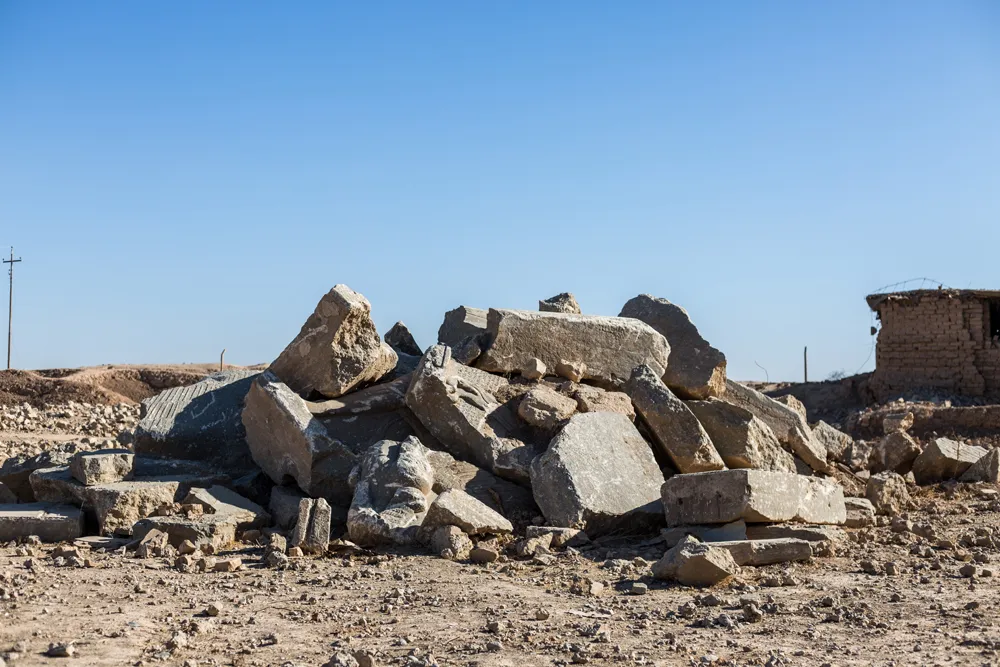
A number of artifacts with inscriptions survived in the ancient Assyrian city of Nimrud, after the Islamic State group (also known as ISIS) destroyed the site.
The group targeted Nimrud, along with many other historical sites in Iraq and Syria, in an attempt to eradicate the history of the Assyrians, Shiite Muslims, Kurds and other peoples who live in Iraq and Syria. Countries and groups around the world have condemned this destruction of cultural heritage as a war crime.
Live Science showed photographs of some of the surviving inscriptions to scholars who translated or deciphered their meanings. The inscriptions tell a number of stories about the AssyrianKing Ashurnasirpal II (reign 883–859 B.C.), including the lands he conquered, the treasures he took, the palace he constructed and the ancestors he had. [See Images of the Ancient Assyrian Inscriptions at Nimrud]
All the surviving inscriptions found so far are written in the king's name, who turned Nimrud into his capital, building a vast palace in the city.
For instance, one story, inscribed on a statue that ISIS had tried to destroy, tells of a monkey colony that Ashurnasirpal II bred at Nimrud, stating that "herds of them in greatnumbers" lived at Nimrud during the king's reign. The inscription also tells of how Ashurnasirpal IIcaptured lions and kept them at Nimrud.
ISIS is under siege in Mosul, Iraq, and the group's remaining territories in Syria and Iraq are shrinking. So the monkey-colony inscription, and its tale of a time when Nimrud was a flourishing place filled with life, may survive far longer than the terrorist group that tried to destroy the statue bearing the inscription.
Nimrud's surviving inscriptions
The Iraq army retook the ancient city of Nimrud (also known as Calah or Kalhu) and surrounding areas on Nov. 13. Photographers who have visited the site, including photojournalist John Beck, have revealed the devastated remains of the ancient city. [Photos: Restoring Life to Iraq's Ruined Artifacts]
Get the world’s most fascinating discoveries delivered straight to your inbox.
Grant Frame, a professor of Near Eastern languages and civilizations at the University of Pennsylvania who is an expert in Neo-Assyrian (ninth to sixth century B.C.) writing, examined some of the images captured by Beck and others. Frame told Live Science what the inscriptions, in general, say, noting that the surviving texts were duplicates of original versions; multiple copies with similar text were made in ancient times.
Monkey colony
The monkey colony is perhaps the most interesting story that Ashurnasirpal II tells. "The section here is a summary of the areas in the west — in Lebanon and Syria — who gave him tribute and the bringing of animals, monkeys and lions, to his capital city of Kalhu [another name for Nimrud]" said Frame.
At least eight "copies" of this monkey tale have been found in the past by archaeologists and historians, Frame said. The Assyrian historian Albert Kirk Grayson published a translation of these texts in 1991 in the book "Assyrian Rulers of the Early First Millennium BC" (University of Toronto Press).
Grayson translated these eight copies as reading, "I brought them [the monkeys] to my land Aššur. I bred herds of them in great numbers in Calah [and] displayed [them] to all the people of my land."
That mention of breeding in great numbers appears even though the translation mentions only the female monkeys. This means that the king already had, or also received, male monkeys and got the newly acquired female monkeys to breed with them. [Photos: New Archaeological Discoveries in Northern Iraq]
The inscription also mentions how Ashurnasirpal II captured lions. "With my outstretched hand and my fierce heart, I captured 15 strong lions from the mountains and forests. I took away 50 lion cubs. I herded them into Calah and the palaces of my land into cages," the inscription reads, as translated by Grayson.
Surviving ancient stories
The surviving inscriptions tell more tales from Ashurnasirpal II's reign, including the pride he felt for his palace.
Two of the surviving inscriptions, Frame said, preserve part of a text in which Ashurnasirpal II says that, at Nimrud, "I founded therein my lordly palace. I built this palace for the eternal admiration of rulers and princes [and] decorated it in a splendid fashion. I made [replicas of] all beasts of mountains and seas," placing the animal replicas in the palace doorways, as translated by Grayson.
ISIS largely destroyed the palace, although a bit of it appears to have survived, said Clemens Reichel, a curator at Toronto's Royal Ontario Museum, who viewed some of the photographs.
Two other inscriptions were found written on two surviving works of art — one showing a winged genie and the other, which is damaged, seeming to show multiple male individuals. These works of art contain a widely used ancient text that modern-day scholars sometimes call a "standard inscription," Frame said.
The two inscriptions indicate that Ashurnasirpal II owned these works of art: "[Property of] the palace of Ashurnasirpal, vice regent of Assur, chosen of the gods Enlil and Ninurta, beloved of the gods Anu and Dagan, destructive weapon of the great gods, strong king, king of the universe, king of Assyria," as translated by Grayson.
Original article on Live Science.

Owen Jarus is a regular contributor to Live Science who writes about archaeology and humans' past. He has also written for The Independent (UK), The Canadian Press (CP) and The Associated Press (AP), among others. Owen has a bachelor of arts degree from the University of Toronto and a journalism degree from Ryerson University.