It's quick and easy to access Live Science Plus, simply enter your email below. We'll send you a confirmation and sign you up for our daily newsletter, keeping you up to date with the latest science news.
Bones unearthed from an ancient mound in Turkey suggest that humans there shifted their diet from hunting to herding over just a few centuries, findings that shed light on the dawn of agriculture, scientists say.Agriculture began in the Neolithic, or New Stone Age, about 11,500 years ago. Once- nomadic groups of people settled down and began farming and herding, fundamentally changing human society and how people related to nature.
To discover more about the initial conditions underlying the evolution of villages, an international team of scientists investigated the site of Aşıklı Höyük, the earliest known Neolithic mound in Cappadocia, in central Turkey. In this volcanic landscape, erosion carved soft rock into thin spires known as "fairy chimneys." Settlers also used this malleable stone to build cave dwellings and underground cities.
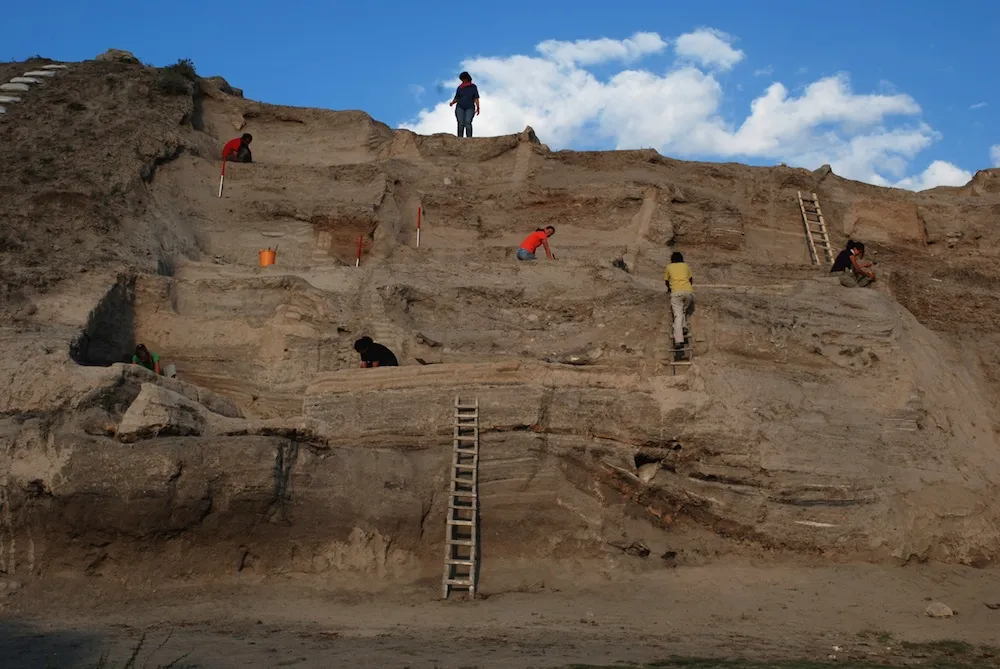
The mound, whose name means "ankle bone hill," stands 52 feet (16 meters) high. The oldest levels of the area span from about 8,200 to 9,000 B.C., predating the emergence of pottery in the region. The mound formed as the result of people continually moving materials such as mud and wood to the settlement for buildings, fires and other purposes. Over centuries, the human-collected debris raised the height of the settlement, with residents adjusting their buildings accordingly. [Image Gallery: Stone-Age Burials in Africa]
View of an excavation, exposed buildings and related features in the deep trench.
(Image credit: MC Stiner)
The research team, led by archaeologist Mihriban Özbaşaran at Istanbul University, discovered the people of the oldest levels of the site originally ate a broad diet of meat from creatures that populated the plains and meadows along the Melendiz River. This included diverse small animals, such as hares, fish, turtles, hedgehogs and partridges, as well as larger prey such as deer, boars, horse, goats, sheep, extinct wild oxen known as aurochs, and the onager, also known as the Asian wild ass.
However, by 8200 B.C., the meat in the diet shifted overwhelmingly to sheep and goats. These animals once made up less than half of all skeletal remains at the site, but gradually increased to 85 to 90 percent of these bones, with sheep bones outnumbering goat remains by a factor of three or more. Young male sheep and goats were selectively killed, probably for their meat, leaving females and some males to breed more livestock.
Moreover, analysis of dung in the mound revealed that plant-eating animals were held captive inside the settlement, probably in between buildings. Altogether, these findings suggest the people in this area shifted from hunting to herding in just a few centuries.
Sign up for the Live Science daily newsletter now
Get the world’s most fascinating discoveries delivered straight to your inbox.
The landscape around the Neolithic dig site in Turkey.
(Image credit: MC Stiner)
Cultivating change
The cultivation of grain may have played a major role in the move from hunting to herding, said lead study author Mary Stiner, an archaeologist at the University of Arizona in Tucson.
"If people become more sedentary to take advantage of grains, they have a tendency to eat what's nearby, and the best and largest kinds of game will get targeted first," Stiner told Live Science. "Eventually, people will have to travel farther afield to get large animals. The alternative is to raise animals yourself."
In future studies, the researchers would like to examine the consequences of holding animals captive in the settlement for people.
"What advantages and problems did that bring?" Stiner said. "Did their nutrition and health improve? Did they suffer diseases that came from the livestock? How did the people reorganize their labor to make sure the animals were fed? What kinds of structural modifications were made within the site to protect and constrain these animals?"
Stiner, Özbaşaran and their colleagues detailed their findings online today (April 28) in the journal Proceedings of the National Academy of Sciences.
Charles Q. Choi is a contributing writer for Live Science and Space.com. He covers all things human origins and astronomy as well as physics, animals and general science topics. Charles has a Master of Arts degree from the University of Missouri-Columbia, School of Journalism and a Bachelor of Arts degree from the University of South Florida. Charles has visited every continent on Earth, drinking rancid yak butter tea in Lhasa, snorkeling with sea lions in the Galapagos and even climbing an iceberg in Antarctica.