













Why Can't All Animals Be Domesticated?

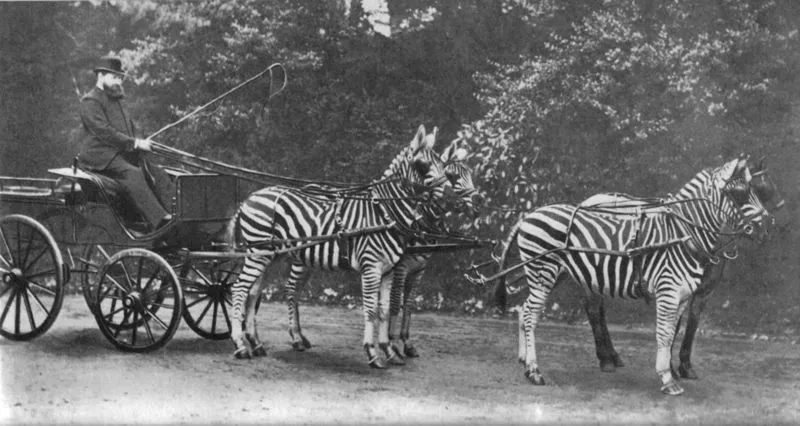
About 11,000 years ago, humans realized there was a better place for some animals than the other end of a spear. We started coaxing them into our settlements, gradually molding their natures to better suit our needs for food, labor and companionship. Over the millennia, we dabbled with the domestication of many species. But only a few — most notably, the cow, goat, sheep, chicken, horse, pig, dog and cat — have proved themselves so useful that they have piggybacked their way across the globe, flourishing almost everywhere humans do.
But why just those animals? Why not the rhinoceros, tiger, zebra, or any of the hundreds of other seemingly suitable creatures that didn't make the cut, and by consequence have been relegated to an ever-diminishing share of Earth's land and resources?
According to the evolutionary physiologist and geographer Jared Diamond, in his acclaimed book "Guns, Germs and Steel" (Norton, 1997), there are six criteria that animals must meet for domestication. Many species come close, but very few fit the bill.
First, domestic animals cannot be picky eaters; they must be able to find enough food in and around human settlements to survive. The herbivores, such as cows and sheep, must be able to forage on grass and eat our surplus grain supplies. Carnivores, such as dogs and cats, must be willing to scavenge on human waste and scraps, as well as the vermin that those morsels attract.
Second, only animals that reach maturity quickly relative to the human life span are worth considering. We can't afford to waste too much time feeding and caring for an animal before it grows large enough to be put to work or slaughtered. Failure to meet this requirement prevented elephants from achieving widespread domestication; they can be tamed and are good laborers, but take 15 years to reach adult size.
Third, domesticated species must be willing to breed in captivity. Creatures that are territorial when breeding, such as antelope, cannot be kept in crowded enclosures. And though the ancient Egyptians prized pet cheetahs, the large cats won't breed without elaborate courtship rituals (including running together over long distances), and so they never achieved domestication.
Fourth, domesticated animals must be docile by nature. For example, the cow and sheep are generally easygoing, but the African buffalo and American bison are both unpredictable and highly dangerous to humans, so the former two species have achieved widespread domestication while the latter pair have not. Similarly, the zebra, though closely related to the horse, is typically much more aggressive, and this may explain why zebras have been tamed only in rare instances. (Some evolutionary biologists do not consider docility to be a criterion of domestication, as many domestic animals are derived from very aggressive species, such as the dog from the wolf.)
Get the world’s most fascinating discoveries delivered straight to your inbox.
Fifth, domestic animals cannot have a strong tendency to panic and flee when startled. This rules out most species of deer and gazelles, which have flighty temperaments and a powerful leap that enables them to escape over high fences. Sheep, though they're panicky, also have a flocking instinct, which causes them to stay close together when nervous. This means they can be herded.
Lastly, with the exception of the cat, all the major domesticated animals conform to a social hierarchy dominated by strong leadership. This has allowed us to easily modify them so that they'll recognize their human caretaker as the pack leader.
Follow Natalie Wolchover on Twitter @nattyover. Follow Life's Little Mysteries on Twitter @llmysteries, then join us on Facebook.

Natalie Wolchover was a staff writer for Live Science from 2010 to 2012 and is currently a senior physics writer and editor for Quanta Magazine. She holds a bachelor's degree in physics from Tufts University and has studied physics at the University of California, Berkeley. Along with the staff of Quanta, Wolchover won the 2022 Pulitzer Prize for explanatory writing for her work on the building of the James Webb Space Telescope. Her work has also appeared in the The Best American Science and Nature Writing and The Best Writing on Mathematics, Nature, The New Yorker and Popular Science. She was the 2016 winner of the Evert Clark/Seth Payne Award, an annual prize for young science journalists, as well as the winner of the 2017 Science Communication Award for the American Institute of Physics.