It's quick and easy to access Live Science Plus, simply enter your email below. We'll send you a confirmation and sign you up for our daily newsletter, keeping you up to date with the latest science news.
Today's climate change doesn't hold a candle to the chemical warfare waged on Earth more than 2 billion years ago.
Before plants discovered the power of photosynthesis, single-celled life survived on chemicals, not sunlight, burning through hydrogen, methane and sulfur, among other yummy compounds. These "anaerobes" that live without oxygen were poisoned when blue-green algae called cyanobacteria evolved photosynthesis and started exhaling oxygen. The highly reactive gas combines with metals and proteins in anaerobic cells, killing them. But cyanobacteria thrived, turning sunlight into sugar and excreting oxygen as waste.
Oxygen levels in rocks suddenly rise starting 2.5 billion years ago — a spike called the "Great Oxidation Event." The jump was long held up as evidence for when cyanobacteria evolved photosynthesis. But a study published today (March 23) in the journal Nature Geoscience joins a growing body of data that suggests the earliest sun-lovers appeared long before this oxygen spike. [7 Theories on the Origin of Life]
Many researchers now think the first photosynthetic organisms lived on Earth 3 billion years ago. And like art restorers who find a hidden image under an Old Master painting, these scientists are discovering a new picture of Earth's first breath.
Heavy metals
In the new study, Yale University geochemist Noah Planavsky and his colleagues analyzed levels of molybdenum and iron in 2.95-billion-year-old rocks from South Africa. The rocks were laid down in water, in a shallow ocean setting near the shore. The metals serve as markers of photosynthesis. Molybdenum isotopes, or elements with the same number of protons but a different number of neutrons, track manganese oxidization, a process that requires high levels of oxygen, Planavsky said.
The chemical traces in the rocks, from the Pongola Supergroup, indicate cyanobacteria were producing oxygen in ocean surface water, Planavsky said. "Our study is telling you that there was localized cyanobacteria production in the oceans," he told Live Science's Our Amazing Planet.
Sign up for the Live Science daily newsletter now
Get the world’s most fascinating discoveries delivered straight to your inbox.
In another recent study, also on South Africa's Pongola rocks, scientists looked at chromium isotopes to estimate atmospheric oxygen levels 3 billion years ago. The results suggest atmospheric oxygen was about 100,000 times higher than could be explained by non-biological chemical reactions, according to the research, published Sept. 26, 2013, in the journal Nature.
"The two studies are quite complementary," Planavsky said. "We're providing independent evidence of the presence of cyanobacteria. We're tracking surface ocean processes and they're tracking terrestrial processes."
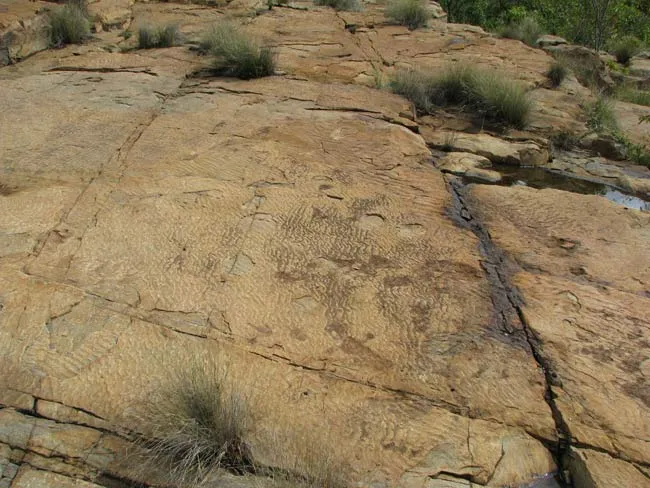
Fossilized ripple marks from the 2.9 billion years old Pongola Supergroup rock in South Africa. These ripple marks record the interference of microbial life with water currents. Studies show that such ripples form over the course of a year in a storm-dominated, moderate climate zone.
(Image credit: Nora Noffke)
However, Woodward Fischer, a geobiologist at Caltech in Pasadena, Calif., cautions that the trace metal techniques need further validation. Both analytic methods are just about a decade old and are being tested in extremely old rocks. "The quality of our interpretations derived from them remains a little bit uncertain," said Fischer, who was not involved in either study. "In all fairness, we don't understand the molybdenum and the chromium cycle today."
Which came first?
As more sensitive techniques emerge for peering into deep time, a new debate has surfaced: Did microbes pump our planet's first breath, or did environmental changes push the planet into oxygen richness?
Emerging evidence suggests oxygen levels took a roller coaster ride in the 500 million years between when the first cyanobacteria evolved photosynthesis and the Great Oxidation Event. That's a long time for life — it's about the same as the time between Earth's first trilobites and humans.
Some researchers think Earth itself played a role in boosting oxygen levels as continents grew in size. Erosion of the crust and the changing nature of volcanoes — bigger continents mean more land-based eruptions spewing out gas into the atmosphere, rather than underwater blasts. These geologic shifts could have pushed Earth's atmosphere toward oxygen in concert with the cyanobacteria.
"What's really exciting about this is the relative role of biological evolution versus geological evolution in the major turning points in Earth's history," Planavsky said. "That's what's driving our research."
Becky Oskin covers Earth science, climate change and space, as well as general science topics. Becky was a science reporter at Live Science and The Pasadena Star-News; she has freelanced for New Scientist and the American Institute of Physics. She earned a master's degree in geology from Caltech, a bachelor's degree from Washington State University, and a graduate certificate in science writing from the University of California, Santa Cruz.

 Live Science Plus