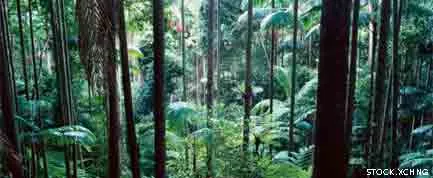
Tropical Trees Cool Earth Most Effectively
Get the world’s most fascinating discoveries delivered straight to your inbox.
You are now subscribed
Your newsletter sign-up was successful
Want to add more newsletters?
Delivered Daily
Daily Newsletter
Sign up for the latest discoveries, groundbreaking research and fascinating breakthroughs that impact you and the wider world direct to your inbox.
Once a week
Life's Little Mysteries
Feed your curiosity with an exclusive mystery every week, solved with science and delivered direct to your inbox before it's seen anywhere else.
Once a week
How It Works
Sign up to our free science & technology newsletter for your weekly fix of fascinating articles, quick quizzes, amazing images, and more
Delivered daily
Space.com Newsletter
Breaking space news, the latest updates on rocket launches, skywatching events and more!
Once a month
Watch This Space
Sign up to our monthly entertainment newsletter to keep up with all our coverage of the latest sci-fi and space movies, tv shows, games and books.
Once a week
Night Sky This Week
Discover this week's must-see night sky events, moon phases, and stunning astrophotos. Sign up for our skywatching newsletter and explore the universe with us!
Join the club
Get full access to premium articles, exclusive features and a growing list of member rewards.
Planting a tree for Earth Day may do more good if you live in Buenos Aires than if you live in New York. A new study finds that tropical trees are better at combating global warming than trees in higher latitudes.
"Our study shows that only tropical rainforests are strongly beneficial in helping slow down global warming," said study team leader Govindasamy Bala of Lawrence Livermore National Laboratory in California.
Forests affect the climate in three different ways: by absorbing carbon dioxide (a major greenhouse gas) to help cool the planet; by evaporating water that forms clouds, also helping to keep the planet cooler; and by absorbing sunlight with their dark leaves, which warms the Earth.
Trees in snowy places like Canada, Scandinavia and Siberia absorb sunlight that would otherwise be reflected back to space by the bright white snow.
But tropical rainforests trap larger amounts of carbon dioxide and evaporate more water to produce clouds that reflect sunlight back to space.
"Tropical forests are like Earth's air conditioner," said Ken Caldeira of the Carnegie Institution of Washington, Bala's colleague.
By simulating the effects of deforestation in different parts of the world, the study, published in the April 9 online issue of the Proceedings of the National Academy of Sciences, found that deforestation in the tropics is more devastating to Earth's climate than deforestation in higher latitudes, and that trees in mid- to high-latitudes could actually cause warming.
Get the world’s most fascinating discoveries delivered straight to your inbox.
But these findings don't mean it's time to take out the axes and chop down all the trees outside of the tropics, the scientists warn.
"A primary reason we are trying to slow global warming is to protect nature," Caldeira said. "It just makes no sense to destroy natural ecosystems in the name of saving natural ecosystems."
- Top 10 Ways to Destroy Earth
- UN: U.S., Europe Deforestation Reversed
- Tropical Deforestation Would Alter Storm Paths, Reduce U.S. Rainfall

Andrea Thompson is an associate editor at Scientific American, where she covers sustainability, energy and the environment. Prior to that, she was a senior writer covering climate science at Climate Central and a reporter and editor at Live Science, where she primarily covered Earth science and the environment. She holds a graduate degree in science health and environmental reporting from New York University, as well as a bachelor of science and and masters of science in atmospheric chemistry from the Georgia Institute of Technology.