















Lava pillars on land

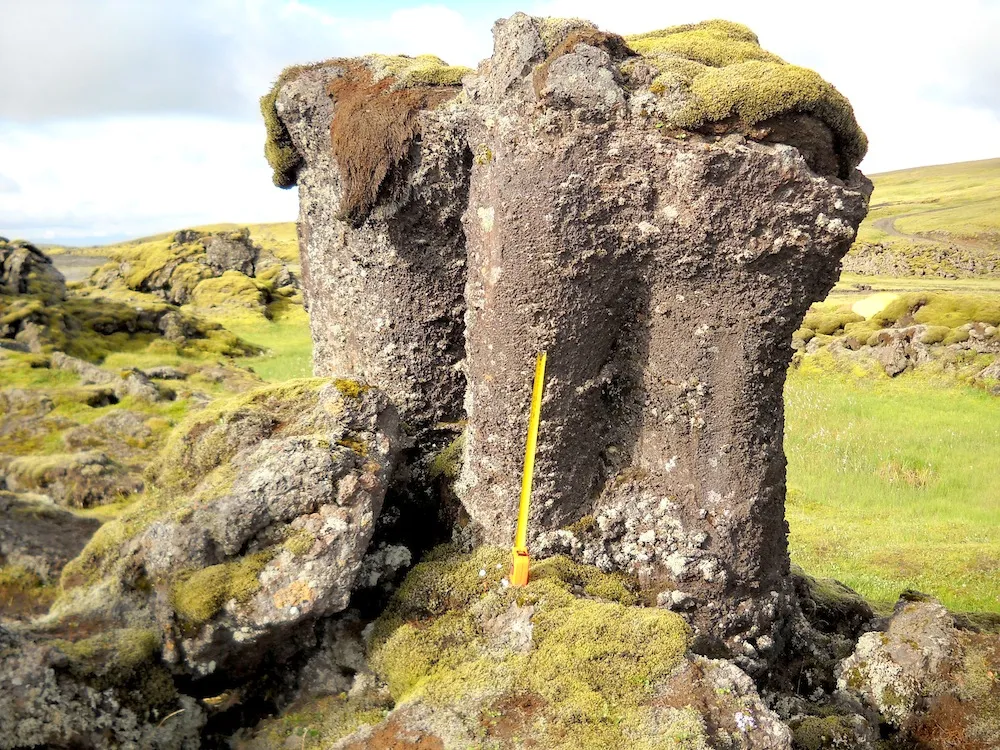
A 2013 study has concluded that bizarre, hollow spires in Iceland are a unique type of volcanic formation that was previously only known to form in the deep ocean.
Fortuitous discovery

University at Buffalo geologist Tracy Gregg was hiking with her husband in the Skaelinger Valley in 1998 in Iceland when she noticed the knobby, hollow spires dotting the landscape.
Troll war?

Though her guide and others told her the rocks were the detritus of warring trolls who had tossed them through the landscape, Gregg was unconvinced.
Ocean formation

The formations looked very similar to those she studied in her research: lava pillars that form at mid-ocean ridges.
Underwater shapes

At places where the continental plates are pulling apart under the ocean, columns of hot water seep through the pillowy lava on the ocean floor. That process cools the lava surrounding the water columns, forming hardened, hollow pillars when the lava ebbs. The Icelandic spires, with their hollow interiors, seemed to have been formed in a very similar process.
Second look

Unfortunately, Gregg didn't have a chance to take a second look at these pillars until 2010, when her graduate student Kenneth Christie received a grant to travel to Iceland to inspect the pillars more closely.
Hollow interiors

The team concluded that the pillars formed just as they would have in the ocean, with hollow interiors encircled by lava walls. The findings change geologists' understandings of the types of interactions that are possible when lava meets water.
Get the world’s most fascinating discoveries delivered straight to your inbox.
Glassy texture

Some of the pillars have a glassy texture, characteristic of the interaction between lava and water. The lava cooled fast enough to drip, but not fast enough to form crystals.
Steam or pillow
Previously, geologists believed that when water and lava met on land, the water either drowned the lava, forming pillowy structures, or the lava heated the water in a flash to form steam, which then exploded.

Tia is the editor-in-chief (premium) and was formerly managing editor and senior writer for Live Science. Her work has appeared in Scientific American, Wired.com, Science News and other outlets. She holds a master's degree in bioengineering from the University of Washington, a graduate certificate in science writing from UC Santa Cruz and a bachelor's degree in mechanical engineering from the University of Texas at Austin. Tia was part of a team at the Milwaukee Journal Sentinel that published the Empty Cradles series on preterm births, which won multiple awards, including the 2012 Casey Medal for Meritorious Journalism.