
 Live Science Plus


Image Gallery: Eye Implant Restores Some Vision to Blind

Wearing an implant

Under the retina
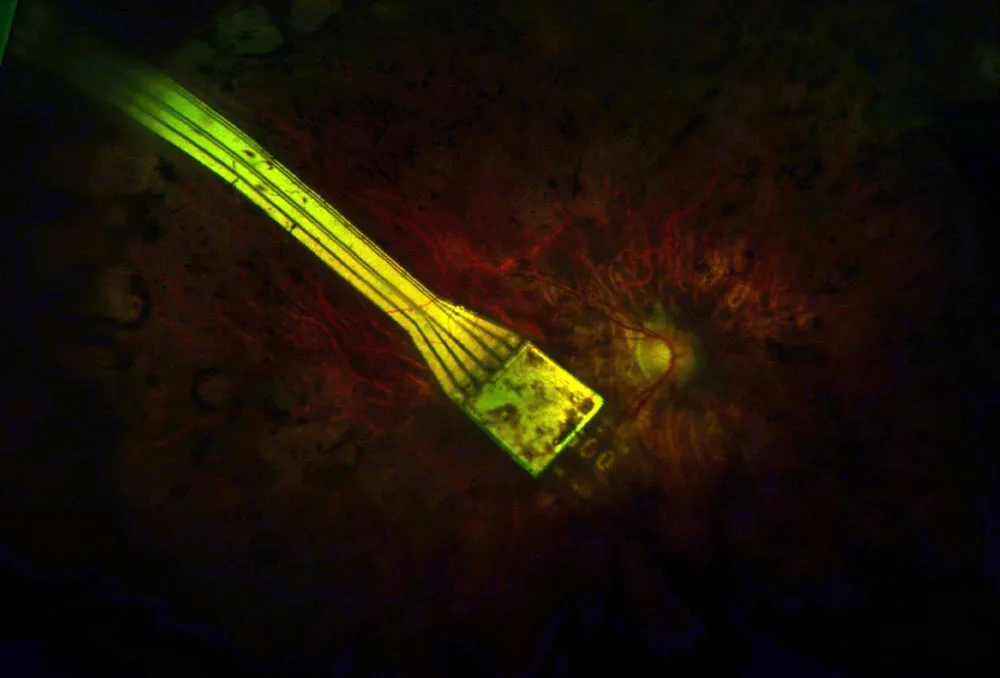
The implant is placed under the retina, the inner lining of the eye. The device essentially replaces degenerated light-sensitive rod and cone cells of patients suffering from diseases such as retinitis pigmentosa, a group of inherited diseases that afflict 1 in 4,000 people across the world.
Invisible implant

A wire trails from inside the eye to its edge and then under the skin to a point behind the ear (shown here in this X-ray image), where patients can place a control box to wirelessly supply power. Patients can also use the control box to adjust the brightness and contrast of images.

Tiny package

Despite its tiny size, the microchip is loaded with 1,500 light detectors, which transmit electrical impulses through a patient's nerves to generate a colorless 1,500-pixel image. In contrast, other visual implants provide images with significantly less than 100 pixels.
Testing success

In the latest human clinical trial with these chips, nine German patients were tested in the laboratory as well as outdoors and at home during a three-to-nine month period. The device restored functional vision for most of the patients — for instance, eight could perceive light, seven could tell where light was coming from, and five could detect motion.
Gaining sight

The success of this latest clinical trial is largely due to how the researchers now know to place the implant under the fovea, a spot near the center of the retina that is responsible for the center of the field of vision.
Eye implant

Another image showing the retinal eye implant.
