













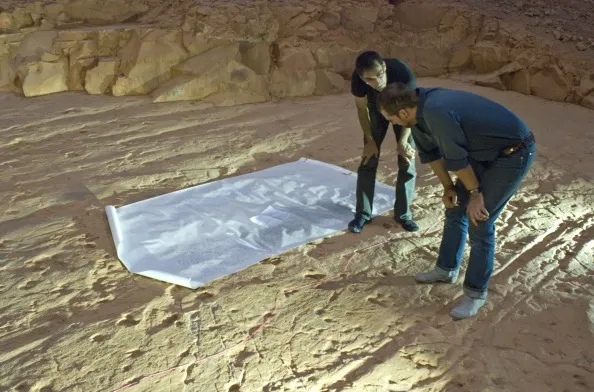
Fossilized track marks from a stampede of dinosaurs in Australia actually may have come from swimming animals, new research suggests.
The finding, published in the January issue of the Journal of Vertebrate Paleontology, upends the traditional interpretation of the world's only dinosaur stampede.
Instead of a group of small dinosaurs trying to escape a massive carnivore, the fossils may reveal an ancient dinosaur "superhighway" or river crossing, said study co-author Anthony Romilio, a paleontologist at the University of Queensland in Australia.
Dinosaur tracks
Some 3,000 to 4,000 fossilized dinosaur footprints were formed about 95 million years ago in a sandy riverbank in what was once a lush, coniferous forest. The site, known as Lark Quarry, is only about the size of a basketball court, and has become an enclosed and air-conditioned museum — a major tourist attraction in Australia.

The tracks came from several types of dinosaurs, ranging in size from a chicken to an emu with one oddball: a giant dinosaur that left its 23.6-inch-long (60 centimeters) footprints there.
In 1984, scientists Tony Thulborn and Mary Wade interpreted the tracks as evidence of a stampede of smaller dinosaurs escaping the clutches of a 4-ton theropod, a bipedal carnivore. [Paleo Art: Stunning Illustrations of Dinosaurs]
Get the world’s most fascinating discoveries delivered straight to your inbox.
But in recent work, Romilio and his colleagues studied the large track marks and concluded the primeval creature was actually a large plant-eating dinosaur called Muttaburrasaurus. That suggested the "fleeing a predator" theory needed a rethink.
Superhighway swimmers
Rather than just analyzing two-dimensional outlines of the tracks, Romilio used three-dimensional computer modeling. [See 3D animation of tracks]
Tracks originally thought to come from a long-toed dinosaur showed deep indentations, as if a short-toed dinosaur had dug its toes into the muddy river bottom.
"The animals were going on tippy-toes, kind of like a prima ballerina would dance across the stage," Romilio told LiveScience.

The site also has traces of dragged vegetation, consistent with a fast-flowing river, he said.
Based on their tracks, the swimming animals were moving downstream with the current. The tracks from similar dinosaurs also revealed that the water level changed dramatically, from as much as 15.7 inches to 6 inches (40 cm to 15 cm) high, he said.
The findings suggest that large groups of dinosaurs used this route over several days while migrating, he said.
"It must have been quite the highway for these very small dinosaurs," Romilio said.
Still a stampede
A scientist not involved in the study said the new findings are convincing but don't change the view that the fossils are from a stampede. It just happened to occur in water, said Paul Willis, a vertebrate paleontologist from the Royal Institution of Australia. It may have been a massive stampede like those of wildebeests in the Serengeti, Willis said.
"There are certainly some footprints there that I've seen that are consistent with a small dinosaur that is swimming and it can't quite touch the bottom with its toes, but it still looks like we are talking about a significant group of dinosaurs all moving together as one mob."
Follow LiveScience on Twitter @livescience. We're also on Facebook & Google+.

Tia is the editor-in-chief (premium) and was formerly managing editor and senior writer for Live Science. Her work has appeared in Scientific American, Wired.com, Science News and other outlets. She holds a master's degree in bioengineering from the University of Washington, a graduate certificate in science writing from UC Santa Cruz and a bachelor's degree in mechanical engineering from the University of Texas at Austin. Tia was part of a team at the Milwaukee Journal Sentinel that published the Empty Cradles series on preterm births, which won multiple awards, including the 2012 Casey Medal for Meritorious Journalism.