














Teensy Newfound Frog Is Smallest Known Vertebrate

The tropical forest in Papua New Guinea is a noisy place at night, filled with the calls from all sorts of living things: frogs, birds and insects, including especially loud cicadas. One particular call — a high-pitched, cricketlike "tink-tink-tink" — caught the attention of herpetologist Christopher Austin and his graduate student Eric Rittmeyer.
Together, they tried to locate the noisemaker, which they assumed was an insect. Four times, they attempted to hone in on the source of the calls, but each time they failed to find the creature in leaf litter on the forest floor. On the fifth try, they grabbed the dead leaves and dropped them in a clear plastic bag. Then, back at camp, they went through and began checking each of the hundreds of leaves they had picked up.
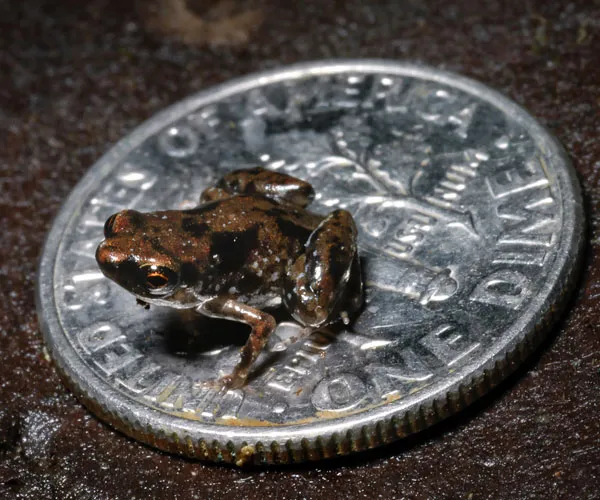
A tiny animal hopped off one of the leaves. This miniature frog, now dubbed Paedophryne amanuensis, has taken over the title of smallest vertebrate, an animal with a backbone. Though they discovered the frog in 2009, only now have they described their finding in a scientific journal. [40 Freaky Frog Photos]
The previous record holder was an acidic swamp-dwelling fish from Indonesia called Paedocypris progenetica. But with an average length of 0.3 inches (7.7 millimeters) from nose to butt, the tiny frog now holds the title. It is so small, that end to end, more than two would fit on a dime.
"We don't really know what they eat, we know very little about their ecology," said Austin, who is an associate curator of herpetology in the Museum of Natural Science at Louisiana State University. "They are probably eating very, very small invertebrates that occupy the leaf litter, like mites."
The tiny frog is a member of a group of related frogs, technically known as a genus, containing other miniatures, including another newly identified species (Paedophryne swiftorum), which is also described online today (Jan. 11) in the journal PLoS ONE.
P. swiftorum is a little bigger than the new record holder, and was discovered a year earlier elsewhere in Papua New Guinea.
Get the world’s most fascinating discoveries delivered straight to your inbox.
By looking at genetic data from these and other miniature frogs from other groups, the team concludes that miniaturization has evolved independently at least 11 times.
"It isn't this one-off oddity," Austin said. "It's actually a more generalized phenomenon that we see across all frogs."
Almost all other diminutive frogs that measure no more than 0.5 inches (13 millimeters), from around the world, occupy a similar habitat, hidden in the perennially moist leaves on tropical forest floors.
This wet habitat solves a potentially fatal problem for the frogs. Small size comes with a high surface-area-to-volume ratio, and this increases the risk of drying out, which would kill the frogs.
The other species of mini frogs likely also eat small invertebrates also living in the leaf litter, according to Austin.
You can follow LiveScience senior writer Wynne Parry on Twitter @Wynne_Parry. Follow LiveScience for the latest in science news and discoveries on Twitter @livescience and on Facebook.
