













Coal-Black Alien Planet Is Darkest Ever Seen

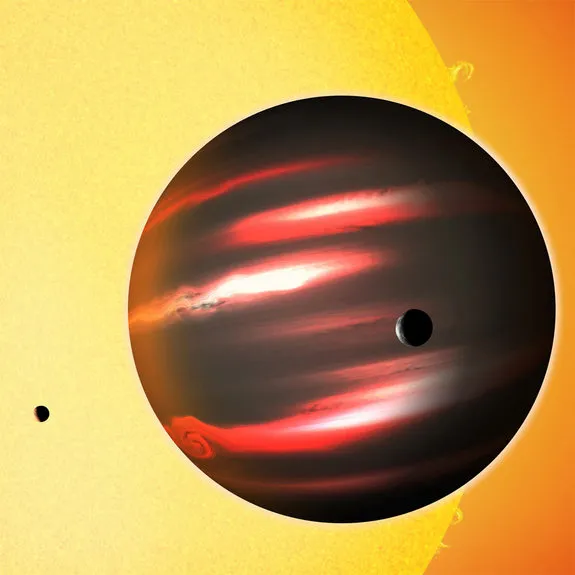
An alien world blacker than coal, the darkest planet known, has been discovered in the galaxy.
The world in question is a giant the size of Jupiter known as TrES-2b. NASA's Kepler spacecraft detected it lurking around the yellow sun-like star GSC 03549-02811 some 750 light years away in the direction of the constellation Draco.
The researchers found this gas giant reflects less than 1 percent of the sunlight falling on it, making it darker than any planet or moon seen up to now. [The Strangest Alien Planets]
"It's just ridiculous how dark this planet is, how alien it is compared to anything we have in our solar system," study lead-author David Kipping, an astronomer at the Harvard-Smithsonian Center for Astrophysics, told SPACE.com. "It's darker than the blackest lump of coal, than dark acrylic paint you might paint with. It's bizarre how this huge planet became so absorbent of all the light that hits it."
Whereas Jupiter has clouds streaking it white and red, reflecting more than a third of the sunlight reaching it, TrES-2b apparently lacks reflective clouds, super-heated as its atmosphere is to more than 1,800 degrees Fahrenheit (980 degrees Celsius) by a star just 3.1 million miles (5 million kilometers) away from it.
"However, it's not completely pitch black," co-author David Spiegel of Princeton University said in a statement. "It's so hot that it emits a faint red glow, much like a burning ember or the coils on an electric stove."
The researchers propose that light-absorbing chemicals such as vaporized sodium and potassium or gaseous titanium oxide in the planet's atmosphere could help explain why it is so dark. Still, none of these can fully explain why the world is as stealthily cloaked as it is.
Get the world’s most fascinating discoveries delivered straight to your inbox.
"It's a mystery as to what's causing it to be so dark," Kipping said. "There's a good chance it's a chemical we haven't even thought of yet."
The astronomers think TrES-2b is tidally locked like our moon, such that one side of the planet always faces the star. This would lead it to change phases as it orbits its star just as our moon waxes and wanes from new to crescent to full, causing the total brightness of the star plus the planet to vary slightly over time.
"By combining the impressive precision from Kepler with observations of over 50 orbits, we detected the smallest-ever change in brightness from an exoplanet — just 6 parts per million," said Kipping. "In other words, Kepler was able to directly detect visible light coming from the planet itself."
These extremely small fluctuations in light proved that TrES-2b is incredibly dark. A more reflective world would have shown larger brightness variations as its phase changed.
Although TrES-2b currently is the darkest known planet, similar worlds around other stars undoubtedly await discovery, the researchers said. For now, it reinforces the idea that our solar system may not be as typical as we once thought, with an extraordinary variety of worlds potentially filling our galaxy.
Additional investigation of the more than 1,200 prospective worlds that Kepler has detected could turn up other unusually dark planets. The spacecraft, which launched in March 2009, is planned to run until at least November 2012.
"If Kepler gets an extended mission as we're hoping, it would be a huge boost to this kind of research," Kipping said.
Kipping and Spiegel detailed their findings in a study accepted for publication in the Monthly Notices of the Royal Astronomical Society.
This story was provided by SPACE.com, sister site to LiveScience.com. Follow SPACE.com for the latest in space science and exploration news on Twitter @Spacedotcom and on Facebook.
