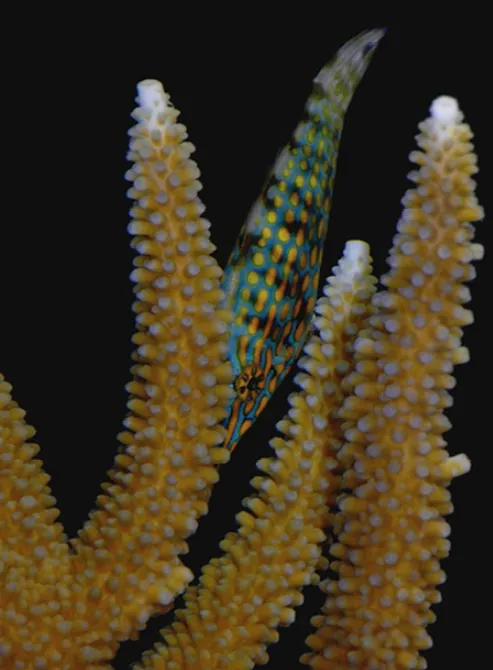
One coral-living fish has found an ingenious way to avoid being gobbled up during a nap, a new study finds. The harlequin filefish has evolved to have polka-dot markings that match its coral home. Just before a snooze, the fish slicks back its fins to make like a piece of reef.
The harlequin filefish uses a special hook-like spine on its back called the first dorsal spine to attach its body to a coral reef.
(Image credit: Brooker, et al., Coral Reefs, Sept. 2011)
The harlequin filefish, also called the orange spotted filefish or Oxymonacanthus longirostris, is a blue and yellow spotted fish that eats the same coral it calls home. The researchers, led by Rohan Brooker at James Cook University in Australia, observed 22 adult and 4 juvenile filefish in their habitats off of Lizard Island, Australia.
They described several adaptations the fish uses to fool its predators into thinking it's a piece of Acropora coral. Its coloration and polka-dot pattern match the pattern of polyps on the surface of the coral colonies, while the lighter coloring of the tip of its caudal fin mimics the coral's growing tip. [See photos of masquerading fish]
The fish uses a special hook-like spine on the back of its head, called the first dorsal spine, to attach its body to a coral reef. It attaches near the top of the coral, where they are relatively exposed. It slicks back its fins and settles in for a rest.
During its rest, if the fish is disturbed it will immediately return to its original position, as if it had never moved.
Called masquerading, in which an organism uses its coloration or shape to resemble an inedible object and fool predators, this mimic behavior is different from common camouflage. Most organisms try to evade predators with a camouflage called crypsis, where their coloration makes them indiscernible from the background, and they remain undetected by predators.
Other animals that masquerade include caterpillars that look like twigs and walking stick bugs. A study published in 2010 in the journal Science showed when a predator (in this case a baby chicken) comes across one of these masquerading creatures, it gets confused and takes longer to attack. The effect was extra strong when the chick was first presented with a real stick, then shown the stick-like catepillar below.
Sign up for the Live Science daily newsletter now
Get the world’s most fascinating discoveries delivered straight to your inbox.
Early thorn (Selenia dentaria) larva on hostplant (hawthorn-crataeous species). The caterpillar blends in with the branches around it, an example of masquerading camouflage.
(Image credit: Hannah Rowland)
The description of the filefish is detailed in the September 2011 issue of the journal Coral Reefs.
You can follow LiveScience staff writer Jennifer Welsh on Twitter @microbelover. Follow LiveScience for the latest in science news and discoveries on Twitter @livescience and on Facebook.
Jennifer Welsh is a Connecticut-based science writer and editor and a regular contributor to Live Science. She also has several years of bench work in cancer research and anti-viral drug discovery under her belt. She has previously written for Science News, VerywellHealth, The Scientist, Discover Magazine, WIRED Science, and Business Insider.