
-
 How many planets are in the universe?
We currently know of more than 5,800 planets beyond the solar system, but we've only found the tiniest fraction of the exoplanets that astronomers think lie elsewhere in the universe.
space -
 'We had less than a 2% chance to find this': James Webb telescope uncovers baffling 'Big Wheel', one of the most massive galaxies in the early universe
Astronomers using the James Webb Space Telescope have discovered an object they've dubbed 'Big Wheel,' a gargantuan galaxy spinning through the early universe and growing larger by the second.
9 Commentscosmology -
 First data from Euclid space telescope reveals 26 million galaxies — and another 1.4 billion are on the way
The Euclid space telescope has spotted 26 million galaxies in just one week of observations.
space -
 Supercomputer runs largest and most complicated simulation of the universe ever
Frontier, the second fastest supercomputer in the world, used dark matter and the movement of gas and plasma rather than just gravity to model the observable universe.
6 Commentscomputing -
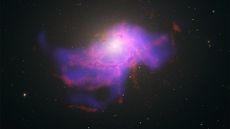 Astronomers catch black holes 'cooking' their own meals in bizarre, endless feeding cycle
Black holes can actively regulate the material they consume, using powerful jets of gas blasted into space, according to a new study. It suggests many such cosmic beasts effectively "cook" their own meals.
black-holes -
 What is the universe expanding into if it's already infinite?
The universe is constantly expanding, but how do scientists think about what it's expanding into?
cosmology -
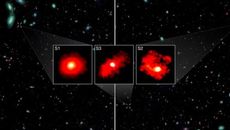 James Webb Space Telescope discovers mysterious 'red monster' galaxies so large they shouldn't exist
The James Webb telescope has spotted three gigantic "red monster" galaxies that were spawned soon after the Big Bang. They're so large they could rewrite the laws of galactic evolution.
space -
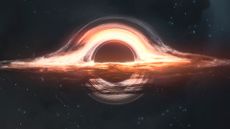 Black holes could be driving the expansion of the universe, new study suggests
An artist's rendering of a black hole
black-holes -
 The universe may end in a 'Big Freeze,' holographic model of the universe suggests
New research suggests holographic dark energy could stop the universe's expansion.
cosmology


