Get the world’s most fascinating discoveries delivered straight to your inbox.
You are now subscribed
Your newsletter sign-up was successful
Want to add more newsletters?
Join the club
Get full access to premium articles, exclusive features and a growing list of member rewards.
An account already exists for this email address, please log in.
'We had less than a 2% chance to find this': James Webb telescope uncovers baffling 'Big Wheel', one of the most massive galaxies in the early universe
Astronomers using the James Webb Space Telescope have discovered an object they've dubbed 'Big Wheel,' a gargantuan galaxy spinning through the early universe and growing larger by the second.
Deep observations from the James Webb Space Telescope (JWST) have revealed an exceptionally large galaxy in the early universe. It's a cosmic giant whose light has travelled over 12 billion years to reach us. We've dubbed it the Big Wheel, with our findings published March 17 in Nature Astronomy.
This giant disk galaxy existed within the first two billion years after the Big Bang, meaning it formed when the universe was just 15% of its current age. It challenges what we know about how galaxies form.
What is a disk galaxy?
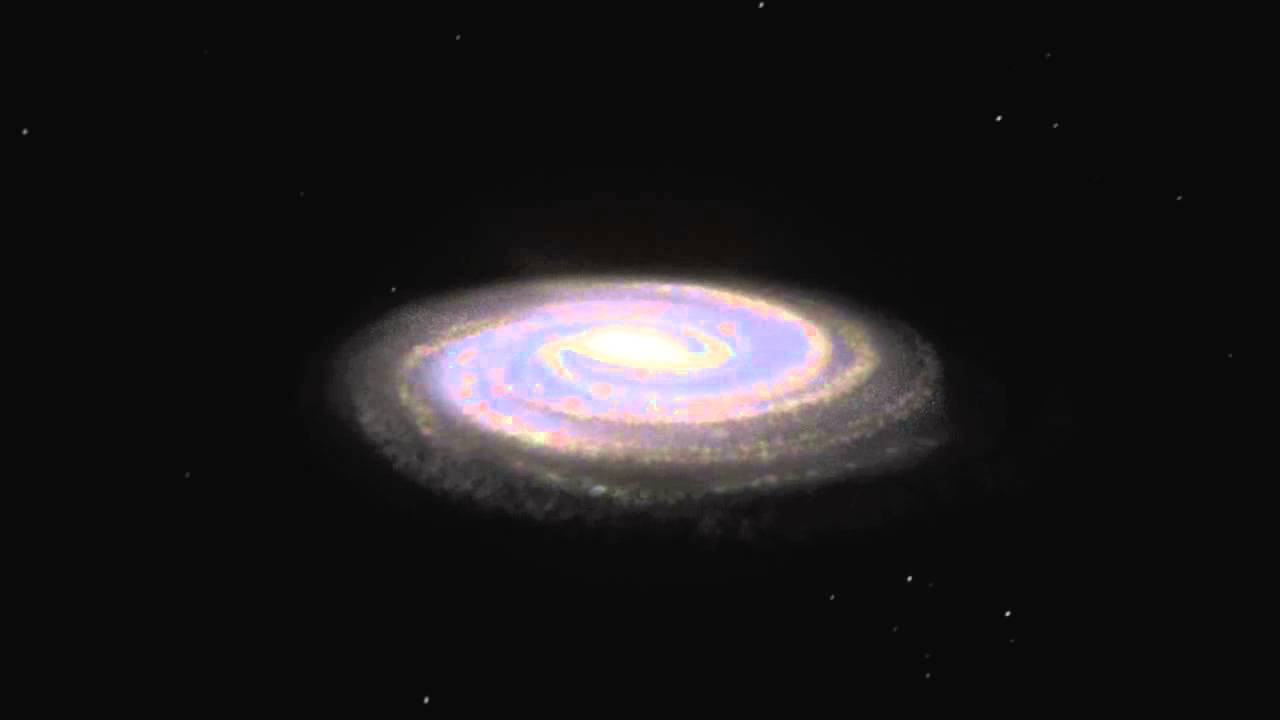
Picture a galaxy like our own Milky Way: a flat, rotating structure made up of stars, gas and dust, often surrounded by an extensive halo of unseen dark matter.
Disk galaxies typically have clear spiral arms extending outward from a dense central region. Our Milky Way itself is a disk galaxy, characterized by beautiful spiral arms that wrap around its center.
Studying disk galaxies, like the Milky Way and the newly discovered Big Wheel, helps us uncover how galaxies form, grow and evolve across billions of years.
These studies are especially significant, as understanding galaxies similar to our own can provide deeper insights into the cosmic history of our galactic home.
Get the world’s most fascinating discoveries delivered straight to your inbox.
A giant surprise
We previously thought galaxy disks form gradually over a long period: either through gas smoothly flowing into galaxies from surrounding space, or by merging with smaller galaxies.
Usually, rapid mergers between galaxies would disrupt the delicate spiral structures, turning them into more chaotic shapes. However, the Big Wheel managed to quickly grow to a surprisingly large size without losing its distinctive spiral form. This challenges long-held ideas about the growth of giant galaxies.
Our detailed JWST observations show that the Big Wheel is comparable in size and rotational speed to the largest "super-spiral" galaxies in today's universe. It is three times as big in size as comparable galaxies at that epoch and is one of the most massive galaxies observed in the early cosmos.
In fact, its rotation speed places it among galaxies at the high end of what's called the Tully-Fisher relation, a well-known link between a galaxy's stellar mass and how fast it spins.
Remarkably, even though it's unusually large, the Big Wheel is actively growing at a rate similar to other galaxies at the same cosmic age.
The Big Wheel galaxy is seen at the center. In striking contrast, the bright blue galaxy (upper right) is only about 1.5 billion light years away, making the Big Wheel roughly 50 times farther away. Although both appear a similar size, the enormous distance of the Big Wheel reveals its truly colossal physical scale.
(Image credit: JWST)
Unusually crowded part of space
What makes this even more fascinating is the environment in which the Big Wheel formed.
It's located in an unusually crowded region of space, where galaxies are packed closely together, ten times denser than typical areas of the universe. This dense environment likely provided ideal conditions for the galaxy to grow quickly. It probably experienced mergers that were gentle enough to let the galaxy maintain its spiral disk shape.
Additionally, the gas flowing into the galaxy must have aligned well with its rotation, allowing the disk to grow quickly without being disrupted. So, a perfect combination.
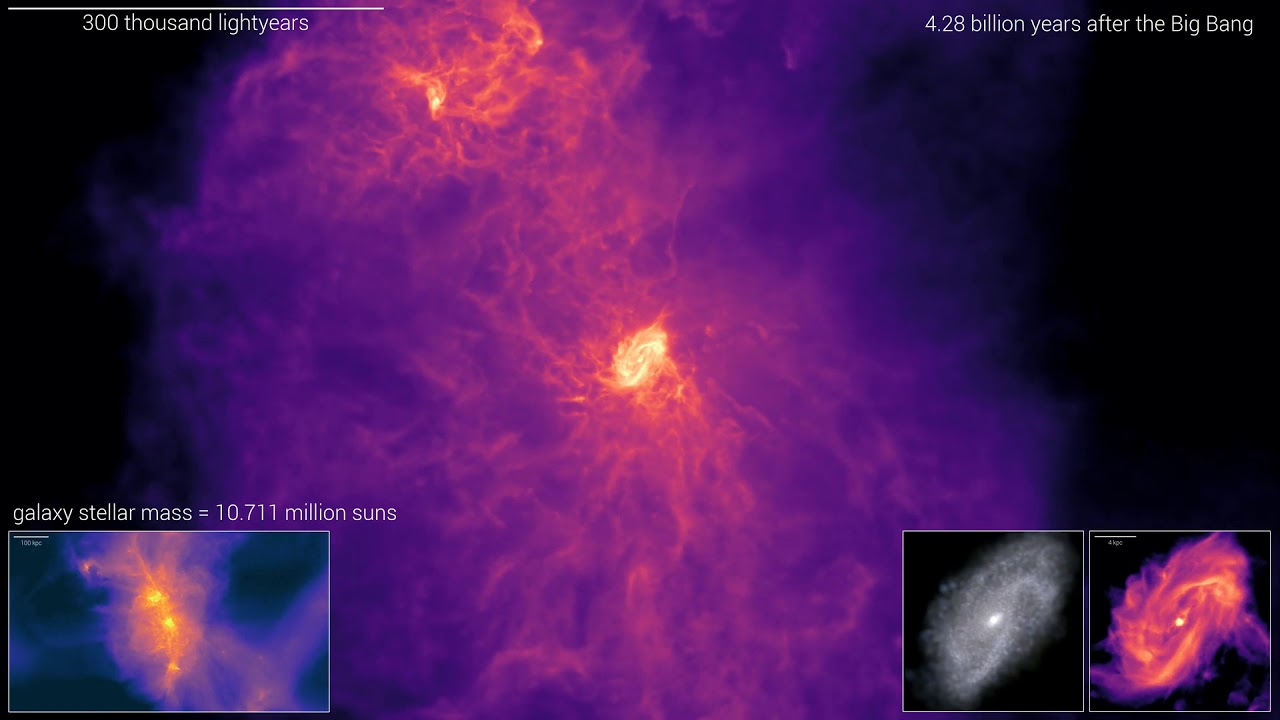
Formation of a single massive galaxy through time in the TNG50 cosmic simulation - YouTube
Discovering a galaxy like the Big Wheel was incredibly unlikely. We had less than a 2% chance to find this in our survey, according to current galaxy formation models.
So, our finding was fortunate, probably because we observed it within an exceptionally dense region, quite different from typical cosmic environments.
Besides its mysterious formation, the ultimate fate of the Big Wheel is another intriguing question. Given the dense environment, future mergers might significantly alter its structure, potentially transforming it into a galaxy comparable in mass to the largest ones observed in nearby clusters, such as Virgo.
The Big Wheel's discovery has revealed yet another mystery of the early universe, showing that our current models of galaxy evolution still need refinement.
With more observations and discoveries of massive, early galaxies like the Big Wheel, astronomers will be able to unlock more secrets about how the universe built the structures we see today.
Senior Scientist, JWST Australian Data Centre, Swinburne University of Technology
Themiya Nanayakkara is a senior scientist at the JWST Australian Data Centre. His role is to help Australian astronomers make the best use of the JWST, providing training and developing new techniques that make it easier for the scientific community to analyze JWST data effectively. His research focuses on understanding how the first stars and galaxies transformed the early universe.
You must confirm your public display name before commenting
Please logout and then login again, you will then be prompted to enter your display name.