
-
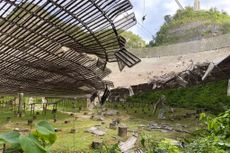 Collapsed Arecibo telescope offers near-Earth asteroid warning from beyond the grave
The famous Arecibo Observatory in Puerto Rico completely collapsed in 2020. Now, scientists going through its final observations offer a major new asteroid report.
asteroids -
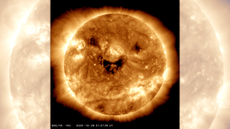 Adorable 'smiling' sun could batter Earth with geomagnetic storms this weekend
With three dark blotches popping up in the sun's atmosphere, our closest star seems to 'smile' even as it pelts our planet with charged-up solar wind.
the-sun -
 UFOs are finally getting the big NASA study they deserve
Following years of increased government interest in unidentified aerial phenomena (UAPs), NASA has officially launched a nine-month investigation into uncovering their mysteries.
extraterrestrial-life -
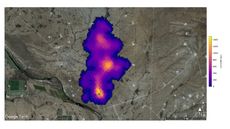 New map of methane 'super-emitters' shows some of the largest methane clouds ever seen
A NASA instrument designed to study dust has revealed that some of the largest methane clouds ever seen are floating over the US, Iran and elsewhere.
space -
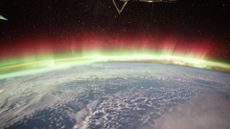 Massive 'proton aurora' blasted a 250-mile-wide hole in Earth's ozone layer
In June 2015, a little-known type of aurora cut a Grand-Canyon-size ozone hole in Earth's mesosphere. Scientists have finally assessed the damage.
space -
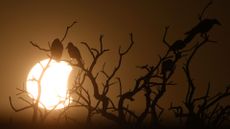 Stunning (and spooky) photos of the final solar eclipse of 2022
On Tuesday, Oct. 25, half the world saw the moon's shadow creep over the surface of the sun in the year's last partial solar eclipse.
space -
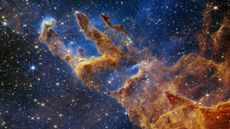 Stunning 'pillars of creation' shine like never before in new James Webb Telescope image
The towering pillars of creation, captured by the James Webb Telescope, are a nursery of newborn stars that’s been slowly destroying itself for millions of years.
space-exploration -
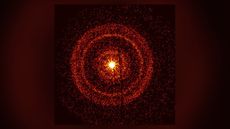 Gamma-ray burst may represent the most powerful cosmic explosion ever recorded
Astronomers stunned by 'brightest of all time' gamma-ray burst reckon it could be the most powerful space explosion since the Big Bang
astronomy -
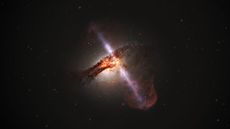 Energy jet traveling 7 times the speed of light appears to break the laws of physics
A jet of particles released by two colliding stars appears to be moving seven times faster than the speed of light — but astronomers blame a cosmic illusion known as superluminal motion.
astronomy


