
-
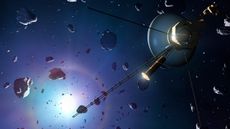 NASA supercomputer reveals strange spiral structure at the edge of our solar system
The mysterious Oort cloud is the source of many of our solar system's comets, but astronomers still have no idea what it looks like. Now, new simulations may have given them a first glimpse.
29 Commentsspace -
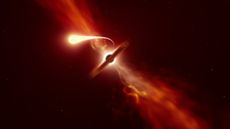 James Webb Space Telescope discovers mysterious flares near the Milky Way's monster black hole
Sagittarius A*, our galaxy's supermassive black hole, is constantly producing strange eruptions. Astronomers are using the James Webb Space Telescope to find out why.
2 Commentsblack-holes -
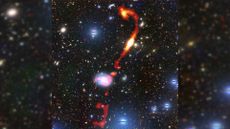 Scientists discover giant galaxy 32 times bigger than Earth's — and they named it 'trouble'
Scientists have discovered an enormous radio galaxy 32 times the size of the Milky Way. They nicknamed it "Inkathazo," or "trouble," as the team struggles to understand the physics behind it.
astronomy -
 Milky Way quiz: How well do you know our home galaxy?
Quiz Test your knowledge of the Milky Way's size, speed, age, galactic neighbors and more.
Quiz -
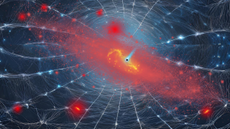 Supermassive black holes in 'little red dot' galaxies are 1,000 times larger than they should be, and astronomers don't know why
"Our measurements imply that the supermassive black hole mass is 10% of the stellar mass in the galaxies we studied."
black-holes -
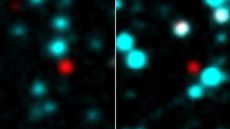 Mysterious 'ice balls' in space baffle astronomers
Astronomers have discovered two strange objects that could be young stars — except they're completely surrounded by ice.
space -
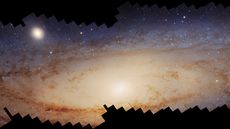 'Herculean' 2.5-billion-pixel mosaic shows our closest galactic neighbor like never before — and took more than a decade to create
The new composite image, which combines hundreds of photos from the Hubble Space Telescope, shows the Andromeda Galaxy with more than 200 million individually resolved stars.
cosmology -
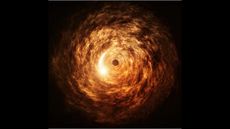 James Webb telescope captures 1st 'mid-infrared' flare from Milky Way's supermassive black hole
The James Webb Space Telescope has captured a mid-infrared picture of Sagittarius A*, filling in a long-standing gap in observations..
space -
 Most of the atoms in your body left the Milky Way on a 'cosmic conveyor belt' long before you were born, new study reveals
New research suggests that most of the atoms within the human body likely spent part of their lives drifting beyond the Milky Way on a cosmic "conveyor belt," before eventually returning to our galaxy.
cosmology


