













James Webb Space Telescope discovers mysterious flares near the Milky Way's monster black hole
Sagittarius A*, our galaxy's supermassive black hole, is constantly producing strange eruptions. Astronomers are using the James Webb Space Telescope to find out why.

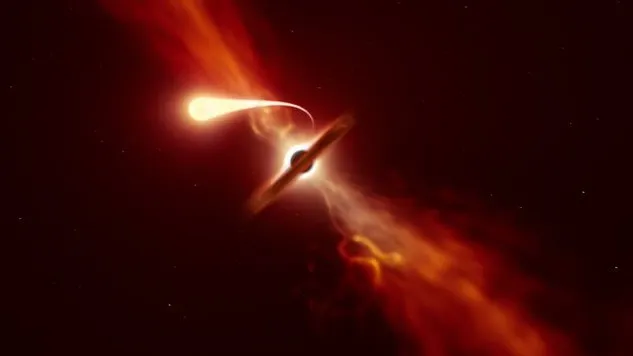
Astronomers have used the James Webb Space Telescope (JWST) to take the longest look yet at our galaxy's supermassive black hole — and it's frothing with unusual activity.
Situated 26,000 light-years away in the center of the Milky Way, Sagittarius A* is a gargantuan tear in space-time that is 4 million times the mass of the sun and 14.6 million miles (23.5 million kilometers) wide.
Now, new observations from JWST have revealed a constant stream of flares erupting from the gas swirling around the black hole's mouth. The new findings, published Feb. 18 in The Astrophysical Journal Letters, could help scientists better understand the chaotic nature of the cosmic monsters and how they sculpt their surroundings.
"Flares are expected to happen in essentially all supermassive black holes, but our black hole is unique," lead author Farhad Yusef-Zadeh, an astronomer at Northwestern University, said in an emailed statement. "It is always bubbling with activity and never seems to reach a steady state. We observed the black hole multiple times throughout 2023 and 2024, and we noticed changes in every observation. We saw something different each time, which is really remarkable. Nothing ever stayed the same."
Despite making up a scant 0.0003% of the Milky Way's mass, Sagittarius A* is a powerful engine that periodically sucks matter in before spitting it out at near light speed, creating a feedback process that has shaped our galaxy since its beginnings.
Related: What would happen if a black hole wandered into our solar system?
Scientists think the gigantic black hole started out much like others, born from the collapse of a giant star or gas cloud before gorging on anything that came too close. After swelling to monstrous scales, black holes can even feed on other supermassive black holes.
Get the world’s most fascinating discoveries delivered straight to your inbox.
To conduct the new research, the astronomers pointed JWST's Near Infrared Camera (NIRCam) at Sagittarius A* and observed the space-time rupture's accretion disk — the fast-moving ring of gas and dust wrapped around the black hole — for a total of 48 hours to track how it evolved over time.
During these observations, the astronomers discovered that the black hole was far more active than they assumed. It produced a fireworks display of five to six big flares per day, with several smaller flares erupting in between.
"In our data, we saw constantly changing, bubbling brightness," Yusef-Zadeh said. "And then boom! A big burst of brightness suddenly popped up. Then, it calmed down again. We couldn't find a pattern in this activity. It appears to be random. The activity profile of the black hole was new and exciting every time that we looked at it."
A cosmic fireworks display
RELATED STORIES
It's unclear what's driving the large and small flares. However, the astronomers suggested the eruptions could emerge from two separate processes. The smaller flickers could result from fluctuations that compress the swirling plasma in the black hole's accretion disk to release temporary bursts of radiation, the team proposed.
The larger eruptions, on the other hand, likely emerge from clashing magnetic-field lines within the disk, which release energy in the forms of particles that accelerate away from the disk at close to the speed of light.
By observing the flares at two different wavelengths (2.1 and 4.8 microns), the researchers also made another surprising discovery: that the flares dimmed faster at shorter wavelengths than at longer ones. They believe this could be because the particles in the flares could be losing energy at these higher wavelengths more quickly — a common feature for particles swirling around magnetic-field lines.
To further investigate these questions, the researchers hope to use JWST to observe Sagittarius A* for a longer, uninterrupted 24-hour period. This should reduce the overall noise in their data and help them map out other features in the vortex surrounding the black hole.
"When you are looking at such weak flaring events, you have to compete with noise," Yusef-Zadeh said. "If we can observe for 24 hours, then we can reduce the noise to see features that we were unable to see before. That would be amazing. We also can see if these flares show periodicity (or repeat themselves) or if they are truly random."

Ben Turner is a U.K. based writer and editor at Live Science. He covers physics and astronomy, tech and climate change. He graduated from University College London with a degree in particle physics before training as a journalist. When he's not writing, Ben enjoys reading literature, playing the guitar and embarrassing himself with chess.
You must confirm your public display name before commenting
Please logout and then login again, you will then be prompted to enter your display name.