
-
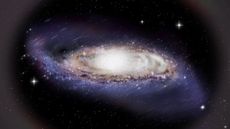 Astronomers measure 'warp speed' of Milky Way galaxy
The Milky Way is warped, possibly as the result of a collision with another galaxy billions of years ago. Studying this warp could reveal more about the structure of our galaxy's hidden matter.
astronomy -
 The Milky Way may be surrounded by 'too many' mini galaxies, new discoveries reveal
Astronomers have just discovered two dwarf galaxy candidates orbiting our galaxy. The orientation of these entities suggests there could be up to 500 similar stellar clusters circling the Milky Way, which is more than double previous estimates.
astronomy -
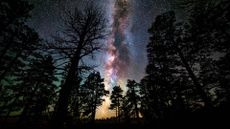 The Milky Way will be visible without a telescope this summer. Here are the key nights to watch for.
Summer is the best time to see the Milky Way in the Northern Hemisphere without a telescope. The key is to find clear, dark skies on moonless nights.
astronomy -
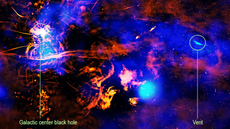 Milky Way's black hole 'exhaust vent' discovered in eerie X-ray observations
A gargantuan "exhaust vent" may be channeling hot gas away from the Milky Way's supermassive black hole at millions of miles per hour — and filling up two enormous bubbles that tower over the galaxy.
black-holes -
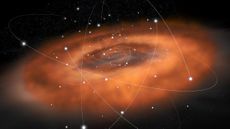 'Immortal' stars at the Milky Way's center may have found an endless energy source, study suggests
Strange stars clustered near the Milky Way's center are much younger than theory predicts is possible. New research suggests their youth could actually be eternal — and fueled by annihilating dark matter.
cosmology -
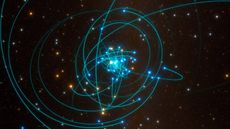 Baby stars that defy explanation are 'swarming like bees' around Milky Way's supermassive black hole
A new analysis of inexplicably young stars orbiting extremely close to the Milky Way's black hole heart reveals that they orbit around the gigantic structure in a surprisingly organized way, similar to swarming insects like bees.
astronomy -
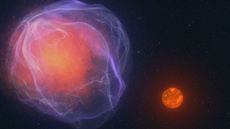 Something 'kicked' this hypervelocity star racing through the Milky Way at 1.3 million miles per hour
A low-mass star has been discovered racing through the Milky Way at over a million miles per hour, a journey that began with either the supernova explosion of a vampire star or an encounter with black holes.
astronomy -
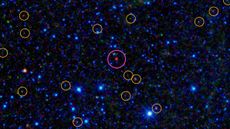 7 potential 'alien megastructures' spotted in our galaxy are not what they seem
Scientists recently identified seven stars in the Milky Way that could potentially be gigantic alien structures called Dyson spheres. New research proposes an alternative explanation: Those are just cosmic "hot DOGs" in disguise.
extraterrestrial-life -
 How many stars in the Milky Way die each year?
Stars die at different rates depending on how they kick the bucket.
astronomy


