
-
 Scientists discover 2 stars dancing around the Milky Way's black hole — and they could point to a type of planet never seen before
Astronomers have discovered a pair of young stars near the supermassive black hole at the heart of our galaxy. Studying them can offer a rare glimpse into how stars can endure — at least briefly — the immense gravity exerted by such cosmic behemoths.
black-holes -
 James Webb telescope spies stunning 'Firefly Sparkle' galaxy — a baby clone of the Milky Way being 'assembled brick by brick' in the early universe
The James Webb Space Telescope has captured an image of a baby, Milky Way-like galaxy that formed more than 13 billion years ago. This "Firefly Sparkle" galaxy could reveal how our own galaxy evolved.
cosmology -
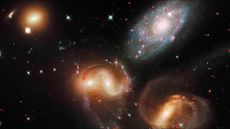 Astronomers spot 1 of the most powerful 'sonic booms' in the universe as massive galaxy crashes into its neighbors
A shockwave caused by the galaxy NGC 7318b slamming into four other galaxies is akin to a "sonic boom from a jet fighter." Astronomers hope the event will reveal vital secrets about the often-violent evolution of our universe.
space -
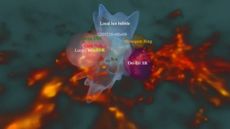 3D map reveals our solar system's local bubble has an 'escape tunnel'
A 3D map of our cosmic neighborhood has revealed hot and cold regions as well as an "escape tunnel" from our local bubble.
astronomy -
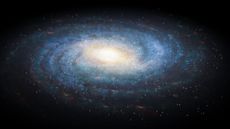 How many galaxies orbit the Milky Way?
The number of known galaxies circling the Milky Way is increasing as we develop new powerful telescopes.
space -
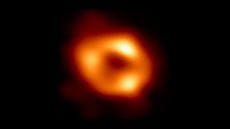 1st image of Milky Way's 'black hole heart' has errors, study claims
The image of Sagittarius A*, the black hole at the heart of the Milky Way, captured by the Event Horizon Telescope.
black-holes -
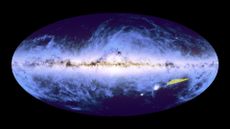 Euclid telescope reveals 1st section of largest-ever 3D map of the universe — and there's still 99% to go
The first piece of the Euclid space telescope's map of the universe is crammed with 14 million galaxies and 100 million sources of light. The mapping project is now 1% done.
cosmology -
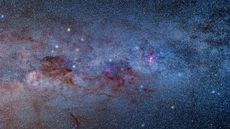 The Milky Way could be part of a much larger 'cosmic neighborhood' than we realized, challenging our understanding of the universe
A probabilistic new map of the universe surrounding the Milky Way reveals that our galaxy is likely part of an even larger "basin of attraction" than we previously assumed.
cosmology -
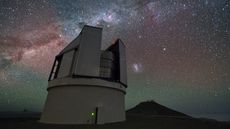 'We have changed the view of our galaxy forever': Astronomers capture most detailed ever infrared map of the Milky Way
Astronomers at the European Southern Observatory have released the largest infrared map of the Milky Way ever. The enormous dataset contains millions of new objects, and the researchers expect to scour it for discoveries for years to come.
astronomy


