Get the world’s most fascinating discoveries delivered straight to your inbox.
You are now subscribed
Your newsletter sign-up was successful
Want to add more newsletters?
Join the club
Get full access to premium articles, exclusive features and a growing list of member rewards.
An account already exists for this email address, please log in.
James Webb Telescope goes 'extreme' and spots baby stars at the edge of the Milky Way (image)
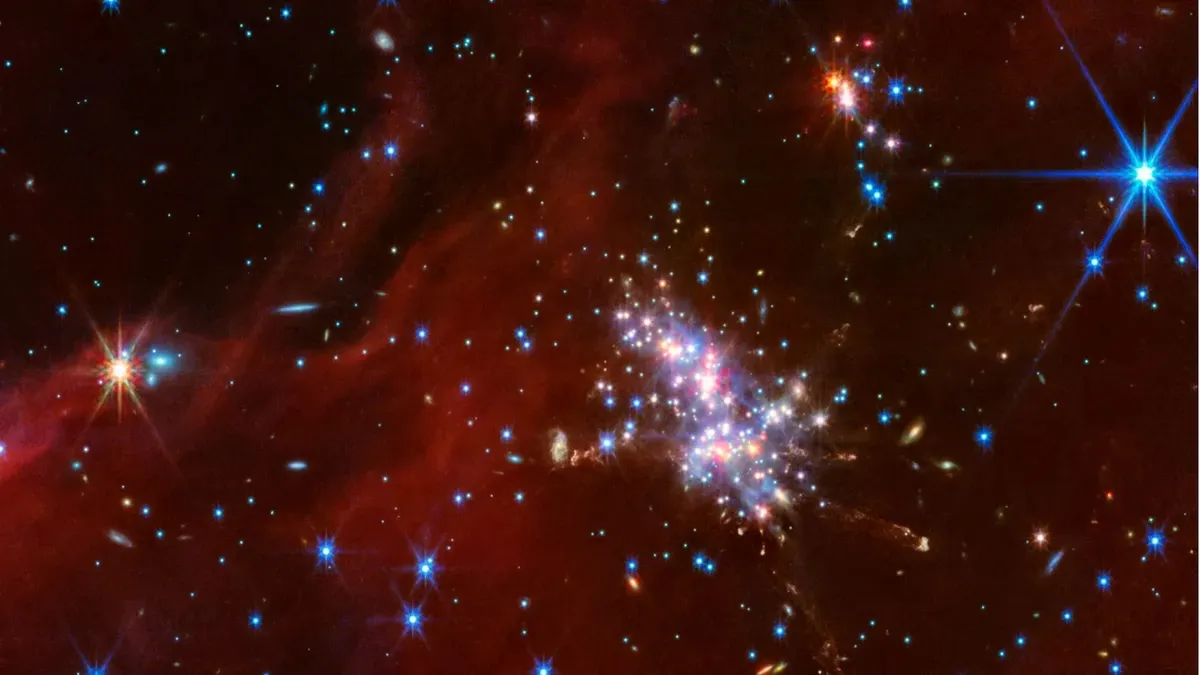
The James Webb Space Telescope has taken things to the extreme, studying the outer edge of our own galaxy, the Milky Way and producing a stunning new image.
Extreme Outer Galaxy in near- and mid-infrared light. Bright blue stars seen within this star-forming region, known as Digel Cloud 2S as seen by the JWST
(Image credit: NASA, ESA, CSA, STScI, M. Ressler (JPL))
The James Webb Space Telescope (JWST) has been no stranger to taking things to the extreme since its launch on Christmas day 2021, observing early galaxies billions of light-years away that existed when the universe was at a fraction of its currently 13.8 billion-year life.
Now, the powerful space telescope has pushed it to the edge closer to home in our very own galaxy, the Milky Way. A team of astronomers has pointed the JWSTat the outskirts of the Milky Way, observing a region scientists call the "Extreme Outer Galaxy."
This area is about 58,000 light-years from the heart of the Milky Way, or "Galactic Center." For comparison, the solar system is located just under halfway between the Galactic Center and the very edge of the Milky Way. That distance is just 26,000 light-years, so when we say "extreme edge" for these new observations, that's more than hyperbole! The result of this galactic envelope-pushing exercise is a stunning image of star clusters in the midst of a "starburst" and an intense period of rapid star birth.
"In the past, we knew about these star-forming regions but were not able to delve into their properties," steam leader Natsuko Izumi of Gifu University and the National Astronomical Observatory of Japan said in a statement. "The JWST data builds upon what we have incrementally gathered over the years from prior observations with different telescopes and observatories. We can get very powerful and impressive images of these clouds with the JWST."
The Milky Way star birthing regions seen by the team using the JWST's Near-Infrared Camera (NIRCam) and Mid-Infrared Instrument (MIRI) are enveloped within dense and vast conglomerations of gas called "molecular clouds." The two molecular clouds in question are designated Digel Cloud 1 and Digel Cloud 2, which are many light-years long and are now imaged in unprecedented detail.
(Image credit: NASA, ESA, CSA, STScI, M. Ressler (JPL))
Among the elements of these clusters visible in the images are extremely young protostars. These are stellar bodies that haven't yet gathered enough material from the prenatal cocoons of gas and dust to pile on mass to trigger the nuclear fusion of hydrogen to helium in their cores, the process that defines what an adult or "main sequence" star is.
As any parent who has ended up with baby food in their hair will tell you, all infants are prone to tantrums, and these protostars are no different. But these ejections aren't Gerber strawberry and banana puree (tasty and great for the hair); they are jets and outflows of superheated gas called "plasma." Evidence of these stellar tantrums is also visible in the new JWST image.
Sign up for the Live Science daily newsletter now
Get the world’s most fascinating discoveries delivered straight to your inbox.
"In the case of Digel Cloud 2, I did not expect to see such active star formation and spectacular jets," Izumi added.
Digel Cloud 2S as seen by the JWST with white arrows indicating the direction of outflows
(Image credit: NASA, ESA, CSA, STScI, M. Ressler (JPL))
The Digel Clouds have a slightly different composition than other regions of the Milky Way. They lack elements heavier than hydrogen and helium, which astronomers somewhat confusingly call "metals."
This metal-poor nature makes the Digel Clouds a good proxy for studying dwarf galaxies and for understanding the Milky Way's earlier history before dying stars increased its metal concentration. This team looked for activity in four young star clusters within Digel Clouds 1 and 2, designated 1A, 1B, 2N, and 2S, respectively.
In 2S the astronomers observed a dense and active region of young stars emitting long jets of material from their poles. The team was also able to distinguish the presence of a "sub-cluster" of stars in 2S.
"We know from studying other nearby star-forming regions that as stars form during their early life phase, they start emitting jets of material at their poles," said Mike Ressler of NASA's Jet Propulsion Laboratory in Southern California, study team member and principal investigator of the observing program.
"What was fascinating and astounding to me from the JWST data is that there are multiple jets shooting out in all different directions from this cluster of stars. It's a little bit like a firecracker, where you see things shooting this way and that."
This is just the beginning of the team's study of the Digel Clouds and the Extreme Outer Galaxy with the JWST. They will continue to push to the limit of the Milky Way to solve puzzles such as the relative abundance of stars of various masses within Extreme Outer Galaxy star clusters.
This could help scientists to better understand how different environments influence the formation of different star types.
"I'm interested in continuing to study how star formation is occurring in these regions. By combining data from different observatories and telescopes, we can examine each stage in the evolution process," Izumi concluded. "We also plan to investigate circumstellar disks within the Extreme Outer Galaxy. We still don't know why their lifetimes are shorter than in star-forming regions much closer to us. And, of course, I'd like to understand the kinematics of the jets we detected in Cloud 2S."
Robert Lea is a science journalist in the U.K. who specializes in science, space, physics, astronomy, astrophysics, cosmology, quantum mechanics and technology. Rob's articles have been published in Physics World, New Scientist, Astronomy Magazine, All About Space and ZME Science. He also writes about science communication for Elsevier and the European Journal of Physics. Rob holds a bachelor of science degree in physics and astronomy from the U.K.’s Open University