













Monster black hole is starving its host galaxy to death, James Webb telescope reveals
New observations with JWST have confirmed that supermassive black holes have the power to quench star formation across their surrounding galaxies.

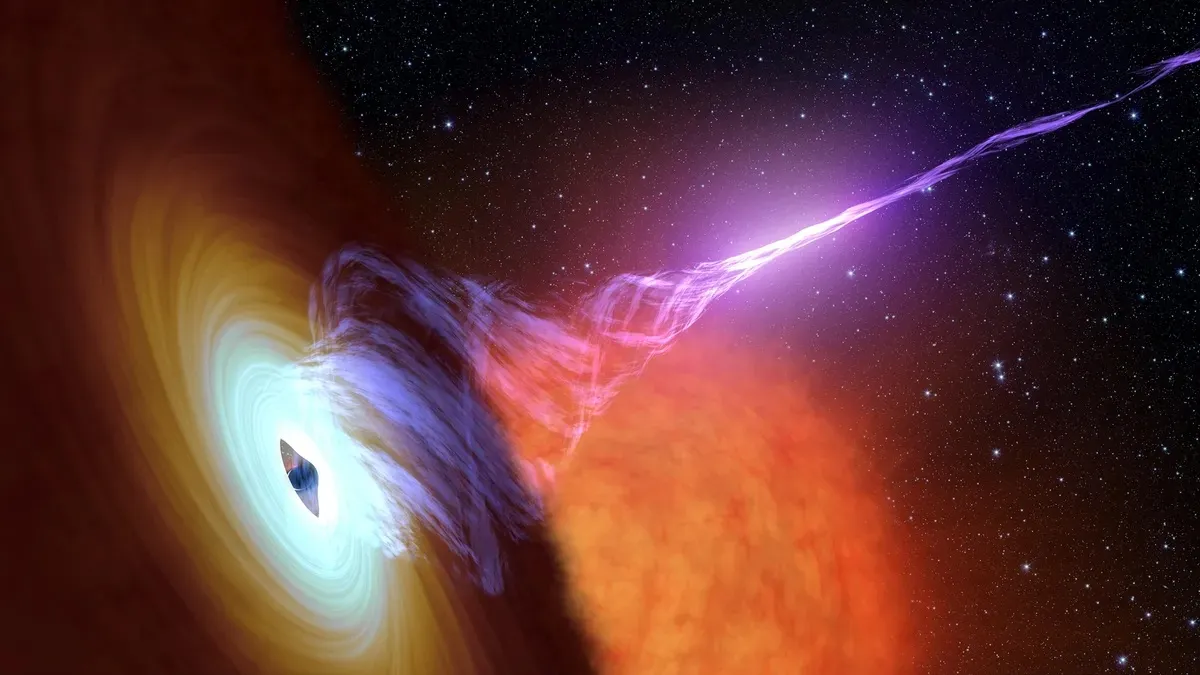
The James Webb Space Telescope (JWST) has spotted a gigantic black hole "starving" its host galaxy to death, astronomers say.
The supermassive black hole — located nearly 12 billion light-years away, at the center of GS-10578, or "Pablo's Galaxy" — is 200 billion times the mass of the sun.
Previous observations revealed that the black hole's host galaxy is "dead" — meaning it has stopped forming new stars — but previous telescopes lacked the accuracy to find the exact cause of this.
Now, the JWST has solved the case: Pablo's galaxy is being suffocated by its own giant black hole, which is ejecting gas from the galaxy before it has time to make new stars. The researchers published their findings Sept. 16 in the journal Nature Astronomy.
"We found the culprit," study co-lead author Francesco D'Eugenio, an astrophysicist at the University of Cambridge, said in a statement. "The black hole is killing this galaxy and keeping it dormant, by cutting off the source of 'food' the galaxy needs to form new stars."
Supermassive black holes typically sit in the centers of galaxies, periodically sucking in matter from their surroundings before spitting it out at near light speed, creating a feedback process that shapes how galaxies evolve.
Get the world’s most fascinating discoveries delivered straight to your inbox.
But exactly how the powerful cosmic engines affect the galaxies around them remains mostly unexplored.
"Based on earlier observations, we knew this galaxy was in a quenched state: it's not forming many stars given its size, and we expect there is a link between the black hole and the end of star formation," D'Eugenio said. "However, until Webb, we haven't been able to study this galaxy in enough detail to confirm that link, and we haven't known whether this quenched state is temporary or permanent."
To sleuth out the answer to the galactic murder mystery, the researchers pointed JWST at the ancient galaxy. Among the outflows of hot gas being spit out from the black hole, the telescope spotted a colder, denser and nonluminous stream of gas that was blocking the light from a galaxy behind it. The mass of this ejected gas is greater than the mass needed to form new stars.
RELATED STORIES
This observation confirms theoretical models that suggested black holes could quench their own galaxies, and contradicts others that predicted that the end of star formation has a violent, wrenching effect on galaxies.
"We knew that black holes have a massive impact on galaxies, and perhaps it's common that they stop star formation, but until Webb, we weren't able to directly confirm this," study co-author Roberto Maiolino, a professor of experimental astrophysics at Cambridge, said in the statement. "It's yet another way that Webb is such a giant leap forward in terms of our ability to study the early universe and how it evolved."
Now that the galaxy-killer has been identified, the researchers will wait for new observations taken by the Atacama Large Millimeter/submillimeter Array in Chile, which should help them find any stray pockets of star-forming gas and identify the effects of the black hole's activity on the surrounding region.

Ben Turner is a U.K. based writer and editor at Live Science. He covers physics and astronomy, tech and climate change. He graduated from University College London with a degree in particle physics before training as a journalist. When he's not writing, Ben enjoys reading literature, playing the guitar and embarrassing himself with chess.