
-
 Groundbreaking atomic clock is off by less than 1 second every 100 million years
The National Institute of Standards and Technology's new cesium fountain clock is one of the most precise atomic clocks ever created.
physics-mathematics -
 Physicists spot elusive 'free-range' atoms ineracting in space for first time ever
Physicists have used a novel technique to observe individual atoms interacting in free space for the first time ever. The new technique confirms a century-old quantum mechanical theory.
6 Commentsquantum-physics -
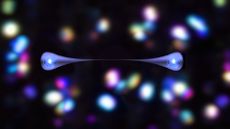 What is quantum superposition?
Quantum superposition is a phenomenon in which a tiny particle can be in two states at the same time — but only if it is not being directly observed.
17 Commentsquantum -
 Most of the atoms in your body left the Milky Way on a 'cosmic conveyor belt' long before you were born, new study reveals
New research suggests that most of the atoms within the human body likely spent part of their lives drifting beyond the Milky Way on a cosmic "conveyor belt," before eventually returning to our galaxy.
cosmology -
 Do atoms ever touch?
Atoms make up everything around us, but do these building blocks of matter ever actually touch?
physics-mathematics -
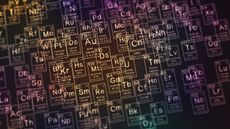 Scientists just got 1 step closer to creating a 'superheavy' element that is so big, it will add a new row to the periodic table
Scientists have discovered a new way of creating superheavy elements by firing supercharged ion beams at dense atoms. The team believes this method could potentially help synthesize the hypothetical "element 120," which would be heavier than any known element.
chemistry -
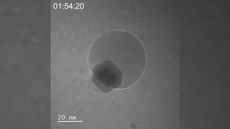 Watch atoms fuse into world's 'smallest bubble' of water in 1st-of-its-kind 'nanoscale' video
A new study captured never-before-seen footage of hydrogen and oxygen atoms combining to form a miniature water droplet out of "thin air." The newly improved reaction could one day help astronauts make water in space.
chemistry -
 Atoms squished closer together than ever before, revealing seemingly impossible quantum effects
Using a clever laser technique, scientists have squished pairs of atoms closer together than ever before, revealing some truly mind-boggling quantum effects.
quantum-physics -
 Dusty 'Cat's Paw Nebula' contains a type of molecule never seen in space — and it's one of the largest ever found
Scientists have detected a new, unusually large molecule never seen in space before. The 13-atom molecule, called 2-methoxyethanol, was detected in the Cat's Paw Nebula.
astronomy


