Get the world’s most fascinating discoveries delivered straight to your inbox.
You are now subscribed
Your newsletter sign-up was successful
Want to add more newsletters?
Join the club
Get full access to premium articles, exclusive features and a growing list of member rewards.
An account already exists for this email address, please log in.
'The sun is slowly waking up': NASA warns that there may be more extreme space weather for decades to come
A new NASA study suggests that solar activity will remain high or rise further in the coming decades, contradicting previous assumptions that the sun was quieting down — and scientists "don't completely understand" why.
NASA scientists are warning that the sun may be "waking up" from a brief period of relative inactivity, contradicting past assumptions about our home star. If true, this could mean that decades of potentially dangerous space weather are in store.
The sun follows a roughly 11-year cycle of solar activity that begins with a prolonged quiet period, known as solar minimum, and builds toward an explosive peak, known as solar maximum — when our home star frequently spits out powerful solar storms at us. This pattern is known as the "sunspot cycle," because the number of dark patches on the sun's surface rises and falls with solar activity. The sunspot cycle is, in turn, governed by a longer 22-year cycle, known as the Hale Cycle — during which the sun's magnetic field entirely flips and then reverses back again.
But in addition to the sunspot and Hale cycles, the sun also experiences long-term fluctuations in solar activity that can span multiple decades and are much harder to predict or explain. Examples include periods between 1645 to 1715, known as the Maunder Minimum, and between 1790 and 1830, known as the Dalton Minimum, when solar activity was generally much lower throughout successive sunspot cycles.
Back in the early 2000s, downward trending solar activity led some scientists to believe that we were possibly entering a new "deep solar minimum." This theory gained traction after the last solar maximum, between 2013 and 2014, which was much weaker than previous cycles. However, the current sunspot cycle, which has just peaked, has massively upended this theory.
In a new study, published Sept. 8 in The Astrophysical Journal Letters, researchers analyzed multiple metrics of solar activity, including solar wind, magnetic field strength and sunspot numbers, and found that they have been on an upward trend since around 2008, and could rise further over future cycles, suggesting that the deep solar minimum theory is well and truly dead.
The sun's roughly 11-year cycle is named after the sunspots that rise and fall with solar activity. This timelapse image shows all the sunspots that appeared in August 2024, when the number of sunspots peaked.
"All signs were pointing to the sun going into a prolonged phase of low activity," study lead author Jamie Jasinski, a plasma physicist at NASA's Jet Propulsion Laboratory in Southern California, said in a NASA statement. "So it was a surprise to see that trend reversed. The sun is slowly waking up."
Sign up for the Live Science daily newsletter now
Get the world’s most fascinating discoveries delivered straight to your inbox.
When the current sunspot cycle began in late 2019, experts from the Space Weather Prediction Center (SWPC) — which includes scientists from NASA and the National Oceanographic and Atmospheric Administration (NOAA) — predicted that solar maximum would most likely begin sometime in 2025 and be comparable to the previous weaker cycle.
The maximum number of visible sunspots during the previous solar maximum was the lowest for almost 100 years.
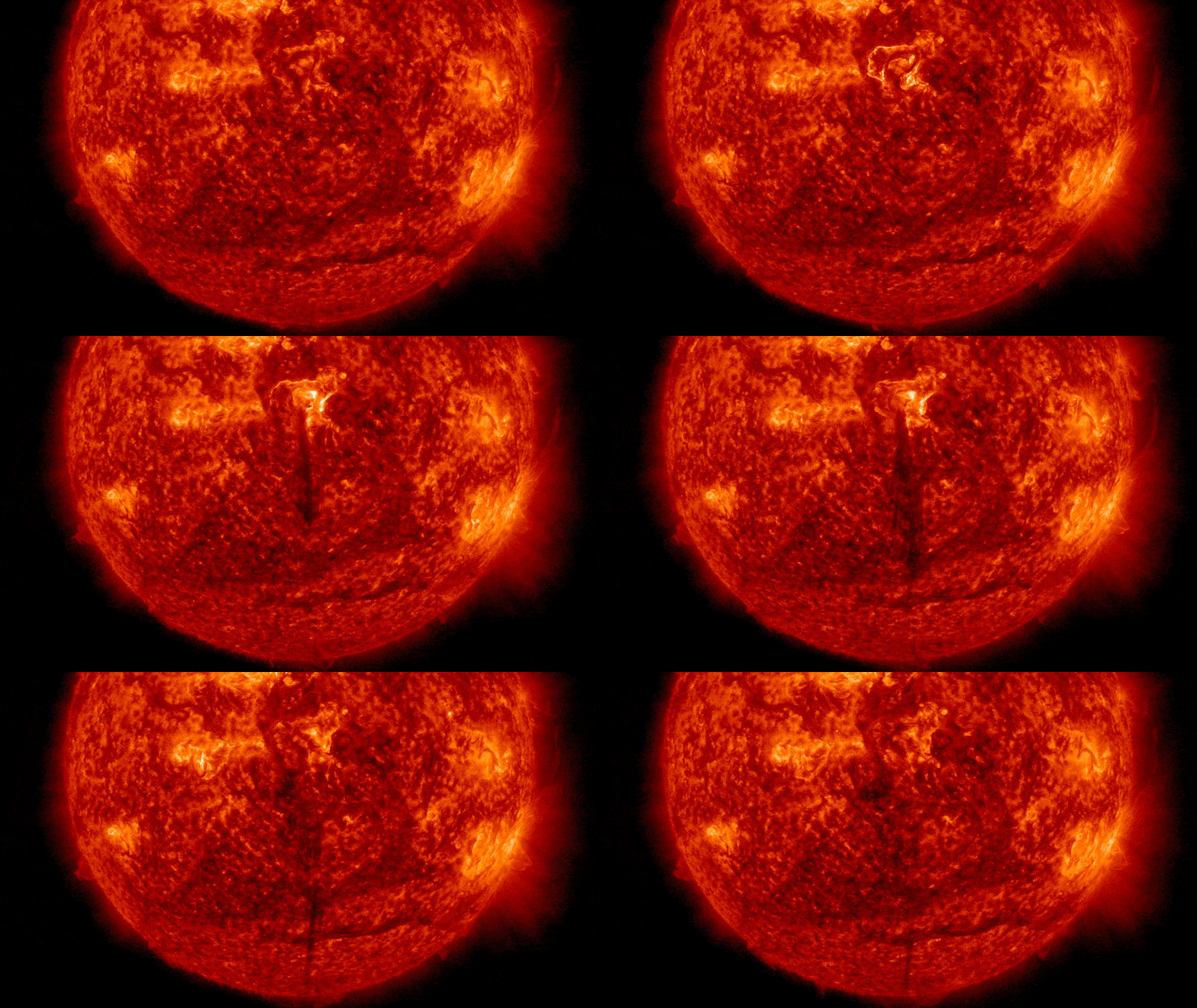
The sun has frequently spat out solar storms during solar maximum. This "dark" coronal mass ejection was launched on Sept. 7, 2025 and triggered a minor geomagnetic storm on Earth.
(Image credit: NASA/SDO)
Now, the new study warns that what we have witnessed over the past few years will likely become the "status quo" over the next few decades. This could be especially problematic because humanity has become much more reliant on technologies that are prone to interference from space weather, such as power grids, GPS-controlled machinery and Earth-orbiting satellites, which can be knocked out of the sky by solar storms.
It is currently unclear why the sun experienced a blip in solar activity over the last few decades or what may be driving its current resurgence: "The longer-term trends are a lot less predictable and are something we don't completely understand yet," Jasinski said.
Another study from earlier this year proposed that the recent surge in activity could be part of a lesser-known and understudied 100-year solar cycle, known as the Centennial Gleissberg Cycle. However, the newest study does not mention this at all.
Harry is a U.K.-based senior staff writer at Live Science. He studied marine biology at the University of Exeter before training to become a journalist. He covers a wide range of topics including space exploration, planetary science, space weather, climate change, animal behavior and paleontology. His recent work on the solar maximum won "best space submission" at the 2024 Aerospace Media Awards and was shortlisted in the "top scoop" category at the NCTJ Awards for Excellence in 2023. He also writes Live Science's weekly Earth from space series.
You must confirm your public display name before commenting
Please logout and then login again, you will then be prompted to enter your display name.