Elusive dark matter particles may lurk deep within the heart of the sun, and researchers have discovered that we can use a detector buried in the Antarctic ice sheet to find them.
Dark matter is the inescapable conclusion from decades of cosmological observations. Everything from the rotation speed of stars within galaxies to the growth of the largest structures in the universe points to the existence of some kind of particle, currently unknown to physics, that rarely interacts with light or with normal matter, despite exerting a powerful gravitational influence all across the universe.
As of yet, we do not know the identity of this dark matter particle. So with a relative lack of hard evidence, theorists have come up with dozens of proposals for what dark matter could be. In some of these hypotheses, dark matter does indeed interact with normal matter — but only extremely rarely, in the densest cosmic environments.
A great place for this kind of dark matter to collect naturally is the interior of the sun, researchers suggested in a paper that was posted to the preprint database arXiv on Aug. 23 but has not yet been peer-reviewed. The core of the sun is incredibly dense — over 20 times denser than iron. And ever since its birth about 4.5 billion years ago, the sun has been orbiting around the center of the Milky Way. In all those billions of years, our star has been swimming through the invisible sea of dark matter particles that are thought to make up the bulk of our galaxy.
Even if interactions between dark matter and normal matter are exceptionally rare, the density of the sun's core — combined with its extremely old age — means that it's had plenty of time for one of its particles to interact with dark matter. Those interactions would sap energy away from the dark matter particles, slowing them down until they settled deep within the sun's core.
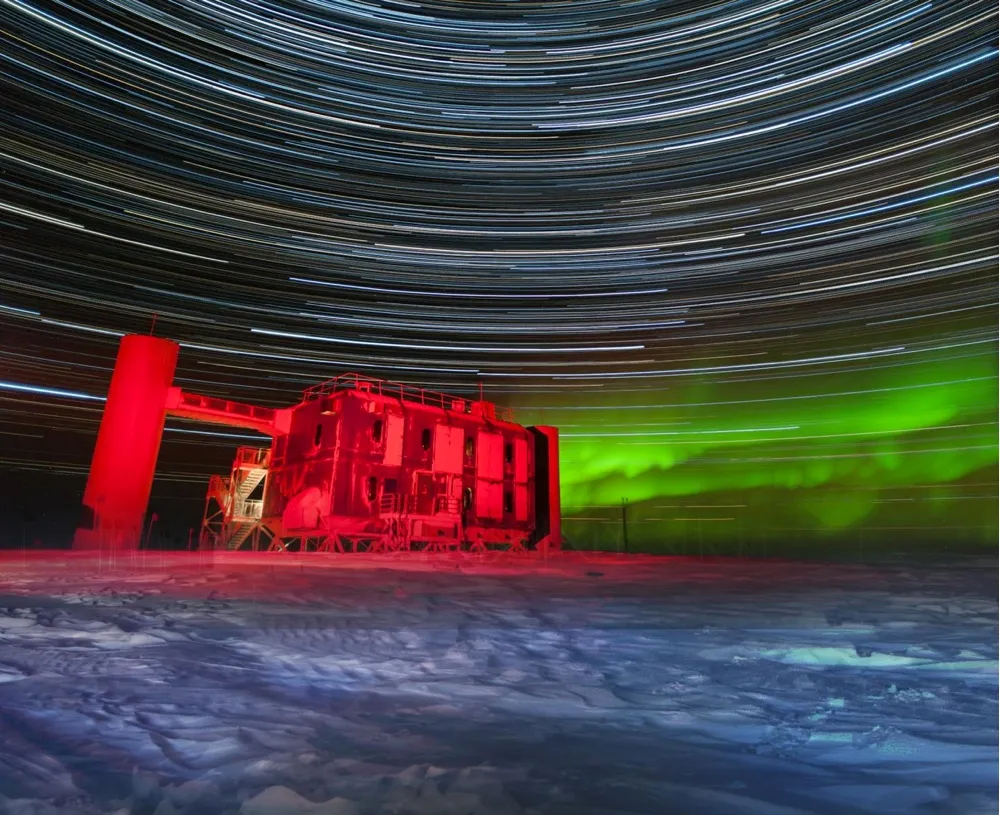
The IceCube Lab at the South Pole, lit up by star trails in this photo taken in July 2015.
(Image credit: IceCube Collaboration)
And those dark matter particles can just sit there, for a second or a billion years, until they interact with another normal matter particle in that dense environment. When that happens, the dark matter particle, if it's heavy enough, can decay into a shower of other, more familiar particle species. Most of those particles will remain trapped within the core, bouncing around in the never-ending frenzy of their fiery environment. But one kind of particle, the neutrino, is capable of escaping the sun.
Sign up for the Live Science daily newsletter now
Get the world’s most fascinating discoveries delivered straight to your inbox.
Neutrinos are like almost-dark matter. They're incredibly lightweight (by far the lightest known particles), don't have any electric charge and hardly ever interact with anything else. To detect neutrinos, scientists have to build giant laboratories. The largest of these detectors is IceCube, which uses an entire cubic kilometer (0.24 cubic mile) of the Antarctic ice sheet as a test chamber. When neutrinos strike water molecules, they create a shower of particles and light that strings sunk into the ice can detect.
The sun naturally produces neutrinos as a consequence of its fusion reactions. But in the new paper, the researchers reason that if dark matter was building up inside the sun's core, and those dark matter particles evaporated into a shower of normal particles, including neutrinos, then we should expect to see a higher number of high-energy neutrinos coming from the sun in the IceCube detection array.
However, current neutrino detection rates from the sun are consistent with normal fusion reactions, meaning that if dark matter does exist and is currently building up inside the sun, then those dark matter particles are extremely inefficient at annihilating into normal matter. This lack of a detection puts strong limits on the properties of dark matter particles.
Notably, these are the strongest constraints placed on theories of high-mass dark matter theories, and all the data was just sitting there, gathered for other purposes, the researchers pointed out. Instead of developing new, expensive experiments to search for dark matter, they said, we should devise clever ways to use existing experiments, because we never know what surprises may turn up.
Paul M. Sutter is a research professor in astrophysics at SUNY Stony Brook University and the Flatiron Institute in New York City. He regularly appears on TV and podcasts, including "Ask a Spaceman." He is the author of two books, "Your Place in the Universe" and "How to Die in Space," and is a regular contributor to Space.com, Live Science, and more. Paul received his PhD in Physics from the University of Illinois at Urbana-Champaign in 2011, and spent three years at the Paris Institute of Astrophysics, followed by a research fellowship in Trieste, Italy.