














We finally know where the moon's atmosphere comes from
"We give a definitive answer that meteorite impact vaporization is the dominant process that creates the lunar atmosphere."

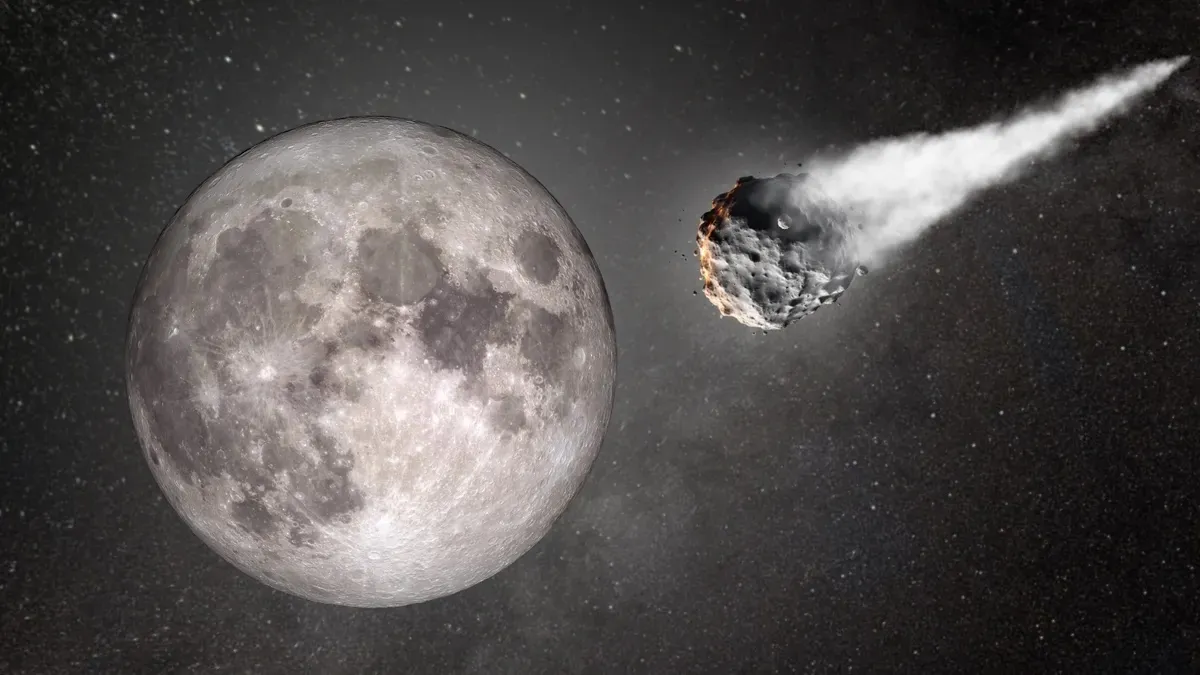
It is easy to imagine the moon as an atmosphere-less hunk of rock orbiting Earth. However, while lacking breathable air, our planet's loyal natural satellite companion does have a thin and wispy atmosphere.
Scientists have long puzzled over the existence of this tenuous atmosphere or "exosphere" and have searched for the main process that sustains it, but new research indicates that this tenuous lunar atmosphere or "exosphere" owes its existence to renewal and replenishment caused by the violent bombardment of space rocks upon the moon.
The team behind the research suggests that the moon's atmosphere is mainly sustained, and has been for billions of years, by this assault causing a phenomenon called "impact vaporization." This process occurs when impacts kick up lunar soil, vaporizing materials that either escape to space or remain suspended over the moon, thus renewing its exosphere.
"We give a definitive answer that meteorite impact vaporization is the dominant process that creates the lunar atmosphere," team leader Nicole Nie, an assistant professor at the Massachusetts Institute of Technology (MIT), said in a statement. "The moon is close to 4.5 billion years old, and through that time, the surface has been continuously bombarded by meteorites. We show that eventually, a thin atmosphere reaches a steady state because it's being continuously replenished by small impacts all over the moon."
Related: Earth has extra moons, and they may hold the secrets of our solar system's past
The moon's history of violence
The moon's pitted and scarred surface is a clear and obvious geological reminder that it has been peppered with space rocks throughout its near 4.5 billion-year history.
Early in the moon's lifetime, the infant solar system was violent and turbulent. As a result, the lunar surface was frequently struck by massive meteorites. As time progressed, collisions between solar system bodies ground many larger space rocks down. This meant that as the moon aged, the bombardment continued, but the assailants shrank to smaller "micrometeoroids," particles from space that are smaller than a grain of sand. Yet, these less dramatic impacts were still sufficient to allow impact vaporization to continue and to continuously replenish the moon's atmosphere.
Get the world’s most fascinating discoveries delivered straight to your inbox.

An impact crater on the moon.
Scientists first began to suspect that the space-rock assault on the moon was responsible in part for generating the exosphere when NASA's Lunar Atmosphere and Dust Environment Explorer (LADEE) investigated the moon's thin atmosphere, surface conditions, and the environmental influences on the lunar dust in 2013.
This led them to highlight two processes regenerating the exosphere. The first was impact vaporization, the other was "ion sputtering." This latter process occurs when high-energy charged particles from the sun, known as the "solar wind," strike the lunar surface and impart energy to atoms. This also causes those atoms to be flung into the exosphere.

An artist's conception of NASA's moon visting LADEE spacecraft misison as it communicates its findings back to Earth.
"Based on LADEE's data, it seemed both processes are playing a role," Nie explained. "For instance, it showed that during meteorite showers, you see more atoms in the atmosphere, meaning impacts have an effect.
"But it also showed that when the moon is shielded from the sun, such as during an eclipse, there are also changes in the atmosphere's atoms, meaning the sun also has an impact. So, the results were not clear or quantitative."
Nie and colleagues wanted to determine which process is primarily responsible for sustaining the moon's atmosphere. To do this, they turned to lunar soil collected during NASA's Apollo missions.
The answers are in the dirt
The team was able to touch ten samples of lunar soil, each measuring just 100 milligrams. This amount is so small that Nie estimated it would fit into a single raindrop.
The researchers set about isolating two elements in these samples: potassium and rubidium. Both elements are "volatiles," meaning they are easily vaporized by both meteorite strikes and by solar sputtering caused by solar wind bombardment.
The team wanted to see the ratios of different "isotopes" of potassium and rubidium. An isotope is a variation of an element that has different numbers of neutrons in its atomic nucleus. That means that isotopes with more neutrons (the number of protons can't vary when changing the element to another element) are heavier than those with fewer.
The team predicted that light isotopes of potassium and rubidium would be more likely to be suspended in the exosphere of the moon while heavier isotopes fall back to the lunar surface. However, impact vaporization and ion sputtering should have different effectiveness in pitching isotopes into the lunar atmosphere. That means looking at the amount of heavy isotopes of these two elements in lunar soil and comparing it to the amount of lighter isotopes in the samples should reveal which of these two processes is the more dominant.
"With impact vaporization, most of the atoms would stay in the lunar atmosphere, whereas with ion sputtering, a lot of atoms would be ejected into space," Nie said.
Nie and colleagues found the soils contained mostly heavy isotopes of both potassium and rubidium. This told them impact vaporization was the dominant process by which atoms are vaporized and uplifted to form the moon’s atmosphere. They found that 70% of the exosphere was generated by meteorite hits and impact vaporization, with 30% allotted to the solar winds and ion sputtering.
RELATED STORIES
"The discovery of such a subtle effect is remarkable, thanks to the innovative idea of combining potassium and rubidium isotope measurements along with careful, quantitative modeling," Justin Hu, lunar soils researcher at Cambridge University, who was not involved in the study, said. "This discovery goes beyond understanding the moon's history, as such processes could occur and might be more significant on other moons and asteroids, which are the focus of many planned return missions."
Nie, too, acknowledges that the team's findings simply wouldn't have been achievable were it not for the Apollo program, which drew to a close with Apollo 17 in Dec. 1972.
"Without these Apollo samples, we would not be able to get precise data and measure quantitatively to understand things in more detail," Nie concluded. "It’s important for us to bring samples back from the moon and other planetary bodies, so we can draw clearer pictures of the solar system’s formation and evolution." The team's research was published on Friday (August 2) in the journal Science Advances.
Originally posted on Space.com.

Robert Lea is a science journalist in the U.K. who specializes in science, space, physics, astronomy, astrophysics, cosmology, quantum mechanics and technology. Rob's articles have been published in Physics World, New Scientist, Astronomy Magazine, All About Space and ZME Science. He also writes about science communication for Elsevier and the European Journal of Physics. Rob holds a bachelor of science degree in physics and astronomy from the U.K.’s Open University