














Where do fast radio bursts come from? Astronomers tie mysterious eruptions to massive galaxies.
Fast radio bursts — powerful and poorly understood cosmic eruptions — tend to occur in massive galaxies that host long-dead stars known as magnetars, a new study suggests.

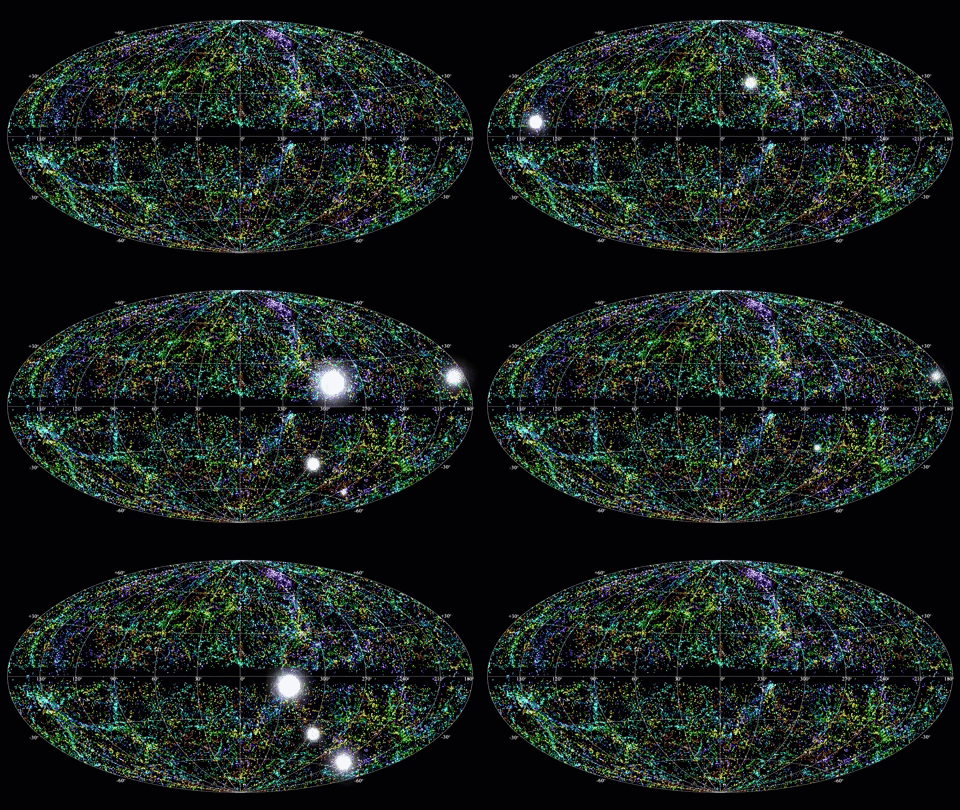
Every day, invisible to the human eye, thousands of enigmatic flashes of cosmic energy known as fast radio bursts (FRBs) erupt across the sky, releasing as much energy in milliseconds as the sun does in a day.
Thanks to their fleeting nature, scientists have often had to rely on luck just to observe FRBs, let alone pinpoint where they come from or what causes them to behave the way they do.
Now, astronomers led by Kritti Sharma at the California Institute of Technology posit that such energy-packed light flashes tend to occur in massive, star-forming galaxies from powerful eruptions of rare, long-dead stars known as magnetars. These findings, the researchers say, also point to magnetars themselves being cosmic fusions of two stars, pinning down one potential formation pathway for the mysterious objects.
"Very little is known about what causes the formation of magnetars upon the death of massive stars," Sharma said in a recent news release. "Our work helps to answer this question."
Related: Strange radio bursts that outshine entire galaxies may come from colliding neutron stars, new study suggests
By analyzing the home galaxies of 30 FRBs recorded by California's Deep Synoptic Array-110, Sharma and her colleagues found that the bursts originated in massive, star-forming galaxies rich in "metals" — astronomer-speak for any element heavier than hydrogen and helium. Such metal-rich environments may be conducive to the formation of magnetars, which are the leading candidates for producing FRBs, according to the researchers.
Magnetars, a type of neutron star, may be the explosive remnants of stellar mergers, rather than the result of massive stars collapsing and exploding as supernovae, since the phenomena originate in different types of environments, the team suggested in a paper published Nov. 6 in the journal Nature.
Get the world’s most fascinating discoveries delivered straight to your inbox.
Metal-rich stars that reside in pairs in such galaxies tend to become less compact as they evolve, accelerating the transfer of mass between them and effectively initiating the timeline for a stellar merger, the researchers say. The surviving star, usually the larger of the two, is rejuvenated by burning the fuel accreted from its companion, leading to amplified magnetic fields that are hundreds of trillions of times stronger than Earth's — a magnetar.
RELATED STORIES
This scenario could also explain the occasional detection of FRBs in regions with old stars, as binary star systems typically live longer compared to isolated magnetars, Nature News reported.
Other questions linger about the nature of FRBs, including why a handful seem to go off multiple times a day while others flash only once.
"We have no idea what's causing them," Ayush Pandhi of the University of Toronto in Canada told Astronomy.com. "It's one of the big mysteries in astronomy right now."
Originally posted on Space.com.

Sharmila Kuthunur is an independent space journalist based in Bengaluru, India. Her work has also appeared in Scientific American, Science, Astronomy and Space.com, among other publications. She holds a master's degree in journalism from Northeastern University in Boston. Follow her on BlueSky @skuthunur.bsky.social