Get the world’s most fascinating discoveries delivered straight to your inbox.
You are now subscribed
Your newsletter sign-up was successful
Want to add more newsletters?
Join the club
Get full access to premium articles, exclusive features and a growing list of member rewards.
An account already exists for this email address, please log in.
New robotic heart mimics common, mysterious condition to help researchers study it
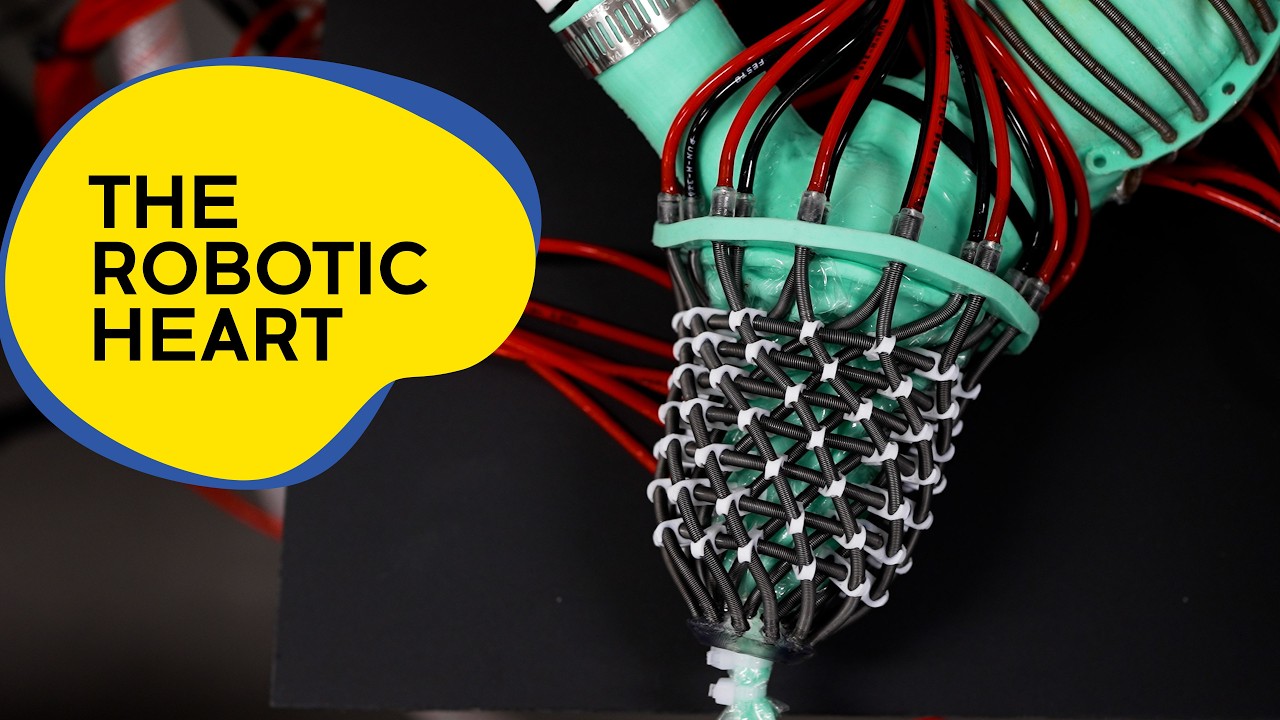
A new robotic heart can recreate different stages of heart failure, potentially giving researchers a new way to test treatments before they reach patients.
Scientists have invented a soft robotic heart that could give them a new way to study a mysterious condition that accounts for roughly half of all heart failure cases.
This form of heart failure, called heart failure with preserved ejection fraction (HFpEF), is a condition in which the heart pumps out a normal amount of blood but becomes too stiff to relax and refill properly between beats. Over 3 million Americans have the condition, but researchers still don't fully understand why it develops, making it difficult to design treatments that directly target the disease.
The new device, described June 1 in the journal Nature Communications, is the first soft robotic heart model that can actively adjust how it responds to changes in pressure. It tightens or relaxes its artificial muscles, enabling researchers to control how stiff the heart becomes. This allows it to better mimic a diseased human heart.
Current laboratory models of HFpEF have drawbacks. Traditional "mock circulation loops" use rigid pumps and tubing to recreate blood flow but don't physically resemble a beating heart. Lab animals capture more realistic biology but are expensive and don't perfectly mirror human disease, said study co-author Thanh Nho Do, a biomedical engineer and associate professor at the University of New South Wales in Australia.
"HFpEF has been notoriously difficult to study and treat," Nho Do told Live Science in an email.
Earlier versions of the robotic heart could realistically recreate cardiac movement, but they followed present commands that didn't adapt to changing conditions. The new system attempts to solve that limitation by allowing the artificial muscle fibers to "feel" the pressure created by the fluid they are pumping and dynamically contract or relax against it.
That feedback is critical for reproducing HFpEF, in which abnormal stiffness — rather than weakened pumping — lies at the core of the disease.
Sign up for the Live Science daily newsletter now
Get the world’s most fascinating discoveries delivered straight to your inbox.
The researchers built a silicone replica of the left side of the human heart and wrapped it in artificial muscle fibers made from rubber tubes reinforced with spring coils. The model continuously senses the pressure generated by the fluid flowing through it and adjusts the force of its artificial muscles in response. By changing how much the muscles resist being stretched as the heart fills, researchers can dial in different levels of stiffness.
Instead of modeling a single snapshot of HFpEF, the researchers recreated several stages of the disease's progression. In early stages, patients' hearts start to show impaired relaxation between beats, while in more advanced forms, the heat is so stiff that it can't adequately fill with blood before the next contraction.
The soft robotic heart that could be the perfect medical testing ground - YouTube
"If we can model its progression pathway, we might be able to use models like ours to develop medical devices that interrupt that trajectory, rather than just treating end-stage disease," Nho Do said.
The researchers hope their new model might pave the way, but they emphasized that the work is an early proof of concept. Looking ahead, they hope to develop increasingly sophisticated robot heart models that can complement other data on HFpEF, including that from computer simulations, animal studies and clinical testing.
"We hope the biggest impact will be in understanding HFpEF mechanisms and improving the way we develop cardiovascular devices," Nho Do said.
Article Sources
Davies, J., Sharma, B., Ji, A., Vasquez, G. M., Nguyen, C. C., Nicotra, E., Zhu, K., Phan, P. T., Wan, J., Rnjak-Kovacina, J., Stevens, M., Phan, H., Hayward, C., Lovell, N. H., & Nho, T., DO. (2026). Compliance modulation of a soft robotic atrioventricular model of heart failure with preserved ejection fraction. Nature Communications. https://doi.org/10.1038/s41467-026-73791-w
Olivia Maule is a science journalist whose beats include space, biotechnology and the environment. She holds a B.A. in biology and a B.S. in anthropology from the University of Florida and completed a master's degree in science communication at U.C. Santa Cruz. A 2025 AAAS Mass Media Fellow, she wrote stories and produced videos during a summer at El Nuevo Día, Puerto Rico's largest newspaper, and has written for Eos, Mongabay, Science magazine and Stanford Report. Olivia is a native Spanish and English speaker.
You must confirm your public display name before commenting
Please logout and then login again, you will then be prompted to enter your display name.