













'Missing link' found in ancient rocks of Colorado show that Snowball Earth really happened
Geologists found evidence in the way enigmatic sandstones called Tava formed in the Rocky Mountains hundreds of millions of years ago.


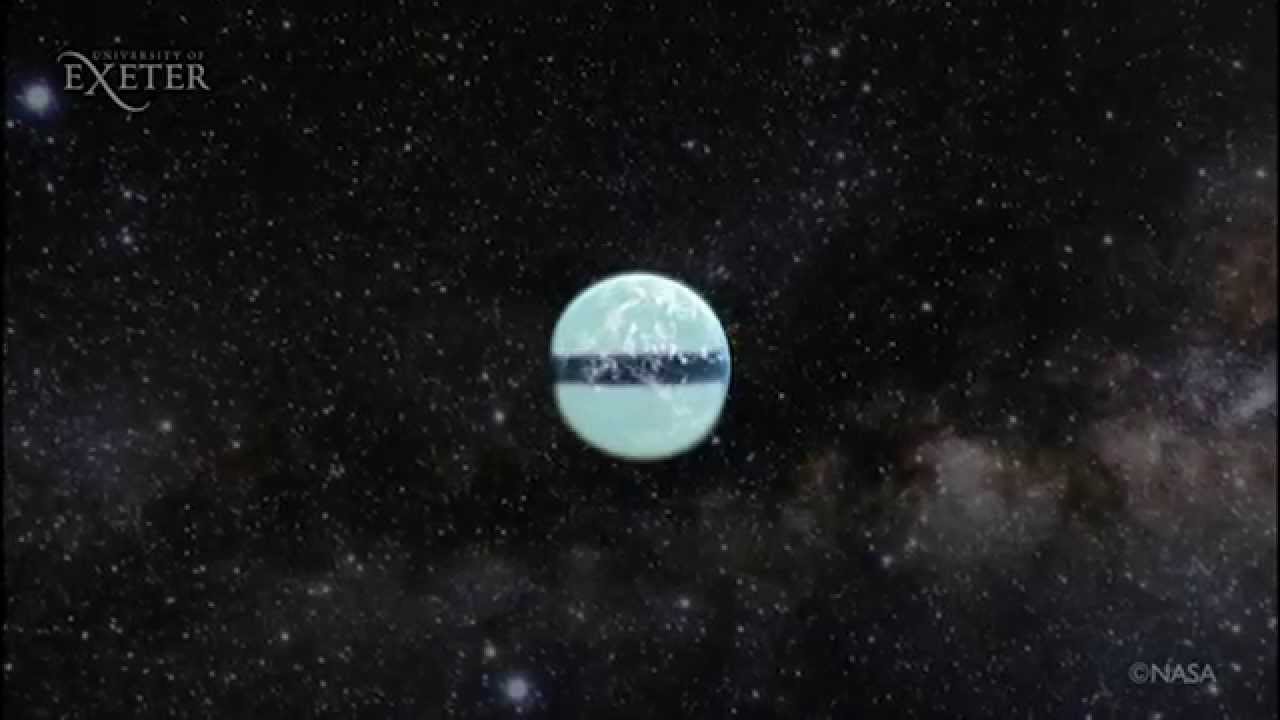
Around 700 million years ago, the Earth cooled so much that scientists believe massive ice sheets encased the entire planet like a giant snowball. This global deep freeze, known as Snowball Earth, endured for tens of millions of years.
Yet, miraculously, early life not only held on, but thrived. When the ice melted and the ground thawed, complex multicellular life emerged, eventually leading to life-forms we recognize today.
The Snowball Earth hypothesis has been largely based on evidence from sedimentary rocks exposed in areas that once were along coastlines and shallow seas, as well as climate modeling. Physical evidence that ice sheets covered the interior of continents in warm equatorial regions had eluded scientists — until now.
In new research published in the Proceedings of the National Academy of Sciences, our team of geologists describes the missing link, found in an unusual pebbly sandstone encapsulated within the granite that forms Colorado's Pikes Peak.

Earth iced over during the Cryogenian Period, but life on the planet survived.
Solving a Snowball Earth mystery on a mountain
Pikes Peak, originally named Tavá Kaa-vi by the Ute people, lends its ancestral name, Tava, to these notable rocks. They are composed of solidified sand injectites, which formed in a similar manner to a medical injection when sand-rich fluid was forced into underlying rock.
A possible explanation for what created these enigmatic sandstones is the immense pressure of an overlying Snowball Earth ice sheet forcing sediment mixed with meltwater into weakened rock below.
Get the world’s most fascinating discoveries delivered straight to your inbox.

Dark red to purple bands of Tava sandstone dissect pink and white granite. The Tava is also cross-cut by silvery-gray veins of iron oxide.
An obstacle for testing this idea, however, has been the lack of an age for the rocks to reveal when the right geological circumstances existed for sand injection.

A 5-meter-tall, almost vertical Tava dike is evident in this section of Pikes Peak granite.
We found a way to solve that mystery, using veins of iron found alongside the Tava injectites, near Pikes Peak and elsewhere in Colorado.
Iron minerals contain very low amounts of naturally occurring radioactive elements, including uranium, which slowly decays to the element lead at a known rate. Recent advancements in laser-based radiometric dating allowed us to measure the ratio of uranium to lead isotopes in the iron oxide mineral hematite to reveal how long ago the individual crystals formed.
The iron veins appear to have formed both before and after the sand was injected into the Colorado bedrock: We found veins of hematite and quartz that both cut through Tava dikes and were crosscut by Tava dikes. That allowed us to figure out an age bracket for the sand injectites, which must have formed between 690 million and 660 million years ago.
So, what happened?
The time frame means these sandstones formed during the Cryogenian Period, from 720 million to 635 million years ago. The name is derived from "cold birth" in ancient Greek and is synonymous with climate upheaval and disruption of life on our planet — including Snowball Earth.
While the triggers for the extreme cold at that time are debated, prevailing theories involve changes in tectonic plate activity, including the release of particles into the atmosphere that reflected sunlight away from Earth. Eventually, a buildup of carbon dioxide from volcanic outgassing may have warmed the planet again.
The Tava found on Pikes Peak would have formed close to the equator within the heart of an ancient continent named Laurentia, which gradually over time and long tectonic cycles moved into its current northerly position in North America today.
The origin of Tava rocks has been debated for over 125 years, but the new technology allowed us to conclusively link them to the Cryogenian Snowball Earth period for the first time.
The scenario we envision for how the sand injection happened looks something like this:
A giant ice sheet with areas of geothermal heating at its base produced meltwater, which mixed with quartz-rich sediment below. The weight of the ice sheet created immense pressures that forced this sandy fluid into bedrock that had already been weakened over millions of years. Similar to fracking for natural gas or oil today, the pressure cracked the rocks and pushed the sandy meltwater in, eventually creating the injectites we see today.
Clues to another geologic puzzle
Not only do the new findings further cement the global Snowball Earth hypothesis, but the presence of Tava injectites within weak, fractured rocks once overridden by ice sheets provides clues about other geologic phenomena.
Time gaps in the rock record created through erosion and referred to as unconformities can be seen today across the United States, most famously at the Grand Canyon, where in places, over a billion years of time is missing. Unconformities occur when a sustained period of erosion removes and prevents newer layers of rock from forming, leaving an unconformable contact.

Unconformity in the Grand Canyon is evident here where horizontal layers of 500-million-year-old rock sit on top of a mass of 1,800-million-year-old rocks. The unconformity, or 'time gap,' demonstrates that years of history are missing.
RELATED STORIES
Our results support that a Great Unconformity near Pikes Peak must have been formed prior to Cryogenian Snowball Earth. That's at odds with hypotheses that attribute the formation of the Great Unconformity to large-scale erosion by Snowball Earth ice sheets themselves.
We hope the secrets of these elusive Cryogenian rocks in Colorado will lead to the discovery of further terrestrial records of Snowball Earth. Such findings can help develop a clearer picture of our planet during climate extremes and the processes that led to the habitable planet we live on today.
This edited article is republished from The Conversation under a Creative Commons license. Read the original article.

Liam Courtney-Davies is a Postdoctoral Research Associate in Geological Sciences at the University of Colorado Boulder. He completed a MSci degree in Earth Sciences at Royal Holloway, University of London, in 2015 and Ph.D. in geochronology and economic geology at the University of Adelaide, South Australia in 2020. During a postdoctoral position at Curtin University, Western Australia, his team developed understanding of how giant iron ore deposits formed across the continent using state-of-the-art nanoscale and radioisotopic techniques. His current research focuses on geochronology method development and Snowball Earth research.