Get the world’s most fascinating discoveries delivered straight to your inbox.
You are now subscribed
Your newsletter sign-up was successful
Want to add more newsletters?
Join the club
Get full access to premium articles, exclusive features and a growing list of member rewards.
An account already exists for this email address, please log in.
Large Hadron Collider finds 1st evidence of the heaviest antimatter particle yet
Scientists at CERN's ALICE detector are replicating conditions found during the Big Bang, attempting to get to the bottom of how matter came to dominate over antimatter.
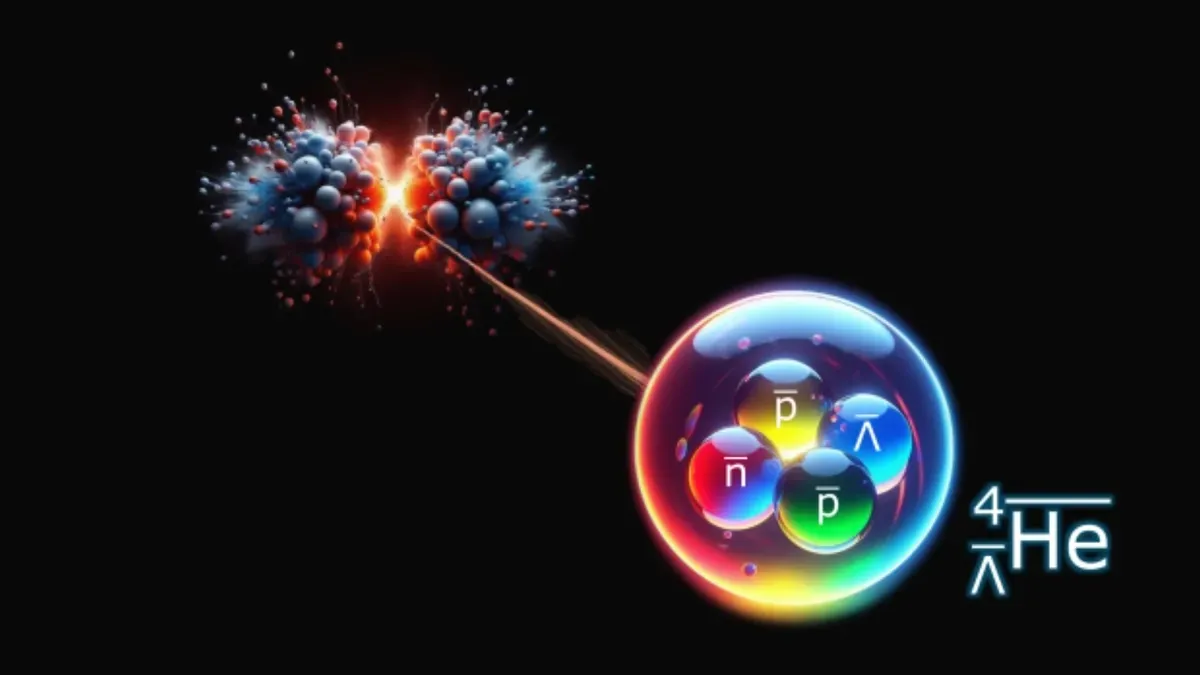
The world's most massive science experiment has done it again, detecting hints of the heaviest antimatter particle ever found.
This means the Large Hadron Collider (LHC), the most powerful particle accelerator ever built, has given scientists a glimpse into conditions that existed when the universe was less than a second old. The antimatter particle is the partner of a massive matter particle called hyperhelium-4, and its discovery could help scientists tackle the mystery of why regular matter came to dominate the universe, despite the fact that matter and antimatter were created in equal amounts at the dawn of time.
This imbalance is known as "matter-antimatter asymmetry." Matter particles and antimatter particles annihilate on contact, releasing their energy back into the cosmos. That implies that if an imbalance between the two hadn't arisen early in the universe, then the cosmos may have been a much emptier and less interesting place indeed.
The LHC is no stranger to paradigm-shifting discoveries about the early universe. Running in a 17-mile (27-kilometer) long loop beneath the Alps near Geneva, Switzerland, the LHC is most famous for its discovery of the Higgs Boson particle, the "messenger" of the Higgs Field responsible for giving other particles their mass at the dawn of time.
The collisions that occur at the LHC generate a state of matter called "quark-gluon plasma." This dense sea of plasma is the same as the "primordial soup" of matter that filled the universe around one-millionth of a second after the Big Bang.
Exotic "hypernuclei" and their antimatter counterparts emerge from this quark-gluon plasma, allowing scientists a glimpse at the conditions of the early universe.
Get the world’s most fascinating discoveries delivered straight to your inbox.
ALICE through the looking glass
Hypernuclei contain protons and neutrons like ordinary atomic nuclei and also unstable particles called "hyperons." Like protons and neutrons, hyperons are composed of fundamental particles called "quarks." Whereas protons and neutrons contain two types of quarks known as up and down quarks, hyperons contain one or more so-called "strange quarks."
Hypernuclei were first discovered in cosmic rays, showers of charged particles that rain down on Earth from deep space around seven decades ago. However, they are rarely found in nature and are difficult to create and study in the lab. This has made them somewhat mysterious.
An image of the ALICE detector taken during LHC upgrades in 2019
(Image credit: Robert Lea)
The discovery of the first evidence of the hypernuclei that is an antimatter counterpart of hyperhelium-4 was made at the LHC detector ALICE.
While most of the nine experiments at the LHC, each with its own detector, generate their results by slamming together protons at near the speed of light, the ALICE collaboration creates quark-gluon plasma by slamming together much heavier particles, usually lead nuclei, or "ions."
The collision of iron ions (try saying that ten times fast) is ideal for generating significant amounts of hypernuclei. Yet until recently, scientists conducting heavy-ion collisions had only succeeded in observing the lightest hypernucleus, hypertriton, and its antimatter partner, antihypertriton.
That was until earlier in 2024 when scientists used the Relativistic Heavy Ion Collider (RHIC) in New York to detect antihyperhydrogen-4, which is composed of an antiproton, two antineutrons, and a quark-containing particle called an "antilambda."
Now, ALICE has followed this with the detection of a heavier anti-hypernuclei particle, antihyperhelium-4, composed of two antiprotons, an antineutron, and an antilambda.
An illustration of antimatter particles entering the ALICE detector at the Large Hadron Collider.
(Image credit: ORIGINS Cluster/S. Kwauka)
The lead-lead collision and the ALICE data that yielded the detection of the heaviest antimatter hypernucleus yet at the LHC actually date back to 2018.
The signature of antihyperhelium-4 was revealed by its decay into other particles and the detection of these particles.
ALICE scientists teased the signature of antihyperhelium-4 out of the data using a machine-learning technique that can outperform the collaboration's usual search techniques.
In addition to spotting evidence of antihyperhelium-4 and antihyperhydrogen-4, the ALICE team was also able to determine their masses, which were in good agreement with current particle physics theories.
The scientists were also able to determine the amounts of these particles produced in lead-lead collisions.
They found these numbers consistent with the ALICE data, which indicates that antimatter and matter are produced in equal amounts from quark-gluon plasma produced at the energy levels the LHC is capable of reaching.
The reason for the universe's matter/antimatter imbalance remains unknown, but antihyperhelium-4 and antihyperhydrogen-4 could provide important clues in this mystery.
Robert Lea is a science journalist in the U.K. who specializes in science, space, physics, astronomy, astrophysics, cosmology, quantum mechanics and technology. Rob's articles have been published in Physics World, New Scientist, Astronomy Magazine, All About Space and ZME Science. He also writes about science communication for Elsevier and the European Journal of Physics. Rob holds a bachelor of science degree in physics and astronomy from the U.K.’s Open University