













1,500-year-old skeleton found in chains in Jerusalem was a female 'extreme ascetic'
Archaeologists were surprised that the skeleton of a person wrapped in heavy chains was female.

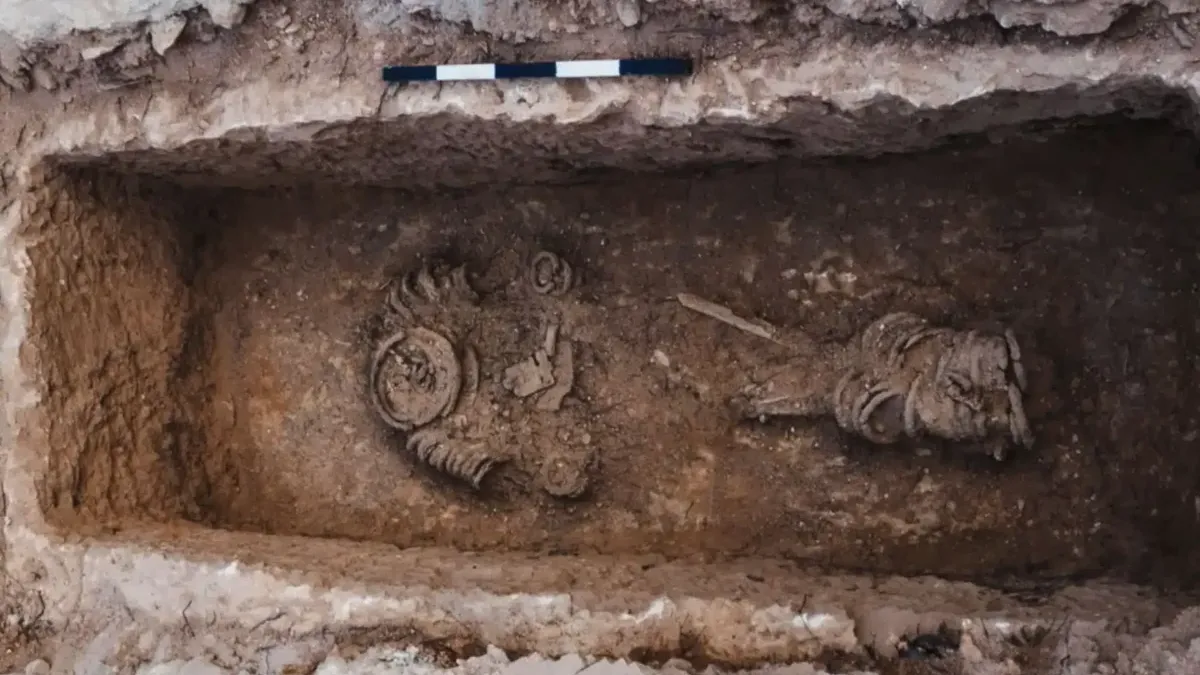
Not far from Jerusalem, archaeologists have discovered the fifth-century burial of a person wrapped in heavy metal chains. But the Byzantine-era grave held another surprise: The person who had practiced religious bodily punishment was female.
Excavations of a series of crypts at the Byzantine monastery at Khirbat el-Masani, about 1.9 miles (3 kilometers) northwest of the Old City of Jerusalem, revealed the skeletons of several men, women and children. One tomb contained the poorly preserved bones of an individual wrapped in chains. The corpse was not constrained for nefarious reasons, archaeologists suggested. Rather, the chains were used by the person during life to limit mobility as a part of a religious ascetic lifestyle. Initially, the Israel Antiquities Authority, which oversaw the dig, reported that this individual was male.
After Christianity became the main religion of the Roman Empire in A.D. 380, there was a surge of new monasteries and asceticism, in which monks abstained from worldly pleasures for spiritual purposes. A common practice of asceticism involved living at the top of a pillar while preaching and praying, often with heavy chains worn around the body.
In a study published in the April issue of the Journal of Archaeological Science: Reports, researchers studied the bones in the chain-filled burial with the goal of confirming the person was male. But they got a big surprise: the person was probably female.
"The use of chains by male ascetics is widely documented," study co-author Elisabetta Boaretto, an archaeologist at the Weizmann Institute of Science in Israel, told Live Science in an email, but "it's much rarer to find accounts of women using chains in the same way."
Related: 1,800-year-old silver amulet could rewrite history of Christianity in the early Roman Empire
The person appeared to be between 30 and 60 years old at the time of death, but the bones were poorly preserved. So the researchers analyzed peptides — short chains of amino acids — in the person's tooth enamel to figure out their sex.
Get the world’s most fascinating discoveries delivered straight to your inbox.
They found the presence of AMELX, an X-chromosome gene involved in enamel development, but no evidence of AMELY, the Y-chromosome gene that codes for the same thing. This meant the person very likely had two X chromosomes and was female.
"It is important to note that our results only show biological sex identification and not gender preference," the researchers wrote in the study.
Female ascetics are known from historical records, the study authors said, particularly among nobility starting in the fourth century. However, women in ascetic communities tended to pursue their spiritual paths in different ways that were generally less extreme than those practiced by men, Boaretto said. Prayer, fasting and meditation were more likely to be integral to women's spiritual journeys.
RELATED STORIES
As physical restraints, chains were a more extreme way to practice asceticism, Boaretto said, as they were meant to keep the body in check and the spirit focused. "By restricting their physical movements, they created space for their minds and hearts to turn solely to God," she said.
Although other chained burials of ascetics have been discovered in the past, the identification of a woman buried in this way is highly unusual.
"The chains were likely viewed as integral to her identity as an ascetic," Boaretto said, and her burial "may have served to honor her ascetic life and ensure that her spiritual commitment continued to be recognized even after death."
What do you know about Jesus Christ, the man? Test your knowledge of biblical archaeology

Kristina Killgrove is a staff writer at Live Science with a focus on archaeology and paleoanthropology news. Her articles have also appeared in venues such as Forbes, Smithsonian, and Mental Floss. Kristina holds a Ph.D. in biological anthropology and an M.A. in classical archaeology from the University of North Carolina, as well as a B.A. in Latin from the University of Virginia, and she was formerly a university professor and researcher. She has received awards from the Society for American Archaeology and the American Anthropological Association for her science writing.