













Sun's Super-Hot Shell Cooked by Plasma Jets

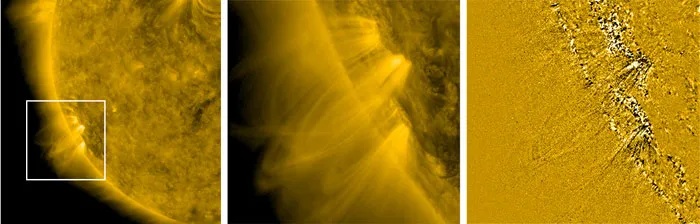
Physicists who train their thoughts on the sun have long been perplexed by why its outer atmosphere is millions of degrees hotter than the surface. While theories abound, no direct observations have been made of the mysterious processes that heat the sun's atmosphere … until now.
With the help of some state-of-the-art technology, a team of scientists thinks it has discovered an important piece of the puzzle. The results of the new study suggest that the scorching heat of the solar atmosphere is continuously replenished by jets of plasma that scream upward from the surface of the sun at supersonic speeds.
These plasma jets, called spicules, are "long, elongated fin features at the edge of the sun," Bart De Pontieu, the study's lead researcher, told SPACE.com. The motion of the heated spicules could explain how the sun's atmosphere, or corona, is a few million degrees hotter than the surface, which has a temperature of about 10,800 degrees Fahrenheit (6,000 degrees Celsius).
"The gas or plasma is originally pretty cool, but as the spicules are propelled upwards, some fraction of that gas gets heated to a few million degrees," said De Pontieu, a solar physicist at the Lockheed Martin Solar and Astrophysics Laboratory in Palo Alto, Calif.
Fountains of plasma
Scientists had previously examined spicules as a possible source of coronal heating, De Pontieu said, but many researchers dismissed the idea because they lacked observations of the jets' intense temperature.
In 2007, De Pontieu and his colleagues identified what they called Type II spicules, extremely fast but short-lived jets that burst upward faster than 60 miles (100 kilometers) per second.
Get the world’s most fascinating discoveries delivered straight to your inbox.
The researchers combined data from NASA's recently launched Solar Dynamics Observatory and the Japanese Hinode satellite to make direct observations of these fast-moving jets of hot plasma for the first time.
"By identifying that these jets insert heated plasma into the sun's outer atmosphere, we gain a greater knowledge of the corona and possibly improve our understanding of the sun's subtle influence on Earth's upper atmosphere," said Scott McIntosh, a solar physicist at the National Center for Atmospheric Research in Boulder, Colo., who was also involved in the study.
Taking a different approach
The findings represent a departure from existing theories of coronal heating, but the keen eye of the Solar Dynamics Observatory, which captures a daily bounty of high-definition images of the sun, afforded scientists the clearest views yet of the magnificent star.
"The high spatial and temporal resolution of the newer instruments was crucial in revealing this previously hidden coronal mass supply," McIntosh said.
Still, there is much more to be learned about spicules and the mechanisms behind coronal heating.
"We're not saying this is the only way that the corona is heated, but our results show something that cannot be explained by the current theories," De Pontieu said. "Based on our current estimates, these jets likely play a significant role in coronal heating, but we have to be careful with our conclusion. It's very possible other mechanisms are at play – these observations show there's a lot of interesting stuff going on."
The road ahead
To expand upon this study, De Pontieu and his colleagues are hoping to obtain data on the composition of the jets and the mechanisms that take place between the solar surface and the corona.
"One of our biggest challenges is to understand what drives and heats the material in the spicules," De Pontieu said.
In 2012 NASA is scheduled to launch the Interface Region Imaging Spectrograph (IRIS), which will focus on the density, temperature and magnetic field between the surface of the sun and the corona. Researchers are hoping that data from this mission will lead to a better understanding of spicules and coronal heating.
"We want to understand the big picture, but we need to understand all the little details of how things work in order to understand that big picture," De Pontieu said.
The results of the study are published in today’s (Jan. 6) issue of the journal Science.
- Images: Hyperactive Sun
- Video — NASA's Solar Dynamics Observatory
- Spectacular Northern Lights Show Signals Sun Is Waking Up
You can follow SPACE.com Staff Writer Denise Chow on Twitter @denisechow.
This article was provided by SPACE.com, a sister site of LiveScience.com.

Denise Chow was the assistant managing editor at Live Science before moving to NBC News as a science reporter, where she focuses on general science and climate change. Before joining the Live Science team in 2013, she spent two years as a staff writer for Space.com, writing about rocket launches and covering NASA's final three space shuttle missions. A Canadian transplant, Denise has a bachelor's degree from the University of Toronto, and a master's degree in journalism from New York University.