














Distant, Cold Space Rock Had 'Frankenstein' Beginnings
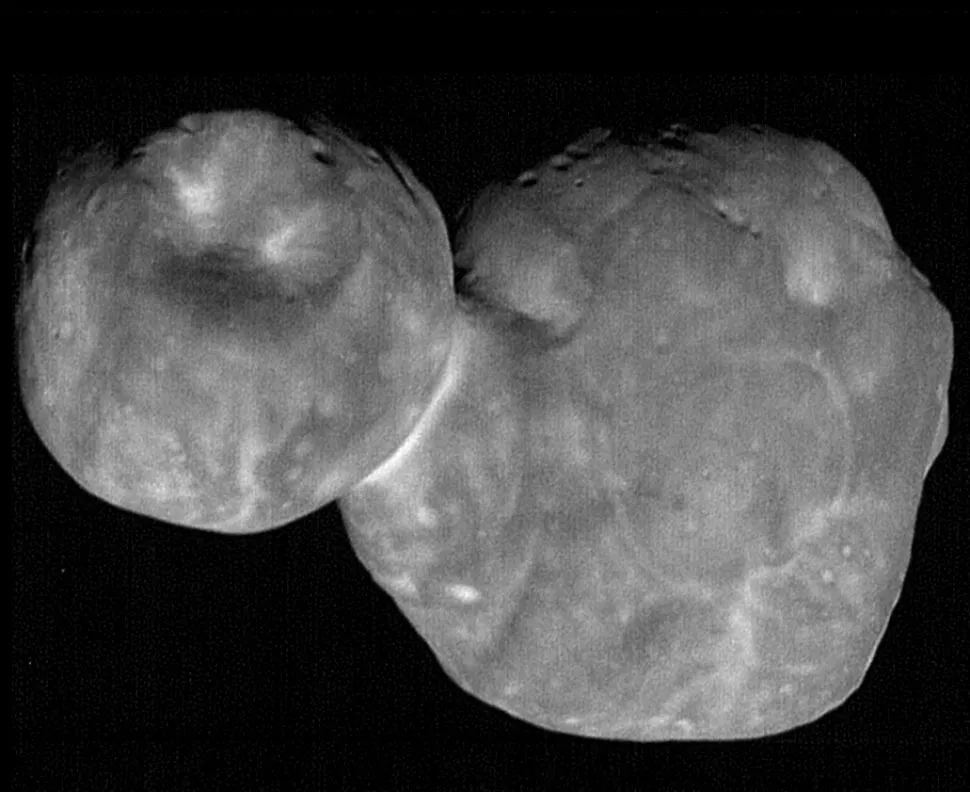
THE WOODLANDS, Texas — Less than three months after the New Horizons spacecraft zoomed past a distant, cold space rock, scientists are beginning to piece together the story of how that object, nicknamed Ultima Thule, came to be.
In a series of scientific presentations held March 18 at the 50th Lunar and Planetary Science Conference, mission scientists shared new data about the space rock's topography and composition, which is helping them to refine scenarios about how the object formed.
"Every single observation that we planned worked as planned," Alan Stern, principal investigator of the New Horizons mission and a planetary scientist at the Southwest Research Institute, said during the team's first presentation. "We had a 100 percent successful flyby."
Related: New Horizons' Ultima Thule Flyby in Pictures
The wealth of data the spacecraft was able to gather has offered mysteries and hypotheses alike about the distant Kuiper Belt object, which scientists hadn't even discovered when New Horizons launched. In particular, the team has been eager to piece together how the object, which is formally known as 2014 MU69, formed.
Soon after the flyby, the team confirmed that MU69 is in fact two objects stuck together in what scientists call a contact binary. Continuing analysis of high-resolution black-and-white New Horizons photographs suggests that the two halves of the object formed separately, and that the larger lobe, nicknamed Ultima, appears to be the result of many much smaller objects clumping together, like Dippin' Dots.
"In some sense, Ultima has a fairly simplified geology, a bit like Frankenstein here," Jeff Moore, a New Horizons scientist at NASA's Ames Research Center in California, said during a presentation. "Thule has a lot more stuff here going on." In particular, this smaller lobe sports the largest feature on the object, a depression the team has nicknamed Maryland. (New Horizons is operated by the Johns Hopkins University Applied Physics Laboratory in that state.)
Get the world’s most fascinating discoveries delivered straight to your inbox.

But when the team turns to color images, it's harder to see evidence of this aggregate structure. MU69's overwhelmingly red surface shows some variations in color that match surface features, but not the hypothesized small geologic subunits.
"You definitely see some correlation with the geological features, but one thing that you don't see is any logical correlations with these lumps which might be previous stages of accretion," Will Grundy, an astronomer at Lowell Observatory in Flagstaff, said during his presentation. "They don't look obviously different from each other."
The new findings also touch on how the two pieces of MU69 converged. As the team has gotten a closer look at the joint of the object, they haven't found any signs that a violent collision distorted the rock. Instead, the scientists believe that the two halves of the object formed separately, hung around together long enough to sync up their longest and shortest dimensions — like two neighboring pancakes — then very slowly touched, at a speed of about 9.8 feet (3 meters) per second.
"You can do this yourself, you can walk into a wall," William McKinnon, a New Horizons partner and a planetary scientist at the Washington University in St. Louis, said during his presentation. "It's a very gentle situation."
Although the spacecraft's stay at MU69 was incredibly brief, mission scientists will be receiving new data from New Horizons for more than a year. That's thanks to the amount of observations it was able to make and the slow data-relay rate possible for the probe at such a long distance from Earth. The combination means scientists will be grappling with puzzles about the object for quite a while to come.
"Ultima Thule is beyond remarkable," Stern said. "It has presented us with a wide variety of mysteries, and frankly, I think on a per-gram basis, it may even be outdoing Pluto itself.
- New Horizons' Historic Flyby of Ultima Thule: Full Coverage
- Meet Ultima Thule': 1st Color Photo Reveals a Red 'Snowman'
- Watch Ultima Thule Spin Like a Propeller in Awesome New Horizons Video
Email Meghan Bartels at [email protected] or follow her @meghanbartels. Follow us on Twitter @Spacedotcom and on Facebook.
Meghan is a senior writer at Space.com and has more than five years' experience as a science journalist based in New York City. She joined Space.com in July 2018, with previous writing published in outlets including Newsweek and Audubon. Meghan earned an MA in science journalism from New York University and a BA in classics from Georgetown University, and in her free time she enjoys reading and visiting museums. Follow her on Twitter at @meghanbartels.