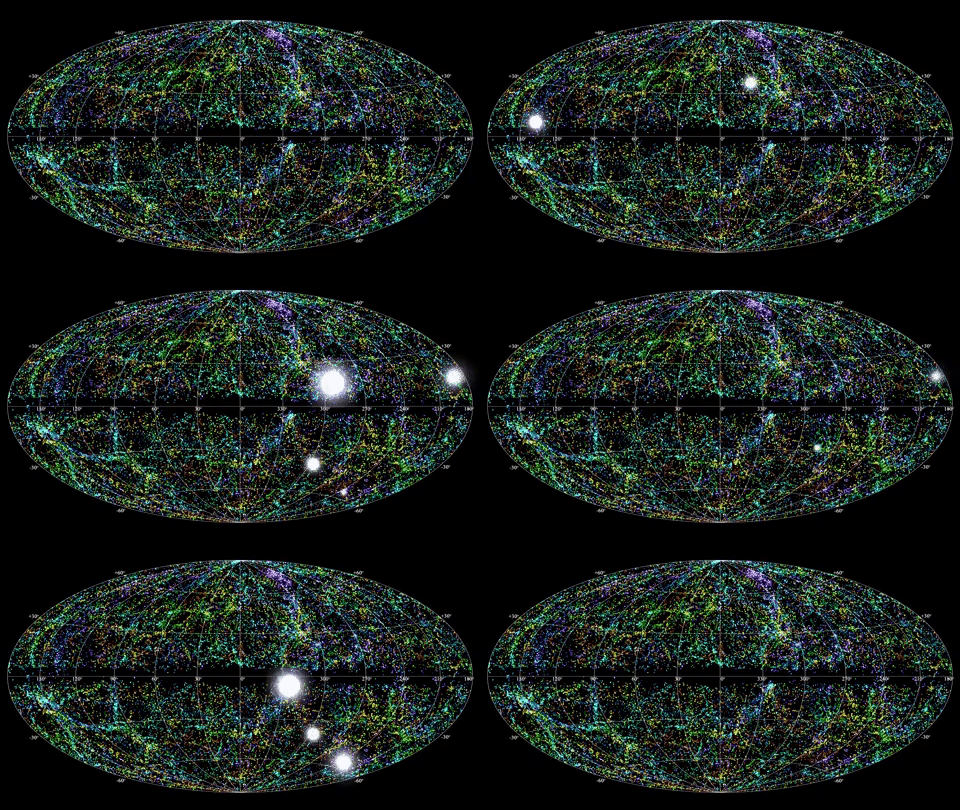
An animation shows the random appearance of fast radio bursts (FRBs) across the sky. Astronomers recently discovered 13 of the mysterious signals, including one that repeated from the same location over several months.
(Image credit: NRAO Outreach/T. Jarrett (IPAC/Caltech); B. Saxton, NRAO/AUI/NSF)
Don't look now, but Earth is being bombarded with mysterious, invisible light. Among the typical array of radio signals and microwaves cast out by distant stars, black holes and other celestial bodies, there exists a brand of intergalactic light that consistently boggles scientists' minds — and their instruments. These signals are known as fast radio bursts (FRBs). These ultrastrong, ultrabright radio signals last only a few milliseconds and are thought to originate from billions of light-years away, though their precise source is unknown. (Aliens have not been ruled out.)
The mystery is partially owed to a lack of data; since astronomers first discovered FRBs in 2007, only about 60 have been observed. Now, those numbers are growing fast. According to two new papers published today (Jan. 9) in the journal Nature, scientists working at the CHIME (Canadian Hydrogen Intensity Mapping Experiment) radio telescope in the hills of British Columbia have detected 13 new FRBs in just a two-month span. Among these newly captured signals are seven bursts that registered at 400 megahertz — the lowest FRB frequency detected so far — and, for only the second time ever, an FRB that flashed repeatedly, six times in a row. [Stephen Hawking's Most Far-Out Ideas About Black Holes]
"Until now, there was only one known repeating FRB," Ingrid Stairs, a member of the CHIME team and an astrophysicist at the University of British Columbia, said in a statement. "With more repeaters and more sources available for study, we may be able to understand these cosmic puzzles — where they're from and what causes them."
CHIME radio telescope (seen at night here) recently detected rare, low-frequency bursts of energy from deep in the universe. Astronomers are eagerly searching for an explanation.
(Image credit: Courtesy Canadian Hydrogen Intensity Mapping Experiment (CHIME))
Scientists have a few theories about those origins. Previous studies have suggested that FRBs may be the remnants of distant supernovas, or radiation spewed out by supermassive black holes. Avi Loeb, a scientist at the Harvard-Smithsonian Center for Astrophysics who was not involved in the discovery, has said that we shouldn't rule out "artificial origins," like the pulses of an alien spacecraft.
These newly discovered signals could help scientists get closer to an answer. For starters, the existence of repeating FRBs like the one captured last year could rule out some possible origins. These repeating signals flashed from the same spot in the sky (from an estimated 1.5 billion light-years away) six times over the course of several months. According to the study authors, this delayed repetition rules out "cataclysmic events" like supernovas as a likely source of the repeated blasts, as bursts from an exploding star would be expected to happen just once.
Moreover, the CHIME team's new discoveries suggest that FRBs are probably far more common than current technology is able to reflect. The fact that seven of the new bursts registered at 400 MHz (the lowest frequency the CHIME telescope is able to detect) suggest that FRBs with even lower frequencies are likely zipping past our planet all the time — we just aren't able to see them yet.
Brandon is the space / physics editor at Live Science. With more than 20 years of editorial experience, his writing has appeared in The Washington Post, Reader's Digest, CBS.com, the Richard Dawkins Foundation website and other outlets. He holds a bachelor's degree in creative writing from the University of Arizona, with minors in journalism and media arts. His interests include black holes, asteroids and comets, and the search for extraterrestrial life.