














Donated Spy Satellite Telescope Would Suit NASA Dark Energy Mission, Report Finds

INDIANAPOLIS — NASA could use a donated spy satellite telescope to carry out a high-priority mission that would hunt for alien planets and mysterious dark energy, a new report found.
Not only would one of two donated U.S. National Reconnaissance Office (NRO) telescopes suit the mission of NASA's proposed Wide-Field Infrared Survey Telescope (WFIRST) — it would boost the mission's capabilities without much exceeding its expected $1.63 billion budget, according to a study released on May 23.
The results of the study, known as WFIRST-AFTA (Astrophysics Focused Telescope Assets), were presented here today (June 4) at the 222nd meeting of the American Astronomical Society. [Declassified U.S. Spy Satellites Gallery]
"For approximately the same cost … the use of these telescope assets would enable a WFIRST mission that has significantly improved scientific capabilities," Paul Hertz, the director of the astrophysics division of NASA's science mission directorate, said during the conference.
"In addition, the use of these telescope assets would enable us to add an exoplanet-imaging instrument to a WFIRST mission that would be able to image and characterize planets around nearby stars," Hertz added.
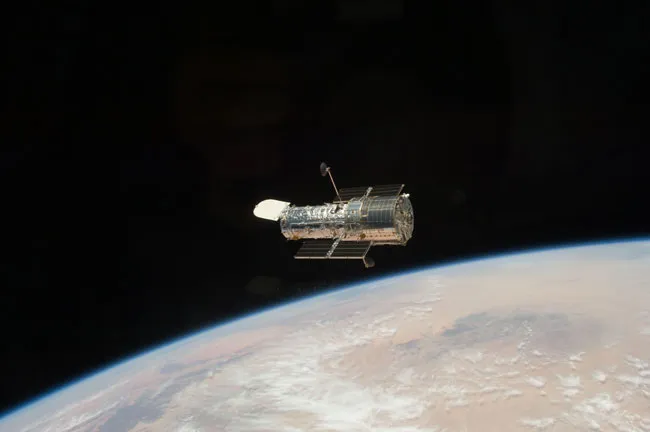
NASA announced last June that it had received the discarded NRO scopes, which are similar in size and appearance to NASA's iconic Hubble Space Telescope, sporting 8-foot-wide (2.4 meters) primary mirrors. However, the NRO telescopes are designed to have a wider field of view, making it possible to survey a bigger swath of the sky with them, NASA officials have said.
Last November, NASA asked scientists to propose uses for the donated telescopes, which are far from flight-ready spacecraft. (They're basically just primary and secondary mirrors with associated support structures.)
Get the world’s most fascinating discoveries delivered straight to your inbox.
The most promising ideas (apart from use in WFIRST) were presented in February at the SALSO (Study on Applications of Large Space Optics) workshop in Huntsville, Ala. These concepts were categorized into seven areas:
- Mars-orbiting space telescope
- Exoplanet observatory
- General-purpose faint object explorer
- Advanced, Hubble-like visible light/ultraviolet telescope
- Optical communications node in space (which would aid transmissions to and from deep-space assets)
- Geospace dynamic observatory (which would study space weather and the sun-Earth system)
- Research of Earth's upper atmosphere (from a spot aboard the International Space Station)
The WFIRST-AFTA study's findings on the possibility of using an NRO telescope for WFIRST were presented to NASA chief Charlie Bolden on May 30. The study was carried out by an independent group of scientists led by David Spergel of Princeton University and Neil Gehrels of NASA's Goddard Space Flight Center. Bolden has directed agency officials to continue to "pre-formulate" the plan, Hertz said.
No official decision governing the future of the two telescopes has been made, Hertz added.
"Our goal is to start a new mission in 2017 after JWST [the James Webb Space Telescope] starts rolling off, and if that were to come true, we would hope it would show up in the president's 2017 budget request which will be released in 2016," Hertz told SPACE.com. "But that is subject to decisions that haven't been made yet."
NASA is aiming to launch WFIRST around the 2023 timeframe, officials have said.
This story was provided by SPACE.com, a sister site to LiveScience. Follow Miriam Kramer @mirikramer and Google+. Follow us @Spacedotcom, Facebook and Google+. Original article on SPACE.com.
