














Earth As Art: Algae & A Dry Lakebed
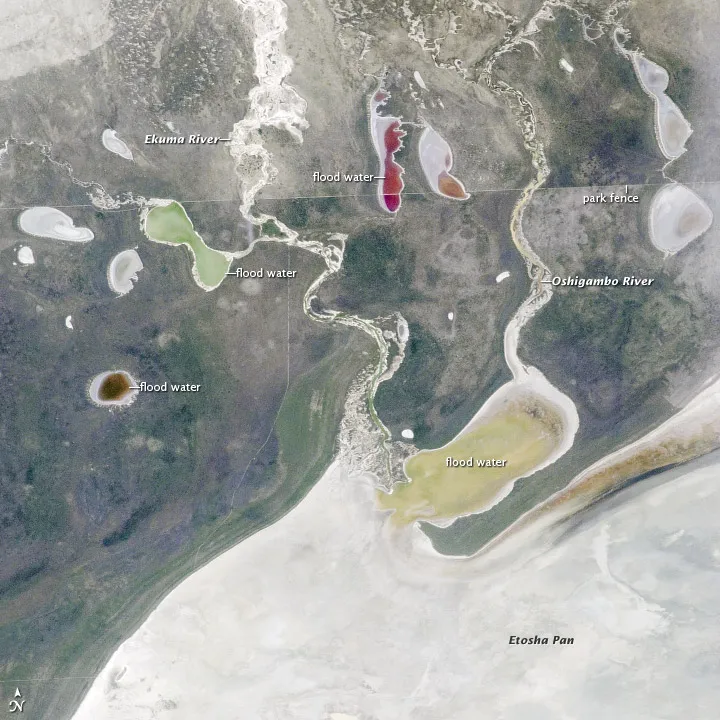
From far away, this tableau may look like something hanging on the walls of a modern art museum, but it's actually a photograph taken by an astronaut aboard the International Space Station of the area around Etosha Pan, a great dry, salt like in Africa.
The large Etosha lakebed — measuring about 75 miles (120 kilometers) long — is located in northern Namibia, and sits at the center of the country's largest wildlife park.
The lakebed is so dry and only covered in salt because little water typically reaches it from the rivers that feed into its basin, the Ekuma and Oshigambo.
This photograph, taken on Dec. 30, 2011, captured a rare event where water from recent rains had traveled down the Ekuma and filled a lobe of the lake with light green water (mid-right in the image). Water has also flowed into a small offshoot dry lake, where it appears a brighter green (upper left).
The other bright colors seen in the image, the red and brown pools of water, are smaller lakes that take their color from the interplay of water depth and resident organisms such as algae. The algae color varies depending on water temperature and salinity.
Usually, any water that flows down the rivers is absorbed by the riverbeds and never reaches the lake. The floor of the pan itself is only rarely covered by even a thin sheet of water. In this image, there was enough surface flow to reach the pan, but too little to flow beyond the inlet bay.
The straight line that crosses the image is the northern fence of Etosha National Park. The 10-foot-high (3 meters) fence was erected to keep wildlife from crossing into the numerous small farms of the relatively densely populated Owambo region of Namibia, north of the pan.
Get the world’s most fascinating discoveries delivered straight to your inbox.