














Possible New Species Found at Ocean Crossroads

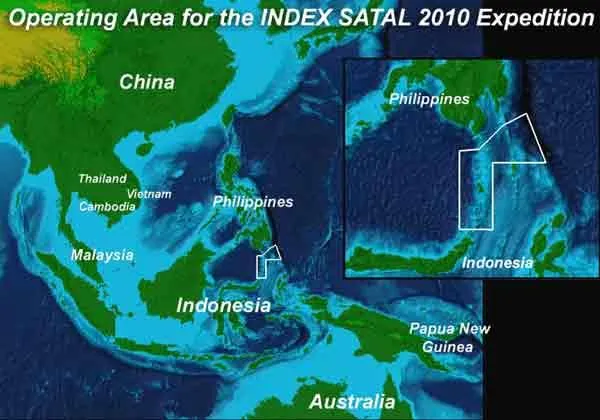
The white outline on the map shows the operating area where both Indonesian Research Vessel Baruna Jaya IV and NOAA Ship Okeanos Explorer conducted joint operations in 2010. The expedition focused on the diversity and distribution of deep sea habitats and marine life in unknown ocean areas in SATAL - a contraction of Sangihe and Talaud - two island chains stretching northeast of North Sulawesi in Indonesia.
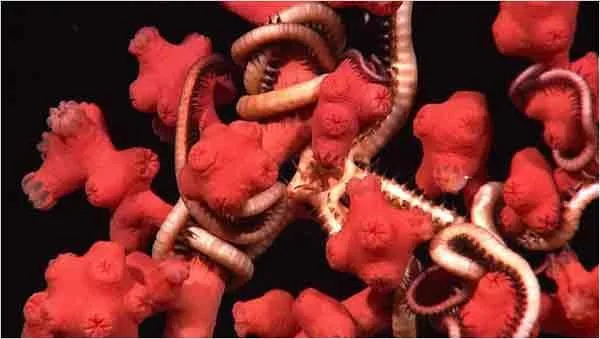
Bubblegum coral, or paragorgiidae, is among the potential new species encountered by the deep sea expedition.

One animal filmed by the ROV is this basket star. It appears to have a mass of twisting and turning appendages, which scientists believe keep dividing and fully extended could measure a meter long.

Large barrel sponges were observed by the Little Hercules ROV (remotely operated vehicle) during a dive at 2,297 feet (700 meters) depth on a new seamount mapped by R/V Baruna Jaya IV during the INDEX-SATAL 2010 Expedition.

Images such as this one of a coral community are streamed live from the ROV to the ship and shore-side ECCs. Scientists with various expertise can then identify seafloor life and habitats.

This benthopelagic sea cucumber is swimming in the near freezing waters of the abyss, approximately two miles (3200 meters) deep near the base of the submarine volcano.

This sea spider is more than eight inches (20 centimeters) acrossmuch smaller spiders have been seen before at seafloor vents.
Get the world’s most fascinating discoveries delivered straight to your inbox.

This close-up could almost pass for a flower in your garden, but appears to be a spongeprobably a carnivorous sponge of the cladorhizids that was photographed by the ROV Little Hercules over a half a mile below the surface.

A 10-armed sea star shown from IFE's Little Hercules ROV, operating 890 feet (271 meters deep) from NOAA Ship Okeanos Explorer during a joint ocean exploration expedition in Indonesia.

A galatheid crab dwelling inside a glass sponge living 2,733 feet (833 meters) deep on a newly mapped seamount during the INDEX SATAL 2010 Expedition.

Scleractinian hard coral imaged by the Little Hercules ROV at 4,534 feet (1,382 meters) depth. Based on published results, this coral may be 1,000 to 6,000 years old.

Close-up imagery showing a type of goose-neck barnacle, shrimp and a scaleworm living more than 1.15 miles (1,850 meters) deep on Kawio Barat underwater volcano.

Cruise participants at work in the control room while ROV operations are underway. The control room aboard NOAA Ship Okeanos Explorer is mission central, serving a variety of operations from mapping to ROV operations to facilitating interactions between the ship and shore.

This is a perspective of the Kawio Barat (West Kawio) seamount looking from the northwest. The underwater volcano rises about 2 miles (3,600 meters) from the seafloor.

Hydrothermal vents were found during the second ROV dive on Kawio Barat volcano. The yellow deposits are molten sulfur and multiple species of hot-vent shrimp are also visible.

Operating from NOAA Ship Okeanos Explorer, the remotely operated vehicle (ROV) Little Hercules descends through deep-water. Using telepresence technology, video collected by a high definition camera on Little Hercules, on loan from The Institute For Exploration, and its camera platform are sent to the ship, to satellites in space, and to Exploration Command Centers on shore in real-time.

INDEX SATAL 2010 mission participants dockside during closing ceremonies for the joint Indonesia U.S. expedition in Indonesian waters. NOAA Ship Okeanos Explorer and R/V Baruna Jaya IV are in the background.
