
 Live Science Plus


How Quantum Entanglement Works (Infographic)

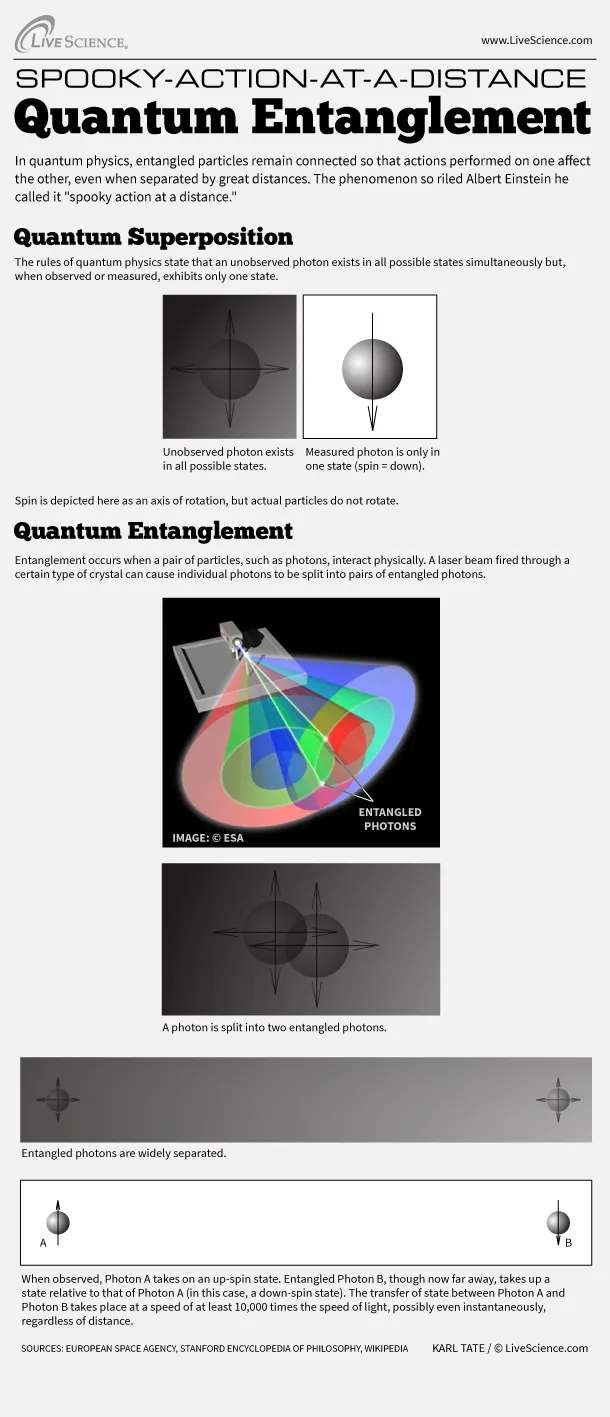
In quantum physics, entangled particles remain connected so that actions performed on one affect the other, even when separated by great distances. The phenomenon so riled Albert Einstein he called it "spooky action at a distance." The rules of quantum physics state that an unobserved photon exists in all possible states simultaneously but, when observed or measured, exhibits only one state. Spin is depicted here as an axis of rotation, but actual particles do not rotate. Entanglement occurs when a pair of particles, such as photons, interact physically. A laser beam fired through a certain type of crystal can cause individual photons to be split into pairs of entangled photons. The photons can be separated by a large distance, hundreds of miles or even more. When observed, Photon A takes on an up-spin state. Entangled Photon B, though now far away, takes up a state relative to that of Photon A (in this case, a down-spin state). The transfer of state between Photon A and Photon B takes place at a speed of at least 10,000 times the speed of light, possibly even instantaneously, regardless of distance. A proposed experiment would send one photon of the entangled pair to the orbiting International Space Station, a distance of around 310 miles (500 kilometers). This would be the largest distance that has been experimentally tested.
Get the world’s most fascinating discoveries delivered straight to your inbox.
