














NASA's Alien Planet Archive Now Open to the World

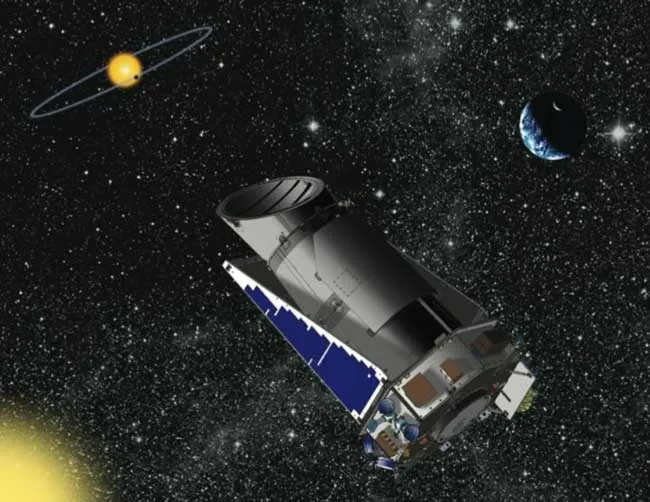
Scientists with NASA's planet-hunting Kepler spacecraft have revamped the mission's online archive of alien worlds, opening up the database for the entire world to see.
Researchers are now posting all exoplanet sightings by the Kepler observatory into a single, comprehensive website called the "NASA Exoplanet Archive." Instead of going through the long planet confirmation process before making data publicly available, since December of last year, scientists have started shoveling out all the data Kepler collects into a comprehensive list.
"When we make that list, right away it goes to the archive," Kepler mission team member Steve Howell told SPACE.com during the 221st American Astronomical Society meeting in Long Beach, Calif., this month. "So the day we know about the list, the archive knows about the list. And then everybody, including us, can work on that list. But that list is dynamic so if we, or a community person, makes an observation and says, 'Hey, I looked at this planet candidate but it's really an eclipsing binary,' then that entry in the archive will be changed."
The archive has information about the size, orbital period and other metrics of any possible planet discovered and investigated by Kepler.[Gallery: A World of Kepler Planets]
"It's all in real time," Howell said. "The sausage-making process is exposed."
Before the new archive was debuted, astronomers were already doing creative work with the data. One created a visually stunning video of every known Kepler planet candidate — 2,299 unconfirmed exoplanets at the time — orbiting one central point.
The Kepler team’s new "open" attitude toward data release is giving everybody, not just members of the scientific community, a chance to do some hands-on scientific research by building their own experiments, Howell said.
Get the world’s most fascinating discoveries delivered straight to your inbox.
A group of high school students has already taken data from groups of planets observed by Kepler and mapped them against a map of known stars looking for a pattern. Howell doesn’t think they'll see much, but he's glad that they have the opportunity to get creative.
"The entire world can help us with this Kepler data," Howell said. "I don't see any downside."
Planet Hunters, a collective of amateur astronomers, recently found 42 new alien planets using Kepler data that was publicly available prior to the launch of the new archive system.
It would be difficult for Kepler scientists to get their jobs done without the help of amateur astronomers around the globe, mission researchers said. By making the exoplanet archive more accessible, it could mean that more planets are found and confirmed in shorter amounts of time than ever before.
More people sifting through the wealth of data collected by Kepler means that scientists have a better chance of finding even more planets circling distant stars, Howell added.
Since its launch in 2009, NASA's Kepler spacecraft has flagged more than 2,300 objects as possible alien worlds. Although only about 100 have been confirmed, scientists expect that at least 80 percent could be certifiable exoplanets.
Currently, Kepler has entered a "safe mode" after researchers spotted an issue with one of the spacecraft's three reaction wheels that are responsible for orienting the telescope. The malfunction has stalled science observations, but researchers hope that the issue will be resolved by Sunday (Jan. 27).
To explore the new NASA Exoplanet Archive, visit: http://exoplanetarchive.ipac.caltech.edu/
This story was provided by SPACE.com, a sister site to Live Science. You can follow SPACE.com staff writer Miriam Kramer on Twitter @mirikramer. Follow SPACE.com on Twitter @Spacedotcom. We're also on Facebook & Google+.
