















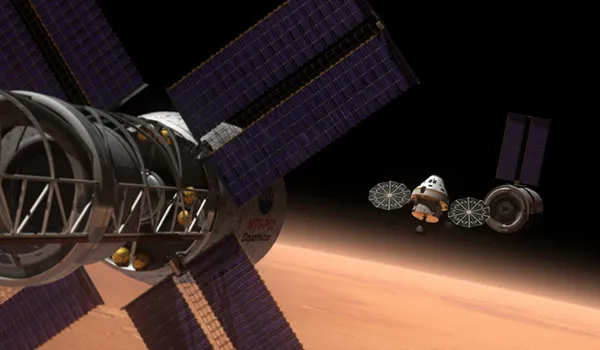
High radiation levels beyond Earth orbit pose the biggest challenge to human exploration of deep-space destinations, experts say.
With current spacecraft technology, astronauts can cruise through deep space for a maximum of one year or so before accumulating a dangerously high radiation dose, researchers say. As a result, many intriguing solar system targets remain off-limits to human exploration at the moment.
"There is an equivalent of a Mach 1 — a sound barrier — that exists, in terms of galactic cosmic radiation," Alvin Drew, manager of NASA's Deep Space Habitat Project, said Wednesday (Dec. 19) during a presentation with the agency's Future In-Space Operations working group.
"Until we solve that, we are still in the age of wooden ships and canvas sail for going out in space," added Drew, an astronaut who has flown on two space shuttle missions. "Until we get to a point where we are looking at steam engines and ships of iron, we may be very limited in how far we can go." [Future Visions of Human Spaceflight]
One-year limit
Earth is pummeled relentlessly by galactic cosmic rays — fast-moving charged particles blasted into space by distant star explosions and other dramatic events.
The planet's atmosphere and magnetic field deflect most of these subatomic wrecking balls, so those of us on Earth's surface don't worry too much about them.
Get the world’s most fascinating discoveries delivered straight to your inbox.
But for astronauts cruising through space — especially deep space, beyond Earth's protective magnetosphere — it's a different story. They can endure this radiation for only a limited time before serious problems such as cancer begin cropping up.
"Until we get new technologies or new ways to mitigate against cancer-induced deaths," Drew said, "we're going to be limited to about one year in space."
The sun also routinely ejects particles that can damage human tissue, and researchers are currently working on ways to shield astronauts from such solar outbursts. But whatever measures they devise may not be terribly effective against cosmic rays, which have much higher energies, Drew said.
"Galactic cosmic radiation is like a low-rate gunfire that comes through — you don't get hit very often, but when you do, it does a lot of damage," Drew said. "And that's why we need to go out and figure out how to protect ourselves against these very high-energy, somewhat massive subatomic particles coming in from our galactic core."
Mars mission still possible
A one-year spaceflight cap would still allow manned missions to some intriguing destinations, such as Mars.
In fact, data gathered by NASA's Curiosity rover — which landed on the Red Planet this past August — suggest that astronauts could endure a six-month outbound flight, a 600-day stay on the Martian surface and the six-month journey home without accumulating a worryingly high radiation dose.
That's good news for NASA, which is working toward sending astronauts to a near-Earth asteroid by 2025, then on to the vicinity of the Red Planet by the mid-2030s. Part of this preparation involves studying the psychological and physiological effects of long-term spaceflight, which the agency will investigate on one-year missions to the International Space Station beginnning in 2015. (The standard stay for astronauts aboard the orbiting lab has been six months.)
But if humanity wants to venture much farther afield — say, to Jupiter's ocean-harboring moon Europa — advances in spacecraft shielding and/or propulsion systems will almost certainly be necessary.
This story was provided by SPACE.com, a sister site to LiveScience. Follow SPACE.com senior writer Mike Wall on Twitter @michaeldwall or SPACE.com @Spacedotcom. We're also on Facebook and Google+.
