NASA Probe to Uncover Secrets of Brightest Asteroid Vesta

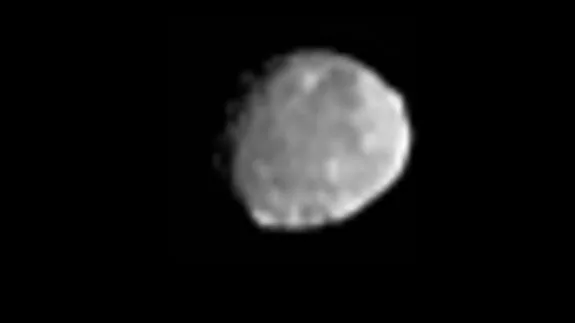
The asteroid Vesta may be the brightest asteroid in the solar system, but it remains shrouded in mystery.
When NASA's Dawn probe enters into orbit around Vesta on July 15 — the first spacecraft to visit the 330-mile-wide (530-kilometer) protoplanet — it promises to shed light on the many enigmas of the second-largest body in the asteroid belt.
NASA launched the $466 million Dawn mission in 2007, with Vesta as the first (but not last) stop. The Dawn probe is also expected to visit Ceres, the largest asteroid in the solar system, but only after unlocking the secrets of Vesta. Here's a look at the main questions astronomers hope the probe will help solve:
Why is Vesta so bright?
Vesta is the brightest asteroid, with a surface about three times as bright as Earth's moon, "and why it is so bright is the No. 1 mystery of Vesta," planetary scientist Christopher Russell, principal investigator for NASA's Dawn spacecraft, told SPACE.com. [Photos: Asteroid Vesta and NASA's Dawn Spacecraft]
When one looks at the most reflective celestial bodies in our solar system, Venus is the most reflective planet because of its clouds, and the sixth-largest Saturn moon Enceladus is the most reflective body overall because of its snow, "but Vesta doesn't have an atmosphere or snow," Russell noted. "Hopefully when Dawn inspects Vesta's surface, we'll get an answer."
Does Vesta have a magnetic field?
Get the world’s most fascinating discoveries delivered straight to your inbox.
One potential explanation for Vesta's brightness is that it possesses a strong magnetic field. This could help shield it from electrically charged particles driven by the solar wind that would normally darken the asteroid over time, Russell said.
Unfortunately, Dawn does not have a magnetometer to probe Vesta for magnetic fields. Still, Russell does not think Vesta has a strong magnetic field, and suspects there is another reason why the asteroid is so reflective and bright.
"Personally, I think the answer is that Vesta has a lot of white crystals or other material on its surface," he said. [Infographic: How NASA's Dawn Asteroid Mission Works]
Where are other asteroids resembling Vesta?
There seem to be very few asteroids that resemble Vesta, but there should be far more.
The outermost layers of Vesta are made up mostly of basaltic rock — the same type found in much of the Earth's crust. There are asteroids called "vestoids" that, judging by their orbits, researchers suspect were once part of Vesta before they got blasted off by a cosmic impact. A few other basaltic asteroids have been discovered relatively recently as well, such as one named Magnya in the outer part of the main asteroid belt.
Still, theories of asteroid formation have suggested that more than half of all asteroids should be made largely of either basalt or another common mineral on Earth, olivine, and approximately 99 percent of these predicted asteroids are missing.
"There may have been other asteroids like Vesta that met a bad fate," Russell said. "It could be that Vesta was born when Jupiter hadn't formed yet, when forming bodies like Vesta was relatively easy."
Many of these Vesta-like asteroids might later have disappeared when Saturn and Jupiter shifted their orbits, with the gravitational pulls of these giant planets pulverizing Vesta's siblings against each other or slinging them at Earth and the rest of the inner solar system. Vesta may have simply been lucky to be very nearly the sole survivor.
What is the dark spot near Vesta's equator?
A series of photos recently captured by Dawn revealed a strange dark spot on Vestaabout 60 miles (97 km) wide near the asteroid's equator, moving from left to right across the field of view as the asteroid rotated.
Researchers suspect this blotch might be a crater.
"We'd like craters on Vesta for a variety of reasons," Russell said. "The number, size and distribution of craters on Vesta would give us some idea of how old the surface is, as impacts need time to accumulate. Craters also serve as digging tools, revealing what's beneath Vesta's surface."
"We'll know very soon now," he added.
This story was provided by SPACE.com, sister site to LiveScience. Follow SPACE.com contributor Charles Q. Choi on Twitter @cqchoi. Visit SPACE.com for the latest in space science and exploration news on Twitter @Spacedotcom and on Facebook.